When you click on links to various merchants on this site and make a purchase, this can result in this site earning a commission. Affiliate programs and affiliations include, but are not limited to, the eBay Partner Network.
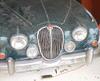
First post for me. just got this home, its not been on the road for 30 yrs but does seem pretty solid. Lots to do but want to get it mechanically sound mot'd and back on the road before i worry about what it looks like.
It doesn't look bad at all, although the paintwork is obviously shot. This will have the 2.5 litre V8 as it's a Daimler. YOur workshiop looks a good size and well equipped so you're obviously up-to-speed on working on cars. I hope it all goes well for you.
Haha, thanks for that, workshop not as big as it looks as I share with two other fellers one with a mk2 Ford consul,the other has two Harley davidsons in there. I have a mate who does all the mechanics I just do what he tells me.
Hi, someone stuck S type FogRangers lamps, instead of MK-2 FogRangers. The S type lamps are larger diameter, the MK-2 lamps are smaller and they fit deep inside the bucket. 1 inch difference in diameter.
Drop a 4.2 liter XK engine in it. You will be happier. I drove one with the V8 and it was as lame as a turtle.
You are kidding right Jose. Drop a 4.2 Xk in it! Are you mad?
That Daimler V8 is one of the smoothest engines I have ever heard. So quiet you would hardly know it was turning over if it was not for a small noise at the end of the exhaust and the fact the fan was spinning.
Yes it not as powerful as the larger 4.2 as it is only a 2.5 liter but it produced 140 BHP where as the American spec 4.2 was only producing 168 BHP. If you add in to this equation that the Daimler engine was lighter having Alloy heads it is a no brainer that the Daimler V8 was actually a better engine. Sir William Lyons actually contemplated using the Daimler V8 in the Mk2 Jaguars but decided to keep the two distinct brands separate leaving the Daimler Mk2 body to have the V8 and the Jaguar Mk2 body to keep the XK engine.
No disrespect to you Jose personally but it is typical of an American to think that more Litres makes a car go faster where as we Brits think that designing a smaller engine which is more efficient to produce the same BHP is the way to go.
Last edited by Cass3958; Feb 22, 2021 at 12:29 PM.
It's not so much displacement and horsepower, but an engines torque curve that's important.
I would like to know if Steve's car is an auto or standard ?
I read somewhere here on the forum that Sir William Lyon's didn't put the standard in the Daimler because he wanted the automatic to "neuter" the Daimlers V8.
Can't have the Daimler engine up-starting the XK engine after-all.
I would imagine that the Daimler's V8 didn't work well with an automatic because it shifted too soon, not allowing to get into the engines torque curve to allow any "get up and go"
"Lame as a turtle" Jose, with an automatic, yes.
Yes, Lyons did not like the fact that the little Turner V8 outperformed the XK 2.4 in the real world. Most were Automatic with all extras as standard & perforated leather upholstery on seat centres. They sold to a typically Daimler wealthy & older clientele. They were eminently tunable.
They are great smooth cars to drive. Lovely smooth gem of an engine. Had a particular character all of their own.
Last edited by Glyn M Ruck; Feb 22, 2021 at 08:41 AM.
First post for me. just got this home, its not been on the road for 30 yrs but does seem pretty solid. Lots to do but want to get it mechanically sound mot'd and back on the road before i worry about what it looks like.
Welcome to the forums Steve,
That's a rare find in the UK nowadays. Most either died long ago or have been restored and cost a fortune.
It's not so much displacement and horsepower, but an engines torque curve that's important.
I would like to know if Steve's car is an auto or standard ?
I read somewhere here on the forum that Sir William Lyon's didn't put the standard in the Daimler because he wanted the automatic to "neuter" the Daimlers V8.
Can't have the Daimler engine up-starting the XK engine after-all.
I would imagine that the Daimler's V8 didn't work well with an automatic because it shifted too soon, not allowing to get into the engines torque curve to allow any "get up and go"
"Lame as a turtle" Jose, with an automatic, yes.
my car is automatic, but im thinking manual overdrive if I can get the parts to do it.
That's a rare find in the UK nowadays. Most either died long ago or have been restored and cost a fortune.
Graham
I think I got it just in time, while the body does not look great it is mostly metal, There is some small bits of filler here and there but underneath the car is really good.
Another reason for the early Daimler engined cars using automatic gears may have been fragility of the crankshaft thrust bearing. Edward Turner was mainly a designer of motorcycle engines and he may have underestimated the loads from the clutch. Of course, Heynes, Hassan and Bailey didn't exactly over design the XK thrust bearing, but it was a bit more robust.
Last edited by Peter3442; Feb 23, 2021 at 09:22 AM.
Reason: Grammatical error
I love my V8 Daimler with its auto box.It is no boy racer, but is quite adequate. It is the car I take to car shows. For every day I use my X330 and its four litres! The 4.2 litre Series 2 tends to get left in the garage, but is also a fine vehicle. We could be out of lockdown by the start of summer!! Hooray! Alec G.
Another reason for the early Daimler engined cars using automatic gears may have been fragility of the crankshaft thrust bearing. Edward Turner was mainly a designer of motorcycle engines and he may have underestimated the loads from the clutch. Of course, Heynes, Hassan and Bailey didn't exactly over design the XK thrust bearing, but it was a bit more robust.
Daimler was always pro automated gearboxes of one form or another ~ part of their DNA. They were all automatic until '67/'68 & best with the aluminium BW 35. The Turner design was also Cadillac & Chrysler influenced & his 4.5 litre V8 was already in the Majestic Major. Turner was driving a Caddy at the time as head honcho of BSA's Automotive Division. Combustion chamber design came from a Triumph Speed Twin. The manual & manual OD versions were only available from late 1967 (Jaguar box) & enthusiastic driving led to some overheating which was cured (never happened in the SP 250 sports car). Stronger pistons were installed from 1968 along with an uprated camshaft & other minor improvements. It was a robust unit out of the gates but high revving for the time & no doubt those revs were used in manual versions. Red lined from 6000 to 6500RPM.
Initially ~ SP250 version to Mk2 bodied saloon:
"The Browns Lane engineers made a few more alterations. They replaced the cylinder-head studs of the Daimler design with set bolts so that the heads could be removed with the engine still in the car. They relocated the water pump centrally on the front face of the cylinder block, with split outlets to each bank of cylinders, and inserted an extra pulley between crankshaft nose and fan to drive the auxiliaries. They reduced the size of the main bearings to make room for balancing weights on the crankshaft. New exhaust manifolds were also drawn up, although their design suggests that maximum power was not a consideration; perhaps there were fears that a more efficient design would give the V8-engined car too much of a performance advantage over the 2.4-litre Jaguar." ~ Credit James Taylor.
Anybody wishing to tune a Daimler 250 V8 should first replace those manifolds. It already has twin exhausts.
Last edited by Glyn M Ruck; Feb 23, 2021 at 06:25 PM.
Reason: improved.
Many wax lyrical about the turner V8s.. and in their time, they were decent enough for the standards that existed.. 140 bhp was a fairly good power output for 2.5 litres when road traffic generally ran at 45-65 mph.... but today one can do much better..
Everyone has an opinion...here's mine:- Firstly they are short lived and are extremely costly to re-build, (budget minmally 6k to do it right... considerably more if here are 'issues' to correct) and have many shortcomings..expect excess main bearing wear by 65,000 miles.. they were far better suited to, and much longer lasting, in the far lighter and taller geared SP250 sports car.. in the Mk2 Jaguar saloon body they had many teething issues and never really 'cut it' .. sticking valves the caused catasptopic engine failure in early models (they got too hot largely due to very low gearing..4.55 diff in first series cars) cured by increasing valve guid clearnace.. which in turn lead to heavy oil consumption...1000 miles per quart is considered 'good'.. early corrosion of cylinder heads giving gasket problems.. excess wear in camshaft and liters ( due to anachronistic design.. very high friction from cam followers/ tappets/ lifters, totally outdated and stupid design...essentially same as used in Turners 1938 'triumph speed twin' motorcycle engine.) very narrow main beings lead to fast wear and low oil pressure..
YES..the V8 is turbine smooth...as are most V8s that dont have a flat plane crankshaft... the 3.5 Rover/buick V8 is equally smooth.. puts out more power, has about double the service life, are out there in huge numbers, and is apprx 1/2 the cost to rebuild.. plus it used the same gearbox in most cases of Uk built cars to early 70s.. the BW type 35..so is easy to adapt and with a jaguar diff (3.54 for 3.4 and 3.8 auto cars) is a very practical upgrade.. I'm Statside so have more in the way of practical choices.. my primary V8 2/12 litre was re-powerd by a Ford 5,0 and matching 'AOD' automatic box with overdrive, coupled to a 3.54 diff.. also has Air con and a few other comforts.. all these mods done in early 1980's when the original V8
expired..
If you are a purist with deep pockets and like to drive a car running at 3,800 - 4,500 rpms at motorway speeds, terrible fuel consumption, allied to perpetual problems with reliability .. by all means self flagellate with the turner V8.. if you want something more practical.. consider pitching that heavy pile of obsolescence out and trying something more practical, affordable and better suited for the purpose the Jaguar Mk2 car was designed for... think 160-180 BHP , 180-220+ of torque and a 3.54 or taller diff, iso you can cruise at 2,800 rpms (or less with a overdrive auto box such as the common in UK ZF4HP 22) in order to really enjoy driving the car..
Maybe.. but the car was laid up for a reason... odds are it has engine problems..most of them that fell by the wayside do...and there is no 'quick' or reasonably costing fix for the 'normal' issues with these engines..
I, rather stupidly in retrospect, have rebuilt many of them.... still have several rebuilt 'short blocks' and a pair of rebuilt heads in stock.. there is no substitute for larger, more suitable for the job dispalcement..
Like Aston Martin. With decent modern lubricants these engines will easily do over 100K miles or more without issues. They were not troublesome units generally. We have a number of them running in SA trouble free at pretty high miles. If one rebuilds the only real issue is if you skim one head the other must be shaved by an equal amount. It is easy to tune them for more power. Decent coolant is required as with any engine with aluminium heads.
Last edited by Glyn M Ruck; Feb 25, 2021 at 04:57 PM.



 First post