When you click on links to various merchants on this site and make a purchase, this can result in this site earning a commission. Affiliate programs and affiliations include, but are not limited to, the eBay Partner Network.
I'm going to guess the reason is the amperage of your trickle charger is less than the amp draw of whatever is staying energized while the car is off. Reason I say that is I had the same issue with a 69 Corvette. Went to go start it one day and blew the caps off the battery. I was using a little Battery Tender Jr. which as I recall was only like 0.8 amps. But the ignition switch on the Corvette was worn and if I didn't get the key in just the right spot before removing it, then the ignition switch stayed "on" and even tho all of the accessories and lights and stuff were off, there was a solenoid that stayed energized and drew more than the little budget battery tender could keep up with. Thus trying with all it's junior might but failing, it boiled at least one cell in the battery, making a little hydrogen bomb that exploded the next time I tried to start the car. The battery of that old Corvette is in a compartment directly behind the driver's seat and scared the $#!+ out of me. Could have been much worse
After that, I did some research and learned that those cheap little low amperage units are only supposed to be used on batteries that are stored on a shelf or disconnected from the vehicle with a cutoff switch while in storage. If you want the keep the clock or other electronics working while in storage, you must buy a maintainer with adequate amperage to cover the clock, plus reserve to cover the dome light, radio and anything else that might accidentally stay on. For antique/classic cars, that's generally about 2 amps and for modern computerized cars about 4 amps.
So you probably have something that's staying energized while the car is off. You could try to diagnose and repair that. You could also install a cutoff switch and disconnect the battery while not in use, or both. I would also suggest a higher amperage maintainer anyway, but I wouldn't connect it without also doing one or the other because it would shorten battery life considerably be constantly charging. But in shopping for a new unit, you want to get a "smart" charger, one that will shut itself off when the battery reaches full charge and also will monitor and shut itself off if it detects other battery problems. That's why the forum consensus is to recommend CTEK brand units (next I'm going to read that you already have a 4 amp CTEK and I've totally guessed wrong ).
I agree with Phil, and will add that once a car or motorcycle battery discharges to a certain point, then trickle chargers are useless. Cteck is also my go to charger after ruining several batteries trying 1 amp trickle chargers on my sled and bike.
If there is just ONE cell with a low voltage, as you describe, it could be a bad cell - I've had that on a battery. If it was a heavy discharge, I'd expect all cells to be similarly low. If it wasn't a duff battery to start wioth, it could be you have damaged the battery with a faulty voltage regulator - it could be you were charging too high and damaged the battery. If you can start the car now, use a multimeter to see what your charging rate is, and what voltage it takes the battery to.
Can you check what circuit may be drawing on the battery? Make sure you have a fully charged battery, if possible in this case. The process is to disconnect the negative/black/ground cable, and then, one by one, remove the fuses from the different circuits. After each fuse removal, put a test lamp or multimeter between the neg/ground battery post and the end of the neg/ground cable. If you find the "parasitic" circuit, you can then check the components that are on that circuit. And yes, a Ctek is the way to go.
There have been many problems with trickle chargers, including unit melt downs, fires and unattended batteries blowing up.. Once you sort out your current battery issue you might change your battery maintenance approach.
You might go with a battery disconnect switch. (The copper knife switch is preferred over the inexpensive green knob variety for reasons I won't go into.) Then about every 2 months use a smart battery charger. Start on 30 amps to "wake up" the battery if it happens to be very low, although it most likely won't be. Otherwise set it to 10 amps and charge for about 90 minutes or until it reads "full" or is down to charging at less than 2 amps. I've been doing this for many years. The process was recommended by the manufacturer of restoration batteries.



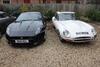
 Battery issue on ‘70 E-Type


 Could have been much worse
 ).
).