


The Definitive Hydraulic Pump Resistor Thread - Take 2


Veteran Member


Joined: May 2010
Posts: 4,114
Likes: 1,272
From: North Carolina

Dennis and I have discussed other ways of controlling the pump electronically. One thought was to use the signal that controls latch solenoid to trigger a relay. The resistor would be switched out of the circuit until the relay was triggered, that way the resistor would only affect the latch closure event.
I'm sure WhiteXKR could design a circuit that uses pulse width modulation to control the pressure output of the pump, However, both the relay and an electonic controller add to the complexity and cost. The advantage of the resistor is that it is so cheap and easy to install. If it becomes expensive and difficult to install, then there's no reason to use the resistor.
The resistor alone reduces the pressure by about 300 PSI. Admittedly, it doesn't reduce it by as much as the relief valve, but still, 300 PSI is 300 PSI. That's like ten times as much pressure as what is in your car tires. I'm satisfied with a 300 PSI reduction.
I'm sure WhiteXKR could design a circuit that uses pulse width modulation to control the pressure output of the pump, However, both the relay and an electonic controller add to the complexity and cost. The advantage of the resistor is that it is so cheap and easy to install. If it becomes expensive and difficult to install, then there's no reason to use the resistor.
The resistor alone reduces the pressure by about 300 PSI. Admittedly, it doesn't reduce it by as much as the relief valve, but still, 300 PSI is 300 PSI. That's like ten times as much pressure as what is in your car tires. I'm satisfied with a 300 PSI reduction.

Veteran Member
Joined: Aug 2007
Posts: 3,430
Likes: 571
From: Los Angeles
Occam's razor starts to play a role here. The beauty of the relief valve is the simplicity and consistent way it works (albeit at a price). The more you start to kludge around with some complex electro-servo modulation frannis fleeber device, it just looks you are just begging for problems.
Just sayin'
Doug
Just sayin'
Doug

Veteran Member
Joined: Sep 2010
Posts: 1,713
Likes: 451
From: New Jersey
So Dennis, is there a variable low resistance component that can be added to the circuit that can be adjusted to produce just enough pressure to make the top work? Maybe just 0-5 ohms or so. I'm sure this may raise the cost, but might provide the optimal reduction in pressure w/o the valve. (Disclaimer, I have the valve installed in my car).
Just as you say, my core idea all along has been that, yes, there is some voltage on the pump which will make it produce exactly the peak pressure we want. Hitting that sweet spot with a series resistor has been not so easy as I once thought.
WhiteXKR has started a new thread this AM, where you'll see some ideas on more precise ways of setting pump voltage. That's what I'll be thinking about next.
This has been a long and hard road to this point. A lot of energy was exhausted in achieving the end results along with a few battle scars that I hope will go away. With the charts from Steve (WhiteXKR) to confirm my results and Sam who used a mechanical device that did the same thing only confirmed what Walt and I have been trying to say from the beginning. Yes you can see a few variations in the pressures taken between tests and that can be contributed to the MY car, the mechanical operation, Devices used and the battery voltages used of the vehicle taking the test. Each play a part in the end results. I will not squabble over 143psi difference, however, I may test it again.
I see that Steve has another option that may have value called PWM (Pressure Limiting Relay) and I wish him great success, because he will test it to confirm that it will work and it will bring another option to the table.
I see that Steve has another option that may have value called PWM (Pressure Limiting Relay) and I wish him great success, because he will test it to confirm that it will work and it will bring another option to the table.

Thread Starter
|
Veteran Member
Joined: Apr 2010
Posts: 7,657
Likes: 3,019
From: Arlington VA USA
Thanks Gus.
Everything we know now is built on your original commitment on this issue, the work that you, Walt an Dennis did, any the many other owners who supported you guys.
Everything we know now is built on your original commitment on this issue, the work that you, Walt an Dennis did, any the many other owners who supported you guys.


It'd be nice if some really knowledgable people could work together on this issue for ALL OUR sakes, for Jag owners and forum members alike. It would be amazing if this could happen.
As it stands there are now several threads dedicated to this issue, and back n forth it goes. All mods will be made aware to check these threads constantly, any bickering, name calling of any kind etc to be removed, infractions given, threads will be closed and persistant offenders removed from the site.
Personally, I'd much rather go with option 1 if humanly possible


Thread Starter
|
Veteran Member
Joined: Apr 2010
Posts: 7,657
Likes: 3,019
From: Arlington VA USA
At last- all results agree
As I mentioned in another thread, the results I had posted at the start of this thread were artificially low because my battery was in a low state of charge. This was kindly pointed out by Walt.
It is clear that the state of the battery has a major bearing on the pressure the pump generates.
As a result, I charged my battery, and ran off the surface charge by waiting three hours and running for complete top cycles with the headlights on before taking my data.
This time I also took a more complete set of data (pressure and voltage), including top open AND top close cycles for:
-Baseline with no resistor, engine off
-Baseline with no resistor, engine on
-3 measurements trials with resistor, engine off
-3 measurements trials with resistor, engine on
Rev. Sam also today did a similar excercise, after taking a long drive to assure a fully charged battery.
I am delighted to say that now Rev Sam's results, Gus & Walt's results and my results all align quite well now and tell the same story.
This post will present the data, I will interpret it in a follow-up post.
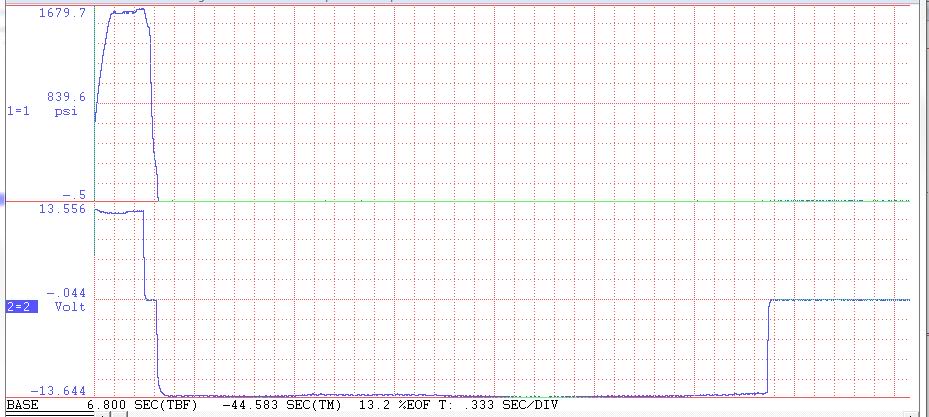
These two charts show the baseline engine off with NO resistor, open then close:
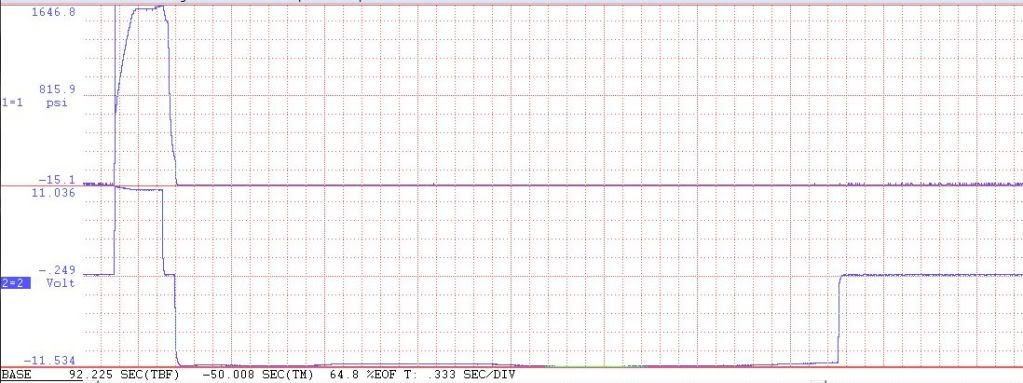

These two charts show the baseline engine on with NO resistor, open then close:
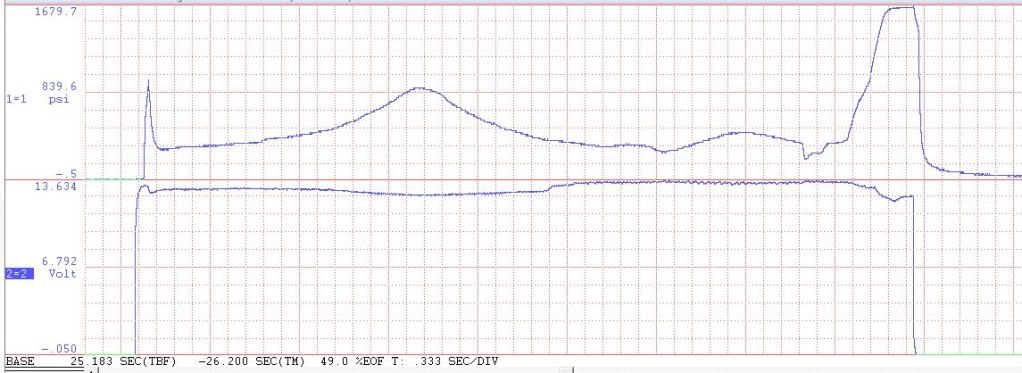
These two charts show the engine off WITH the 0.2 ohm resistor resistor, open then close:
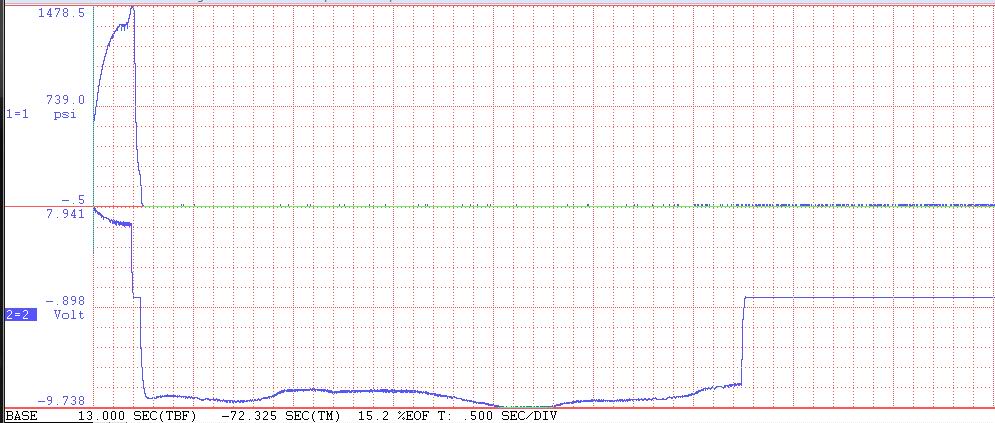
(Chart shows first trial, other two trials were 1479 and 1449 peak pressure)
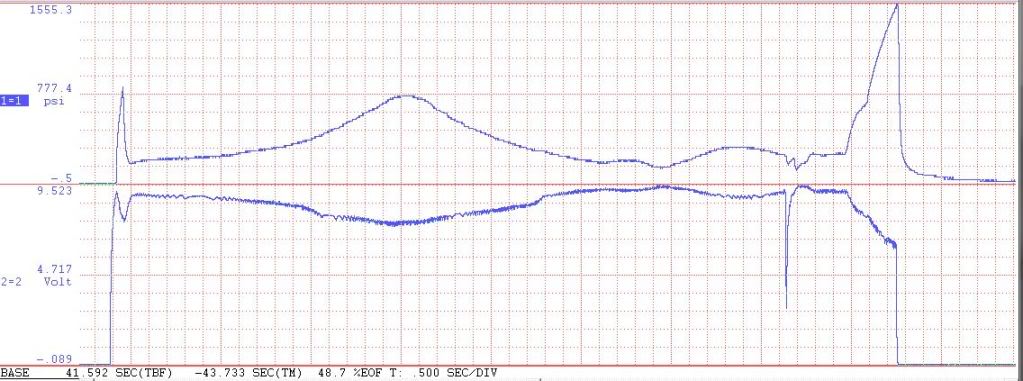
(Chart shows first trial, other two trials were 1540 and 1540 peak pressure)
These two charts show the engine on WITH the 0.2 ohm resistor resistor, open then close:

(Chart shows first trial, other two trials were 1632 and 1617 peak pressure)
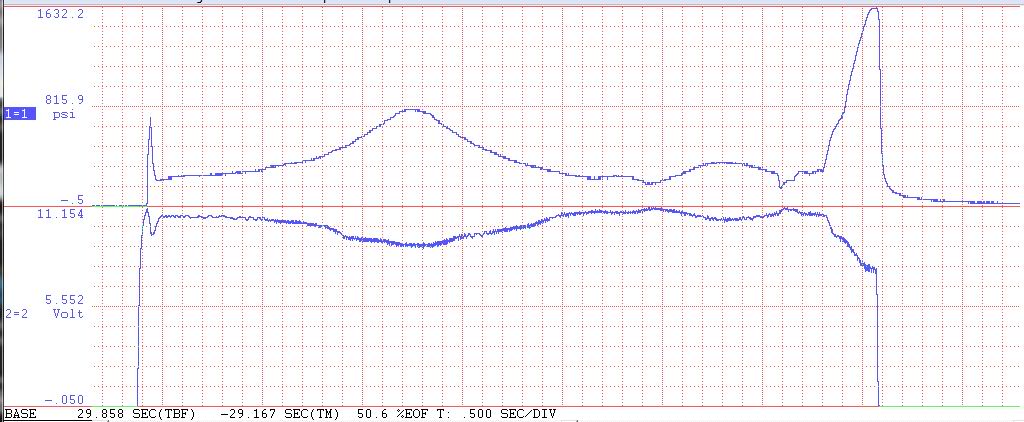
(Chart shows first trial, other two trials were 1632 and 1632 peak pressure)
It is clear that the state of the battery has a major bearing on the pressure the pump generates.
As a result, I charged my battery, and ran off the surface charge by waiting three hours and running for complete top cycles with the headlights on before taking my data.
This time I also took a more complete set of data (pressure and voltage), including top open AND top close cycles for:
-Baseline with no resistor, engine off
-Baseline with no resistor, engine on
-3 measurements trials with resistor, engine off
-3 measurements trials with resistor, engine on
Rev. Sam also today did a similar excercise, after taking a long drive to assure a fully charged battery.
I am delighted to say that now Rev Sam's results, Gus & Walt's results and my results all align quite well now and tell the same story.
This post will present the data, I will interpret it in a follow-up post.
These two charts show the baseline engine off with NO resistor, open then close:
These two charts show the baseline engine on with NO resistor, open then close:
These two charts show the engine off WITH the 0.2 ohm resistor resistor, open then close:
(Chart shows first trial, other two trials were 1479 and 1449 peak pressure)
(Chart shows first trial, other two trials were 1540 and 1540 peak pressure)
These two charts show the engine on WITH the 0.2 ohm resistor resistor, open then close:
(Chart shows first trial, other two trials were 1632 and 1617 peak pressure)
(Chart shows first trial, other two trials were 1632 and 1632 peak pressure)
Last edited by WhiteXKR; Oct 5, 2011 at 08:35 PM.

Veteran Member
Joined: Aug 2007
Posts: 3,430
Likes: 571
From: Los Angeles
As I mentioned in another thread, the results I had posted at the start of this thread were artificially low because my battery was in a low state of charge. This was kindly pointed out by Walt.
It is clear that the state of the battery has a major bearing on the pressure the pump generates.
As a result, I charged my battery, and ran off the surface charge by waiting three hours and running for complete top cycles with the headlights on before taking my data.
This time I also took a more complete set of data (pressure and voltage), including top open AND top close cycles for:
-Baseline with no resistor, engine off
-Baseline with no resistor, engine on
-3 measurements trials with resistor, engine off
-3 measurements trials with resistor, engine on
Rev. Sam also today did a similar excercise, after taking a long drive to assure a fully charged battery.
I am delighted to say that now Rev Sam's results, Gus & Walt's results and my results all align quite well now and tell the same story.
This post will present the data, I will interpret it in a follow-up post.
It is clear that the state of the battery has a major bearing on the pressure the pump generates.
As a result, I charged my battery, and ran off the surface charge by waiting three hours and running for complete top cycles with the headlights on before taking my data.
This time I also took a more complete set of data (pressure and voltage), including top open AND top close cycles for:
-Baseline with no resistor, engine off
-Baseline with no resistor, engine on
-3 measurements trials with resistor, engine off
-3 measurements trials with resistor, engine on
Rev. Sam also today did a similar excercise, after taking a long drive to assure a fully charged battery.
I am delighted to say that now Rev Sam's results, Gus & Walt's results and my results all align quite well now and tell the same story.
This post will present the data, I will interpret it in a follow-up post.

Doug
Thread Starter
|
Veteran Member
Joined: Apr 2010
Posts: 7,657
Likes: 3,019
From: Arlington VA USA
Here is my interpretation of the results:
-Without any pressure reduction device, operating the top with the engine on vs. operating the top with the engine off makes a difference small enough to be negligible.
-If you choose to use the resistor, if you operate the top with the ignition on, there is little benefit.
-If you choose to use the resistor, there is a small pressure reduction benefit when you operate the top with the ignition off: about 150 PSI when you average all trials of open and closing.
-If you choose to use the pressure relief valve, you have a constant pressure reduction of about 650 to 700 PSI under all conditions.
Those are the choices available today.
-Without any pressure reduction device, operating the top with the engine on vs. operating the top with the engine off makes a difference small enough to be negligible.
-If you choose to use the resistor, if you operate the top with the ignition on, there is little benefit.
-If you choose to use the resistor, there is a small pressure reduction benefit when you operate the top with the ignition off: about 150 PSI when you average all trials of open and closing.
-If you choose to use the pressure relief valve, you have a constant pressure reduction of about 650 to 700 PSI under all conditions.
Those are the choices available today.
Steve,
On behalf of many I want to thank you for your time and hard work on this roof operation controversy. When I called you for your assistance I knew that you would help in any way but I had no idea you would go to this extent. Your skills and knowledge has proven to be an asset to me and this forum. Words cannot express my sincere appreciation. Let me know when I can return the favor.
Gus
On behalf of many I want to thank you for your time and hard work on this roof operation controversy. When I called you for your assistance I knew that you would help in any way but I had no idea you would go to this extent. Your skills and knowledge has proven to be an asset to me and this forum. Words cannot express my sincere appreciation. Let me know when I can return the favor.
Gus
Here is my interpretation of the results:
-Without any pressure reduction device, operating the top with the engine on vs. operating the top with the engine off makes a difference small enough to be negligible.
-If you choose to use the resistor, if you operate the top with the ignition on, there is little benefit.
-If you choose to use the resistor, there is a small pressure reduction benefit when you operate the top with the ignition off: about 150 PSI when you average all trials of open and closing.
-If you choose to use the pressure relief valve, you have a constant pressure reduction of about 650 to 700 PSI under all conditions.
Those are the choices available today.
-Without any pressure reduction device, operating the top with the engine on vs. operating the top with the engine off makes a difference small enough to be negligible.
-If you choose to use the resistor, if you operate the top with the ignition on, there is little benefit.
-If you choose to use the resistor, there is a small pressure reduction benefit when you operate the top with the ignition off: about 150 PSI when you average all trials of open and closing.
-If you choose to use the pressure relief valve, you have a constant pressure reduction of about 650 to 700 PSI under all conditions.
Those are the choices available today.

Steve, on behalf of many members here who have a real need for this info and have followed these threads with interest, sometimes with trepidation, I thank you.
Your interpretation seems crystal clear and it would seem much easier to make a more informed decision on which way to go.
The only question I have is this......Where were you a year ago? lol
Thanks again Steve
Veteran Member
Joined: Sep 2010
Posts: 1,713
Likes: 451
From: New Jersey
Thanks to everyone for their work. I have a somewhat different interpretation than Steve on recent measurements.
Effects of source voltage:
I'll ask Rev. Sam to double-check the following, but he did two sets of recent measurements. The first of these used the car's battery "as is" (the videos); the second after extended driving to charge the battery (reported as text). These are engine-off data (the way the system is designed). If I've copied everything correctly ...
Peak Pressure (and reduction): .... Raising Top ..... Lowering Top
1st run, per videos ............... 1430 (-220) ...... 1340 (-300)
2nd run, after charging ........... 1480 (-160) ...... 1320 (-305)
The pressures and reductions did not change appreciably after charging. (Sam, did I get it right?) So 160 to 300 PSI reduction is reported here. If we were to compare to peak engine-on, no-resistor pressures (i.e. stock system, Jaguar's recommmendation) the reductions are somewhat higher.
In contrast, Steve used an external charger on the battery in prep for his latest measurements. I know he made efforts to bleed charge afterward, but introducing the external charger does not seem to me the most neutral of conditions. I would like to see these measurements done after a couple of weeks of driving, with the battery then in the state-of-charge that the car's charging system maintains.
I believe the use of the external charger may account for at least part of the differences now appearing between Sam's and Steve's most recent measurements (they agreed pretty closely in the first round). This should be checked in any case.
(Note on engine-on testing: the system was designed for engine-off operation, the resistor value was chosen for that condition. Doing engine-on testing is fine, but not to the exclusion of engine-off testing, as the valve team did. Any system should be tested under the conditions specified for its use, the way people actually use it, not what the tester prefers.)
Other effects of using the resistor:
More study needed on some of this, but briefly:
- the duration of high pressure spikes are reduced greatly. Some of the pressure peaks shown on the recent graphs are, with resistor, only ~ 200 mSec. in duration, compared to ~ 1 Sec. in a stock or relief valve system. The reduced times spent under high pressure may be affording some protection, but more study to do on that.
[Edit:] Removed an incorrect idea about measurements here.
- Peak pressure reduction in convertible top rams. In a stock, or relief valve system, the pressure on the rams peaks at 850-1000 PSI (values differ on different graphs). With a resistor in place, this peak is reduced by something like 75 PSI (the rams don't fail as often as the latch components, but they do fail).
- Motor wear-and-tear: the presence of the resistor reduces peak current draw, power consumed and mechanical loads on the motor. All by significant percentages. The motor does not need to be driven at full battery or alternator voltage for the job at hand.
I still got much of the story wrong! No avoiding that the resistor is not reducing peak latch pressure nearly as much as I had thought. On the other hand, it's not doing nothing. Each of us can decide about the value of the effects above.
And that's what I wanted to say about recent results, for now.
[edit] Most current info on voltage reduction project found at www.scorekeeper.com/jaguar/jaguar01.htm
Effects of source voltage:
I'll ask Rev. Sam to double-check the following, but he did two sets of recent measurements. The first of these used the car's battery "as is" (the videos); the second after extended driving to charge the battery (reported as text). These are engine-off data (the way the system is designed). If I've copied everything correctly ...
Peak Pressure (and reduction): .... Raising Top ..... Lowering Top
1st run, per videos ............... 1430 (-220) ...... 1340 (-300)
2nd run, after charging ........... 1480 (-160) ...... 1320 (-305)
The pressures and reductions did not change appreciably after charging. (Sam, did I get it right?) So 160 to 300 PSI reduction is reported here. If we were to compare to peak engine-on, no-resistor pressures (i.e. stock system, Jaguar's recommmendation) the reductions are somewhat higher.
In contrast, Steve used an external charger on the battery in prep for his latest measurements. I know he made efforts to bleed charge afterward, but introducing the external charger does not seem to me the most neutral of conditions. I would like to see these measurements done after a couple of weeks of driving, with the battery then in the state-of-charge that the car's charging system maintains.
I believe the use of the external charger may account for at least part of the differences now appearing between Sam's and Steve's most recent measurements (they agreed pretty closely in the first round). This should be checked in any case.
(Note on engine-on testing: the system was designed for engine-off operation, the resistor value was chosen for that condition. Doing engine-on testing is fine, but not to the exclusion of engine-off testing, as the valve team did. Any system should be tested under the conditions specified for its use, the way people actually use it, not what the tester prefers.)
Other effects of using the resistor:
More study needed on some of this, but briefly:
- the duration of high pressure spikes are reduced greatly. Some of the pressure peaks shown on the recent graphs are, with resistor, only ~ 200 mSec. in duration, compared to ~ 1 Sec. in a stock or relief valve system. The reduced times spent under high pressure may be affording some protection, but more study to do on that.
[Edit:] Removed an incorrect idea about measurements here.
- Peak pressure reduction in convertible top rams. In a stock, or relief valve system, the pressure on the rams peaks at 850-1000 PSI (values differ on different graphs). With a resistor in place, this peak is reduced by something like 75 PSI (the rams don't fail as often as the latch components, but they do fail).
- Motor wear-and-tear: the presence of the resistor reduces peak current draw, power consumed and mechanical loads on the motor. All by significant percentages. The motor does not need to be driven at full battery or alternator voltage for the job at hand.
I still got much of the story wrong! No avoiding that the resistor is not reducing peak latch pressure nearly as much as I had thought. On the other hand, it's not doing nothing. Each of us can decide about the value of the effects above.
And that's what I wanted to say about recent results, for now.
[edit] Most current info on voltage reduction project found at www.scorekeeper.com/jaguar/jaguar01.htm
Last edited by Dennis07; Oct 13, 2011 at 03:46 PM. Reason: corrections, clarity
Thread Starter
|
Veteran Member
Joined: Apr 2010
Posts: 7,657
Likes: 3,019
From: Arlington VA USA
I thought this issue was primarily a personality clash.
Then, when Gus and Walt published their resistor test it was clear to me the best way to find the truth was a third party test. I wanted to make an attempt to reason with facts, and find common ground among all of us.
There are still some small differences in interpretation, and some uncertainty due to variability between vehicles, battery state, measurement equipment accuracy, placement of sensors, etc., but by and and large, there is alignment.
Last edited by WhiteXKR; Oct 6, 2011 at 02:17 PM.

Member
Joined: Aug 2011
Posts: 82
Likes: 5
From: Savannah, GA
It the chem industry we call them soft starts and they programable black boxes reduce the starting torque of the motor, "locked rotor torque", and it sure appears that this is a mini version of the soft start and should also save a little wear and tear on the motor too.


Hello Reverend, I've spent many hours reading through all the forum threads, and you are certainly one of the heavy providers of fixes. I would like to purchase a reducer for the pump. I watched your video and it seems to be a piece of cake to install. My recent aquisition of a 2000 XK8 prompt's me to try to mitigate the possibility of the green shower experience. Vehicle has 85000 without a failure yet... Please advise me if you can provide me with one, and I'll make payment ASAP. Thanks, Bob OBrien
Veteran Member
Joined: Sep 2010
Posts: 1,713
Likes: 451
From: New Jersey
Hello Reverend, I've spent many hours reading through all the forum threads, and you are certainly one of the heavy providers of fixes. I would like to purchase a reducer for the pump. I watched your video and it seems to be a piece of cake to install. My recent aquisition of a 2000 XK8 prompt's me to try to mitigate the possibility of the green shower experience. Vehicle has 85000 without a failure yet... Please advise me if you can provide me with one, and I'll make payment ASAP. Thanks, Bob OBrien
The Rev. does not visit here so often as he once did, but if you'll send me a PM with your email address, I'll forward that to him.
Not sure if he has any resistor kits available at the moment, but he may.