


Vacuum or "reverse" brake bleeder? Which is best?


Thread Starter
|



Joined: Apr 2009
Posts: 1,689
Likes: 452
From: Central Florida
 Vacuum or "reverse" brake bleeder? Which is best?
So which is better to use on our jags?
The vacuum bleeder that pulls the fluid to the caliper or a "reverse" positive pressure bleeder that pushes the new fluid from the caliper through the brake system to the brake fluid reservoir?
I would think it would be better to pull the old stuff out rather than forcing it, and any contamination, through all the lines and the ABS pump, etc.
Can anyone recomend an economy model? I only do this once every few years.
Vector
The vacuum bleeder that pulls the fluid to the caliper or a "reverse" positive pressure bleeder that pushes the new fluid from the caliper through the brake system to the brake fluid reservoir?
I would think it would be better to pull the old stuff out rather than forcing it, and any contamination, through all the lines and the ABS pump, etc.
Can anyone recomend an economy model? I only do this once every few years.
Vector



Joined: Dec 2011
Posts: 120,439
Likes: 17,014
From: Durham, UK
I use pressure feed from the Reservoir forcing old fluid out through the Caliper bleed screws.

The fresh fluid container (arrowed in red) is attached to the Reservoir with a non-return valve (arrowed in blue). The fresh fluid container is pressurised by connection to the wheel (arrowed in orange).
This kit is a probably the lowest cost approach but very efficient. The one I'm using in the pic is Gunson Eezibleed. There are many similar available from other manufacturers and more sophisticated kits on the same principle but with a compressed gas cylinder or electric compressor to provide the pressure.
Graham
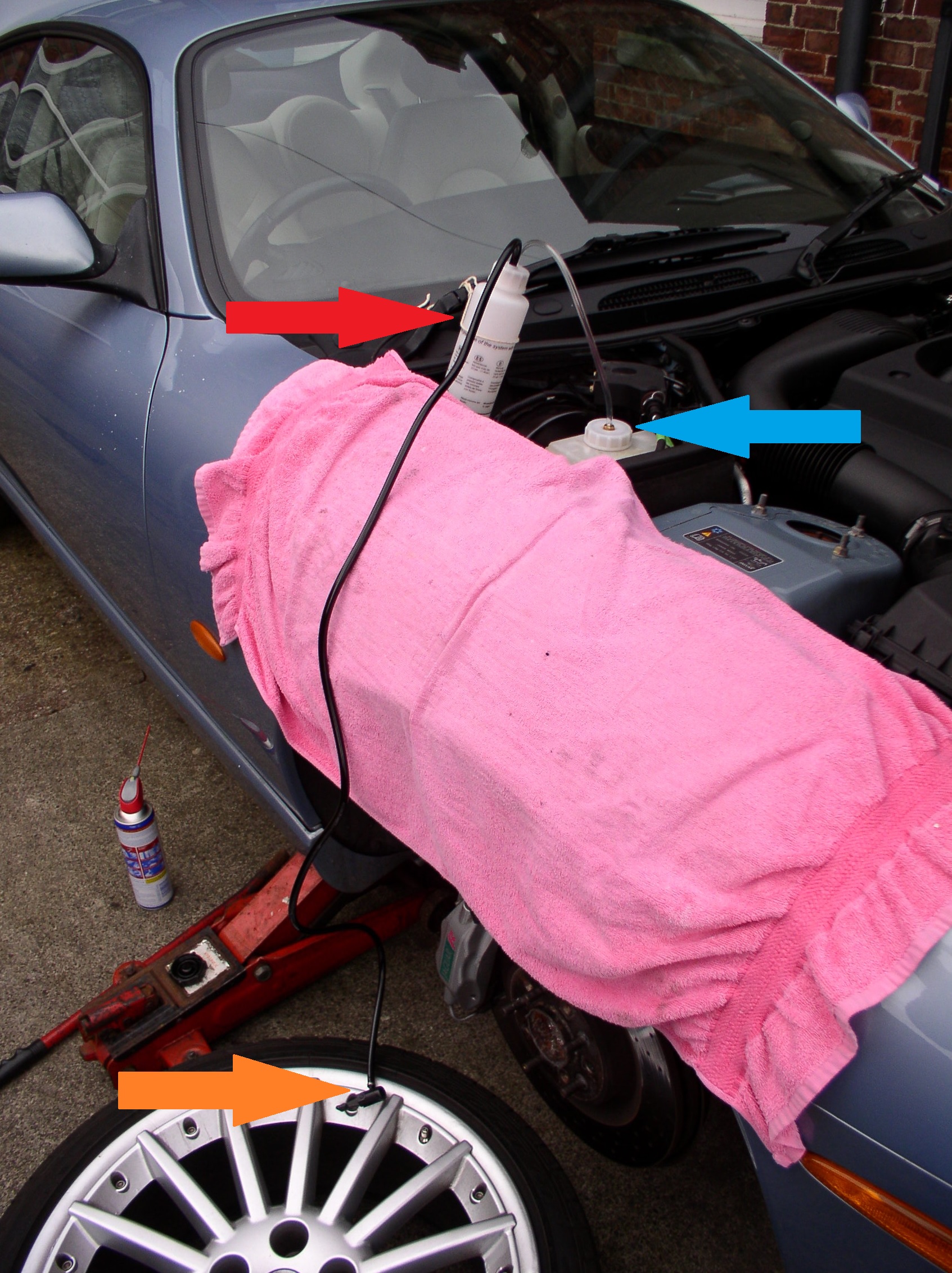
The fresh fluid container (arrowed in red) is attached to the Reservoir with a non-return valve (arrowed in blue). The fresh fluid container is pressurised by connection to the wheel (arrowed in orange).
This kit is a probably the lowest cost approach but very efficient. The one I'm using in the pic is Gunson Eezibleed. There are many similar available from other manufacturers and more sophisticated kits on the same principle but with a compressed gas cylinder or electric compressor to provide the pressure.
Graham

Veteran Member
Joined: Mar 2008
Posts: 25,535
Likes: 11,735
From: Pacific Northwest USA
My experience with vacuum bleeders is....they don't work that well for bleeding. It seems like I always have to go around the car at least twice to get all the air out. Others may have had better luck.
They're great for routine brake fluid flushing, though.
The type that pressurizes the m/c from above, as just mentioned, are better, IMHO
Cheers
DD
They're great for routine brake fluid flushing, though.
The type that pressurizes the m/c from above, as just mentioned, are better, IMHO
Cheers
DD


Joined: Sep 2010
Posts: 2,114
Likes: 976
From: Indianapolis, IN
My experience with vacuum bleeders is....they don't work that well for bleeding. It seems like I always have to go around the car at least twice to get all the air out. Others may have had better luck.
They're great for routine brake fluid flushing, though.
The type that pressurizes the m/c from above, as just mentioned, are better, IMHO
Cheers
DD
They're great for routine brake fluid flushing, though.
The type that pressurizes the m/c from above, as just mentioned, are better, IMHO
Cheers
DD


Veteran member


Joined: May 2008
Posts: 14,803
Likes: 4,102
From: Great Mills, MD
I see things this way and I am simply using my day job as a basis for what I am saying here. A vacuum "pulling" system is going to be limited to a differential of 14.7 psi. Where a pressure bleed system is going to be limited by whatever the pressure pump can put out. Where this can make the difference is in the rate at which the fluid is moving through the line. The faster the fluid moves through the line, the more gunk that you can "scrape" off the wall of the tubing and get out of the system. Granted, I also look at it this way and if you are getting gunk inside of your system, then you have other issues.
Now, the one benefit that I can give to the vacuum setups is if you are suspecting that you have water in your brake fluid, you can draw a decent vacuum on the system (above 28" of vacuum) and on a warm day, this will actually "boil" the water out of the fluid. Then you would just need to move the fluid slowly while under this vacuum.
Me, I find that doing it the old fashion way of keeping the reservoir full, pumping the brakes and using a piece of tygon about 4 feet long (long enough to go from the bleeder port, to the top of the wheel where where it is taped in place and then down to a collection jar) does the job for me. The benefits as I see them are:
- I can see when I get new fluid out at the caliper (fluid changes color),
- you have a column of brake fluid that if you happen to accidentally draw a slight vacuum on the brake system, this fluid is going to make up and not allow air into the system
- the setup costs you under $5 to get and is very easy to do even using 1 person and uses common every day items.
Now, the one benefit that I can give to the vacuum setups is if you are suspecting that you have water in your brake fluid, you can draw a decent vacuum on the system (above 28" of vacuum) and on a warm day, this will actually "boil" the water out of the fluid. Then you would just need to move the fluid slowly while under this vacuum.
Me, I find that doing it the old fashion way of keeping the reservoir full, pumping the brakes and using a piece of tygon about 4 feet long (long enough to go from the bleeder port, to the top of the wheel where where it is taped in place and then down to a collection jar) does the job for me. The benefits as I see them are:
- I can see when I get new fluid out at the caliper (fluid changes color),
- you have a column of brake fluid that if you happen to accidentally draw a slight vacuum on the brake system, this fluid is going to make up and not allow air into the system
- the setup costs you under $5 to get and is very easy to do even using 1 person and uses common every day items.

Thread
Thread Starter
Forum
Replies
Last Post
clubairth1
S-Type / S type R Supercharged V8 ( X200 )
30
Sep 3, 2025 04:38 PM

Currently Active Users Viewing This Thread: 1 (0 members and 1 guests)