When you click on links to various merchants on this site and make a purchase, this can result in this site earning a commission. Affiliate programs and affiliations include, but are not limited to, the eBay Partner Network.
The other is for top gear - that's the one in the overdrive circuit. If the two switches aren't accessible when the gearbox is installed in your car, check they are working first and if you have to replace them, check the replacements work. I've not heard of problems in Jaguars, but MG owners, their cars have nominally the same devices, often have to replace/adjust them with a spacer.
I don't plan on using the overdrive, but it does need to be tested. The city fuel economy is 18-20 mpg, highway is 22 mpg, not to bad for a 60+ year old engine. I could see using the overdrive for highway driving, but not so much for city.
Overdrive (or a fifth gear in general) is nice to have for cruising and allows a rapid down change for overtaking. O/d top pulls adequately down to 40 m/h. In a light vehicle, it's not unreasonable to use the reverse switch on the gearbox as an inhibitor and make the overdrive accessible in lower gears. Though, with a JS or CR Moss box, the overall ratio of overdrive 3rd is very close to direct top.
Last edited by Peter3442; Sep 3, 2024 at 07:21 AM.
I had an MGB GT V8 with overdrive in 3rd and 4th. Ideal for overtaking as already stated and often I would use it on "A" roads where I never touched the gear stick just kept flicking the O/D on and off through 3rd and 4th.
My father in the 1960s used to sprint and hill climb a 3.8 Mk2 and he set the O/D up so it worked in all forward gears. He would set off from the line in a standing start in first and then flicked the O/D into what is the equivalent of 2nd and this would get him up to about 60 mph without having to change gear using the gear stick or clutch.
All of the eleven 2.4, 3.4 and 3.8 Jags I have owned used Lucas generators.
I suspect your Delco is a "ring in".
I did convert a couple of these cars to alternators. I recommend this to owners who have major generator failures such as burnt windings and poling where bearings have failed as the cost to rebuild the old generator can be eye watering.
All of the eleven 2.4, 3.4 and 3.8 Jags I have owned used Lucas generators.
I suspect your Delco is a "ring in".
I did convert a couple of these cars to alternators. I recommend this to owners who have major generator failures such as burnt windings and poling where bearings have failed as the cost to rebuild the old generator can be eye watering.
So the Delco is an aftermarket replacement part, correct? There's probably not much value in one of the Delco generators is there?
The water pump is leaking a few drops of coolant. It's time for a rebuild or replacement. For rebuilding the pump, the manual refers to using "water resistant jointing compound". Is that pipe joint compound?
It's a job I have to do on my car as the pump is locked solid. While you're working on it, it's worth replacing everything that's consumable such as hoses, if you haven't done so already, and also flushing the cooling system.
Make sure the sealing surfaces are good and the gasket sits well between solid metal surfaces otherwise coolant can leak into the engine oil via the timing gear.
Cass
Would like to have been able to buy the new water pump you recommended in post #290 but on closer inspection of the site, the company does not post to Australia.
Even if they did the cost of postage would almost, for sure, have doubled the quoted price.
Ah, well, we in the "colonies" will just have to make and mend.
Cheers
The water pump I have was new (NOS), the bearings are in excellent condition, it's the seal that's bad. I've located a replacement seal based on the original seals size, that would be a cheap fix. However, all the rebuild kits I've seen come with a replacement impeller, they must break during removal. I'll experiment with a worn out 4.2 pump I have, maybe the impeller can be removed without damage.
Cass
Would like to have been able to buy the new water pump you recommended in post #290 but on closer inspection of the site, the company does not post to Australia.
Even if they did the cost of postage would almost, for sure, have doubled the quoted price.
Ah, well, we in the "colonies" will just have to make and mend.
Cheers
Bill, Have you looked at the Davies-Craig electric pumps? Some owners have used the small version to help their Smiths heaters.
The water pump I have was new (NOS), the bearings are in excellent condition, it's the seal that's bad. I've located a replacement seal based on the original seals size, that would be a cheap fix. However, all the rebuild kits I've seen come with a replacement impeller, they must break during removal. I'll experiment with a worn out 4.2 pump I have, maybe the impeller can be removed without damage.
All the re-builders have a jig to press off impeller without damage. The new impeller, is a new design that was supposed to be more efficient than the stock one. The re-builder that I used in Oregon has retired so don't have a recommendation.
Rgds
David
Peter
No and I was simply remarking on how expensive and difficult it is to get parts for us in the antipodes.
In regards the heaters I live in a sub-tropical climate and a heater is way down on the list of needs.
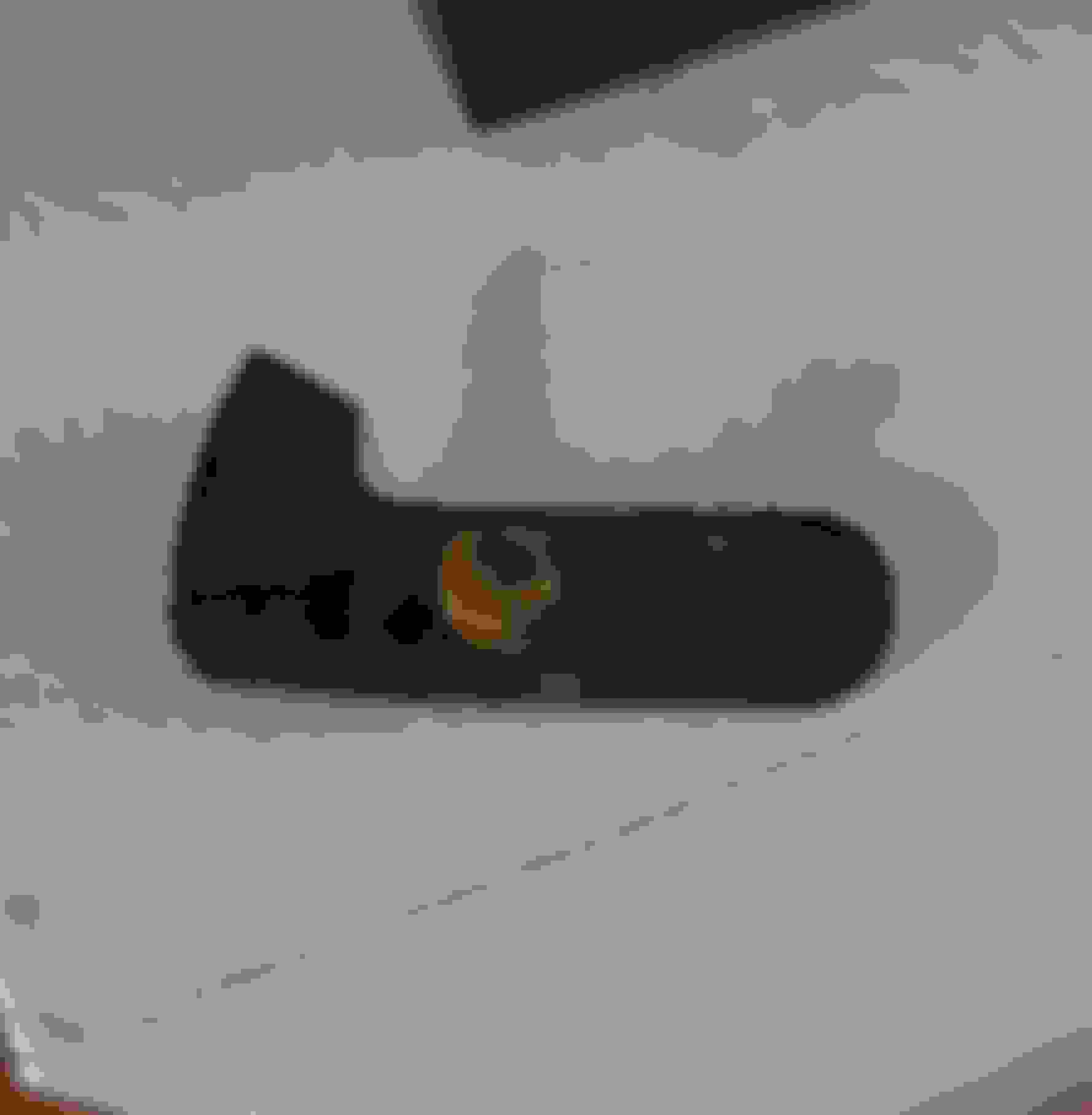
I found a small part in the distributor, it was in between the housing and the bearing plate. Is it part of the mechanical advance assembly?
The distributor is currently in a 4.2. Today, the engine had first start in years, runs great so far. It's in a test stand, nest step is an extended run at full operating temperature.
Almost certainly (IMHO) the brass part of a distributor rotor. My cars were Mk 1 and still have 65 Etype. The rotor was made of what we used to call bakelite insulator and had a molded-in part like you show ...on the top of the rotor... this is the conductor. The carbon contact in the top center of the distributor cap rested on the brass rounded end and as it rotated and the "flag" end (left on your photo) conducted the spark to each spark plug wire conductor in the distributor cap. Usually they had an arrow on the top surface that showed the direction to the next spark plug (yours looks like the photo is showing the bottom surface). Looks to me like the rotor came apart and threw this piece as it went to pieces.
The engine uses a filter can that mounts at an angle pointing downwards. Where the filter base mounts to the block, there are 2 gaskets (#27 & #28). There's a plate that sits between the oil filter assembly and the block. The manual shows the outer gasket style (#27), but the gasket that fits next to the block (#28) is partially obscured. It looks slightly different, just to the left of the hole in the center, see second image.
Does anyone know what the inner gasket looks like?