


New Brakes and Tires


Thread Starter
|
Veteran member
Joined: Jan 2009
Posts: 3,390
Likes: 195
From: Akron, Ohio USA
 New Brakes and Tires
So, I finally got around to putting new tires and brakes on the car. I picked up the car in September and as part of the certification process the dealer replaced the front brakes and tires only. The rear tires were pretty bad and so were the brakes. I was also getting a slight pulse in the wheel. Felt like the rotors on the front were starting to go.
The tires I decided to go with are a slightly different size than stock. I replaced the 235/50/17's with 245/45/17's. This has resulted in much better handling than before. The car responds much better to quick transitions and feels much more planted in sweeping turns.
Here are the tires:

I decided to go with drilled and slotted rotors all around with semi-metallic pads. I considered going with ceramic pads to better cope with the heat but felt the loss of initial bite wasn't worth it. Too many idiots cut me off on the way to work. The pads I got are supposed to have superior dust control over the stock pads, but we'll see. The swap went pretty easy. It was no worse than doing the brakes on any other car. Here are some tips:
Have a breaker bar or small impact wrench to get the caliper bracket bolts off. These had a thread lock compound on them and were a real bugger.
Have a rubber mallet handy has well. This helped me tap the calipers in without marring them. The pads on the front and rear have tension springs on them so a light tap was helpful before starting the bolts.
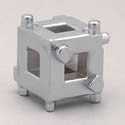
Buy the Jaguar rear caliper tool, or just a better one than I have. I have the universal cube that goes on a 3/8 drive ratchet. The only side that fit the piston to turn it in had four pins, so I had to grind two of them off. Even then, the tool didn't fit real good and it made turning down the pistons hard.
When installing the rear calipers, make sure the piston is lined up to accept the pin on the pad. Also, make sure the springs are set against the caliper and not off to one side.
Please let me know if there was anything else that I left out.
Here are the front brakes:
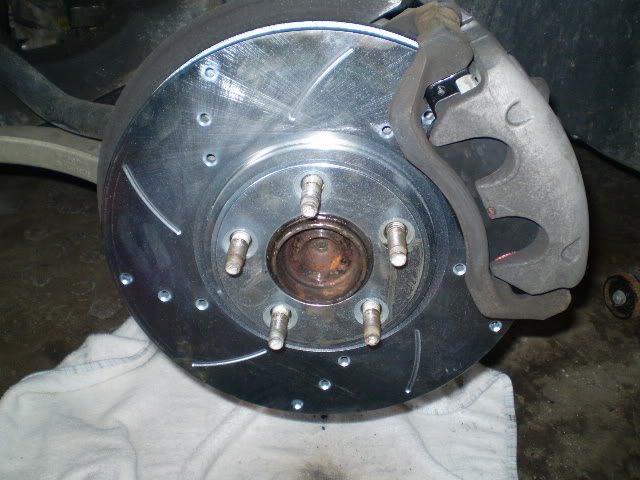
And here are the rear brakes:

I got all the brake parts for $400. I'll update here with how they hold up. The rotors are supposed to be guaranteed for life against warping. Hope I won't have to put it to the test.
BTW: I put the almost new tires off the front up in the Private For Sale section for free if anyone wants them...
The tires I decided to go with are a slightly different size than stock. I replaced the 235/50/17's with 245/45/17's. This has resulted in much better handling than before. The car responds much better to quick transitions and feels much more planted in sweeping turns.
Here are the tires:
I decided to go with drilled and slotted rotors all around with semi-metallic pads. I considered going with ceramic pads to better cope with the heat but felt the loss of initial bite wasn't worth it. Too many idiots cut me off on the way to work.
The pads I got are supposed to have superior dust control over the stock pads, but we'll see. The swap went pretty easy. It was no worse than doing the brakes on any other car. Here are some tips:Have a breaker bar or small impact wrench to get the caliper bracket bolts off. These had a thread lock compound on them and were a real bugger.
Have a rubber mallet handy has well. This helped me tap the calipers in without marring them. The pads on the front and rear have tension springs on them so a light tap was helpful before starting the bolts.
Buy the Jaguar rear caliper tool, or just a better one than I have. I have the universal cube that goes on a 3/8 drive ratchet. The only side that fit the piston to turn it in had four pins, so I had to grind two of them off. Even then, the tool didn't fit real good and it made turning down the pistons hard.
When installing the rear calipers, make sure the piston is lined up to accept the pin on the pad. Also, make sure the springs are set against the caliper and not off to one side.
Please let me know if there was anything else that I left out.
Here are the front brakes:
And here are the rear brakes:
I got all the brake parts for $400. I'll update here with how they hold up. The rotors are supposed to be guaranteed for life against warping. Hope I won't have to put it to the test.
BTW: I put the almost new tires off the front up in the Private For Sale section for free if anyone wants them...
Last edited by JOsworth; Mar 1, 2009 at 06:35 AM. Reason: more info

Senior Member
Joined: May 2008
Posts: 104
Likes: 0
From: Murrieta
I would not have gotten the slotted/drilled rotors. They may not warp but if you actually brake hard, they will crack. When they drill the face, they drill right into the internal vanes and passage ways inbetween the rotor. So now the "mock" vacuum that the rotor creates when spinning is not present. That's why you will usually only see slotted/drilled rotors on cars with brake cooling ducts. There are a few exceptions to how the rotors are made but 99% of the chinese pieces are made like that.
And the pads, IDK your experience with ceramic pads but they have a better coefficient of friction then the semi-metallics, providing a better "bite". Semi-metallics are a downgrade from a good set of ceramics.
And the pads, IDK your experience with ceramic pads but they have a better coefficient of friction then the semi-metallics, providing a better "bite". Semi-metallics are a downgrade from a good set of ceramics.
Thread Starter
|
Veteran member
Joined: Jan 2009
Posts: 3,390
Likes: 195
From: Akron, Ohio USA
Thanks for the heads up. I used to run ceramics pads on my Accord and found that their initial bite was less than the semi's. It took greater brake pressure to produce the same braking force. It has always been explained to me that ceramics help to reduce heat, dust, and run quieter. They are also more expensive to manufacture. The best biting brakes I've ever sampled was a co-worker's Evo with metallic pads. Thought my face would peel off. But man they chewed up his rotors and sounded like a freight train while braking. He has the car set up for auto-cross. A bit extreme for my needs.

Senior Member
Joined: Sep 2008
Posts: 349
Likes: 41
From: Kelowna, British Columbia, Canada

I would not have gotten the slotted/drilled rotors. They may not warp but if you actually brake hard, they will crack. When they drill the face, they drill right into the internal vanes and passage ways inbetween the rotor. So now the "mock" vacuum that the rotor creates when spinning is not present. That's why you will usually only see slotted/drilled rotors on cars with brake cooling ducts. There are a few exceptions to how the rotors are made but 99% of the chinese pieces are made like that.
And the pads, IDK your experience with ceramic pads but they have a better coefficient of friction then the semi-metallics, providing a better "bite". Semi-metallics are a downgrade from a good set of ceramics.
And the pads, IDK your experience with ceramic pads but they have a better coefficient of friction then the semi-metallics, providing a better "bite". Semi-metallics are a downgrade from a good set of ceramics.
My STR and my X-type have them with ceramics. I just installed the X a month ago and the STR last September.
My advice is worth exactly what ya paid for it...
Senior Member
Joined: May 2008
Posts: 104
Likes: 0
From: Murrieta
If he got the parts from Brake Performance per my recommendation they are dimply drilled and not all the way through. I have used three sets of them and my Land Rover now has over 70K on the same rotors. I drive the Rover hard and consequently brake hard from time to time and they never fail to impress considering it weighs in excess of 5,000lbs.
My STR and my X-type have them with ceramics. I just installed the X a month ago and the STR last September.
My advice is worth exactly what ya paid for it...
My STR and my X-type have them with ceramics. I just installed the X a month ago and the STR last September.
My advice is worth exactly what ya paid for it...
Senior Member
Joined: May 2008
Posts: 104
Likes: 0
From: Murrieta
Thanks for the heads up. I used to run ceramics pads on my Accord and found that their initial bite was less than the semi's. It took greater brake pressure to produce the same braking force. It has always been explained to me that ceramics help to reduce heat, dust, and run quieter. They are also more expensive to manufacture. The best biting brakes I've ever sampled was a co-worker's Evo with metallic pads. Thought my face would peel off. But man they chewed up his rotors and sounded like a freight train while braking. He has the car set up for auto-cross. A bit extreme for my needs.
Although, with all this said, you will usually find that any aftermarket brand is better than stock so you should like the improvement!

Veteran Member


Joined: Jan 2009
Posts: 13,082
Likes: 4,736
From: Raleigh, NC
Jeff,
What semi-metallic pads did you decide to go with? Where did you get them and what was the cost for just the front pads? Providing the actual brake pad model numbers would be very much appreciated as well. I know that I'll be replacing my front pads at some point this summer if not sooner....
What semi-metallic pads did you decide to go with? Where did you get them and what was the cost for just the front pads? Providing the actual brake pad model numbers would be very much appreciated as well. I know that I'll be replacing my front pads at some point this summer if not sooner....
Trending Topics

Member
Joined: Mar 2008
Posts: 57
Likes: 0
From: ct
If he got the parts from Brake Performance per my recommendation they are dimply drilled and not all the way through. I have used three sets of them and my Land Rover now has over 70K on the same rotors. I drive the Rover hard and consequently brake hard from time to time and they never fail to impress considering it weighs in excess of 5,000lbs.
My STR and my X-type have them with ceramics. I just installed the X a month ago and the STR last September.
My advice is worth exactly what ya paid for it...
My STR and my X-type have them with ceramics. I just installed the X a month ago and the STR last September.
My advice is worth exactly what ya paid for it...
Would you mind posting some pics of the brake performance parts on the str? I plan on using them with akebono pads but if that colmbo ends up sucking really bad i'll just use the included pads.
Senior Member
Joined: Sep 2008
Posts: 349
Likes: 41
From: Kelowna, British Columbia, Canada
Capiche?

Member
Joined: Nov 2008
Posts: 32
Likes: 0
From:
Have you ever been in that evo with a good set of ceramics? You can't compare different materials among different cars. It is true that ceramics reduce temperatures. This is especially important on larger vehicles. It is also interesting that you brought up an accord with ceramics. I have heard ALOT of complaints about the hondas and ceramic brakes. Also, the manufacture of the pad has alot to do with the performance. A low quality brand will be temperamental to temperature. This is where ceramics got the bad rap of needing to be "warmed up"
Although, with all this said, you will usually find that any aftermarket brand is better than stock so you should like the improvement!
Although, with all this said, you will usually find that any aftermarket brand is better than stock so you should like the improvement!
Alot of high performance brake pads do need to heat up to temp to operate best.
Thread Starter
|
Veteran member
Joined: Jan 2009
Posts: 3,390
Likes: 195
From: Akron, Ohio USA
I didn't start this to debate friction material. I notice that there are owners on here that are apprehensive about working on their own cars, fearing that they are overly complicated. This is here to help alleviate some of that apprehension, and maybe provide some tips on how to perform the brake service.
BTW: While the ceramics required a lot more brake pressure, I liked them on the automatic equipped Accord because they saved me the hassle of constantly replacing warped rotors. They were not needed on the 5-speed though, since the vehicle required less brake force when downshifted properly.
Just had to say it....
Thread Starter
|
Veteran member
Joined: Jan 2009
Posts: 3,390
Likes: 195
From: Akron, Ohio USA
Ok..Back on topic.. A couple of things I forgot to mention in my original post but thought I'd add. When doing the brakes don't forget to pull the pins carefully from the caliper bracket and grease well. Also, before retracting the caliper piston, be sure to inspect the boot for any signs of cracks or holes. My car is still fairly new, but inspected anyway.
Member
Joined: Nov 2008
Posts: 32
Likes: 0
From:
What year and model Honda... Makes a difference.
I didn't start this to debate friction material. I notice that there are owners on here that are apprehensive about working on their own cars, fearing that they are overly complicated. This is here to help alleviate some of that apprehension, and maybe provide some tips on how to perform the brake service.
BTW: While the ceramics required a lot more brake pressure, I liked them on the automatic equipped Accord because they saved me the hassle of constantly replacing warped rotors. They were not needed on the 5-speed though, since the vehicle required less brake force when downshifted properly.
Just had to say it....
I didn't start this to debate friction material. I notice that there are owners on here that are apprehensive about working on their own cars, fearing that they are overly complicated. This is here to help alleviate some of that apprehension, and maybe provide some tips on how to perform the brake service.
BTW: While the ceramics required a lot more brake pressure, I liked them on the automatic equipped Accord because they saved me the hassle of constantly replacing warped rotors. They were not needed on the 5-speed though, since the vehicle required less brake force when downshifted properly.
Just had to say it....
Yeah, I don't want to debate anything either. I just wanted to mention ceramics can be a good choice too. If I didn't autocross/occasional track day I would've gotten a regular brake pad.
I appreciate the write up, my brakes need some care. Do you have a picture of that tool you wrote about in the first post? Thanks
Thread Starter
|
Veteran member
Joined: Jan 2009
Posts: 3,390
Likes: 195
From: Akron, Ohio USA
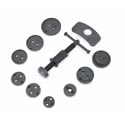
It is a cube that has various pins on each surface. It is a universal tool used to turn in the rear caliper piston. It is cheap at just about any autoparts store. Since it had to be modified, I wouldn't reccomend getting it, but getting a better setup. It was a real pain getting the rears turned in and I was nervous that I was going to mar the piston. I saw a better kit @ Summit Racing for $48 dollars and will more than likely get it so it is in my tool collection.
Here is what the universal tool looks like:
This is the set I plan on getting:
Here is what the universal tool looks like:
This is the set I plan on getting:

Senior Member
Joined: Feb 2009
Posts: 203
Likes: 61
From: socal
May not apply to here, but in many cases on a single piston rear caliper where the front is an arch (like the one posted up front), a pair of needle nose pliers can be used to turn down the piston against the parking rachet, but the dedicated tools are pretty cool. Doesn't take too much torque to retract the piston when rotated in the right direction.
Thread Starter
|
Veteran member
Joined: Jan 2009
Posts: 3,390
Likes: 195
From: Akron, Ohio USA
I would not recommend that on these. There is a great risk of marring the piston. I've used that method when there are actual holes that the tool's pins fit in. These have slots that are V shaped..I should have taken pictures of the naked brakes.. Sorry
Pokerplayer: It would be real cool if you were to make one. Maybe market it for sale here? I haven't priced Jaguar's tool yet so who knows?
Pokerplayer: It would be real cool if you were to make one. Maybe market it for sale here?
I haven't priced Jaguar's tool yet so who knows?