


seperate s/c cooling from engine cooling


Thread Starter
|
Senior Member
Joined: Mar 2009
Posts: 124
Likes: 11
From: SC
 seperate s/c cooling from engine cooling
has anyone separated their s/c cooling from the engine cooling? I am checking the diagrams from jtis, and it appears that they are joined in 2 locations - before going to the heater core and also at the expantion tank. One of the diagrams also shows an "auxiliary coolant flow pump" - the main pump is right by the s/c radiator, where is the aux pump? Of course, if the s/c cooling is split from engine cooling it would need it's own expansion tank. It seems like this could really improve cooling for the charge air coolers.
Thread Starter
|
Senior Member
Joined: Mar 2009
Posts: 124
Likes: 11
From: SC
it lists 3 pumps total-
diagram e30263
1 Charge air cooler water pump.2 Radiator.3 Cooling fan.4 Coolant expansion tank.5 Engine.6 Charge air cooler.7 Throttle housing.8 Heater core.9 Cooling system water pump.10 Charge air cooler.11 Thermostat.12 Auxiliary coolant flow pump.13 Charge air cooler radiator.
diagram e30263
1 Charge air cooler water pump.2 Radiator.3 Cooling fan.4 Coolant expansion tank.5 Engine.6 Charge air cooler.7 Throttle housing.8 Heater core.9 Cooling system water pump.10 Charge air cooler.11 Thermostat.12 Auxiliary coolant flow pump.13 Charge air cooler radiator.


Joined: Mar 2008
Posts: 2,521
Likes: 71
From: Powell, Ohio U.S.A. 43065
"Charge air cooler" is the intercooler pump.
Cooling system water pump is no mystery.
12. is the heater core pump, it's in front of your brake master cylinder if we're talking about an XJ. Apologies for my semantics.
Cooling system water pump is no mystery.
12. is the heater core pump, it's in front of your brake master cylinder if we're talking about an XJ. Apologies for my semantics.
Thread Starter
|
Senior Member
Joined: Mar 2009
Posts: 124
Likes: 11
From: SC
it's for an 03 s type r. heater core pump would make sense because it's right inline with the heater core. thanks jagtech
Thread Starter
|
Senior Member
Joined: Mar 2009
Posts: 124
Likes: 11
From: SC
here is the diagram. i colored the separate flows of the hoses for easier visibility. Possibly could be as simple as clamping the green hose at the s/c radiator then run the orange hose to a new expansion tank, plug the connection on the existing expansion tank.

Veteran Member
Joined: Jul 2008
Posts: 972
Likes: 36
From: Miami, FL
What about just running a larger cooler for the charged air coolant? Like Eurotek sells?
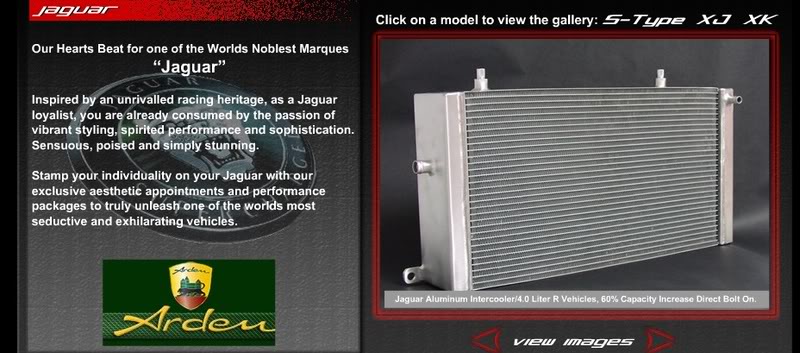
I'm sure we could find a generic one thats cheaper, but I think the concept would be an easy alternative.. Or it could be done along with separating the cooling systems for even better results. Eric
I'm sure we could find a generic one thats cheaper, but I think the concept would be an easy alternative.. Or it could be done along with separating the cooling systems for even better results. Eric
Trending Topics
Veteran Member
Joined: Jul 2008
Posts: 972
Likes: 36
From: Miami, FL
Joined: Mar 2008
Posts: 2,521
Likes: 71
From: Powell, Ohio U.S.A. 43065
I have not seen the two systems separated in practice, but I believe some XJR guys have done it. In theory, it makes good sense to me. The only thing that comes to mind is the need for some sort of pressure relief.
Thread Starter
|
Senior Member
Joined: Mar 2009
Posts: 124
Likes: 11
From: SC
What about just running a larger cooler for the charged air coolant? Like Eurotek sells?
I'm sure we could find a generic one thats cheaper, but I think the concept would be an easy alternative.. Or it could be done along with separating the cooling systems for even better results. Eric
I'm sure we could find a generic one thats cheaper, but I think the concept would be an easy alternative.. Or it could be done along with separating the cooling systems for even better results. Eric
 the hardest part would be fabricating the mounting. my biggest reason for wanting to separate it would be so that 210 deg coolant isn't constantly being introduced into the s/c cooling since the thermostat purposefully lets it warm up to that.
ideally, i want a larger sized intercooler, seprated system, higher flow pump, and possible higher ratio water/antifreeze during summer months just for the intercooler.

Veteran Member
Joined: Apr 2008
Posts: 3,616
Likes: 1,070
From: Europe
Pure waste of money imho, no gains to be expected. The misconception many have is that the engine coolant circuit is fully flowing thru the supercharger coolant circuit. This is not the case, there is only a connection the equalizes pressure, that’s it. The connection is even on the cooler side of the radiator, no so 90 degrees C, so all you can expect is some drops to pass thru.
To control the loss of power due to heat buildup in the system, a larger radiator will help, but more if the surface area is bigger, and not really a thicker core. The latter will hinder airflow more, and that is actually what you want to have increased.
Don’t know the Stype well if you could mount a fan in front of the radiator as that will help cool down the charge in low speed conditions.
The biggest bang for the buck in this area is to have an extra tank installed to increase to supercharger coolant circuit, as that will give you more buffer, i.e. it will take a bit longer for the full circuit to heat up which will cause loss of power. This in combination with a larger pump will help best against heatsoack.
Depending on what you want to achieve (i.e. what sort of driving style), you could also place a tank in the rear in such a way that you could place ice around it, this would be great for short runs, ie ¼ mile runs, or show off on a dyno.
Andre.
To control the loss of power due to heat buildup in the system, a larger radiator will help, but more if the surface area is bigger, and not really a thicker core. The latter will hinder airflow more, and that is actually what you want to have increased.
Don’t know the Stype well if you could mount a fan in front of the radiator as that will help cool down the charge in low speed conditions.
The biggest bang for the buck in this area is to have an extra tank installed to increase to supercharger coolant circuit, as that will give you more buffer, i.e. it will take a bit longer for the full circuit to heat up which will cause loss of power. This in combination with a larger pump will help best against heatsoack.
Depending on what you want to achieve (i.e. what sort of driving style), you could also place a tank in the rear in such a way that you could place ice around it, this would be great for short runs, ie ¼ mile runs, or show off on a dyno.
Andre.
Veteran Member
Joined: Jul 2008
Posts: 972
Likes: 36
From: Miami, FL
Depending on what you want to achieve (i.e. what sort of driving style), you could also place a tank in the rear in such a way that you could place ice around it, this would be great for short runs, ie ¼ mile runs, or show off on a dyno.
Andre.
Eric
Thread Starter
|
Senior Member
Joined: Mar 2009
Posts: 124
Likes: 11
From: SC
Pure waste of money imho, no gains to be expected. The misconception many have is that the engine coolant circuit is fully flowing thru the supercharger coolant circuit. This is not the case, there is only a connection the equalizes pressure, that’s it. The connection is even on the cooler side of the radiator, no so 90 degrees C, so all you can expect is some drops to pass thru.
To control the loss of power due to heat buildup in the system, a larger radiator will help, but more if the surface area is bigger, and not really a thicker core. The latter will hinder airflow more, and that is actually what you want to have increased.
Don’t know the Stype well if you could mount a fan in front of the radiator as that will help cool down the charge in low speed conditions.
The biggest bang for the buck in this area is to have an extra tank installed to increase to supercharger coolant circuit, as that will give you more buffer, i.e. it will take a bit longer for the full circuit to heat up which will cause loss of power. This in combination with a larger pump will help best against heatsoack.
Depending on what you want to achieve (i.e. what sort of driving style), you could also place a tank in the rear in such a way that you could place ice around it, this would be great for short runs, ie ¼ mile runs, or show off on a dyno.
Andre.
To control the loss of power due to heat buildup in the system, a larger radiator will help, but more if the surface area is bigger, and not really a thicker core. The latter will hinder airflow more, and that is actually what you want to have increased.
Don’t know the Stype well if you could mount a fan in front of the radiator as that will help cool down the charge in low speed conditions.
The biggest bang for the buck in this area is to have an extra tank installed to increase to supercharger coolant circuit, as that will give you more buffer, i.e. it will take a bit longer for the full circuit to heat up which will cause loss of power. This in combination with a larger pump will help best against heatsoack.
Depending on what you want to achieve (i.e. what sort of driving style), you could also place a tank in the rear in such a way that you could place ice around it, this would be great for short runs, ie ¼ mile runs, or show off on a dyno.
Andre.
Even better than that.. you could spray the intercooler with nitrous. On turbo'd cars it help A LOT... I've seen guys pick up over 50hp at the wheels!! just by spraying their intercooler with N2O.. idk how well it works on an air to water intercooler, but on an air to air system it works unbelievably..
Eric
Eric
Thread Starter
|
Senior Member
Joined: Mar 2009
Posts: 124
Likes: 11
From: SC
Veteran Member
Joined: Jul 2008
Posts: 972
Likes: 36
From: Miami, FL
I probably wouldn't pay attention to anything that guy posts.. Only because he says that if you run a bigger pulley for extra boost you will see gains and because he says a thicker core radiator will cool better.. Well thats wrong and wrong.. You use a SMALLER pulley on the s/c to increase boost.. The thermostat regulates the temperature not "racing coolant" lol... and just like Andre said, a thinner radiator with more surface area cools better, not a thicker one.. This guy makes it sound like he knows what he's talking about, but I have a feeling he's just an internet racer.. Eric


Veteran Member
Joined: Apr 2009
Posts: 1,409
Likes: 20
From: Canada
I understand the desire to reduce temps, but would that actually create more power? Would the engine chip know that things are cooler and adjust accordingly?
Also, getting the headers coated would reduce underhood temps by over 80 degrees. Has anyone done that?
Also, getting the headers coated would reduce underhood temps by over 80 degrees. Has anyone done that?
Veteran Member
Joined: Jul 2008
Posts: 972
Likes: 36
From: Miami, FL
Well we're not really trying to increase power by lowering engine temps. We're trying to not lose power to heat soak, which is a huge problem with forced induction cars.. When the computer sees the engine starting to get hot it drops timing, starts running richer, and just all around loses power. The car is trying to prevent detonation from running too hot. Coating the manifolds would be a good idea, but I can honestly say that I doubt you can get them out without pulling the entire engine. Therefor its not happening on my car..

Veteran Member
Joined: Apr 2008
Posts: 3,616
Likes: 1,070
From: Europe
@WhiteSTR: For the 4.0 cars you can get bigger lower pulleys, that was what Monster meant. The thicker radiators have bigger side tanks, thus have more coolant volume which is making the difference. Unfortunately you lose airflow, so in the end the coolant temp will go up if there isn't enough air pressure to get enough airflow thru the radiator.
I have learned that the evans coolant operates even at a higher temperature, and the advantage is that no steam bubbles will be created (even if the temps rise dramaticaly), so no hotspots etc. Didn't do it as I also did see that it might be better to take out the Thermostat and also use a higher flow pump. The modern ECUs are calibrated to expected specific coolant temperatures (ie from startup etc), and will throw error codes if the coolant behaves different than expected. So experiment with care here I would say. Also, for the intercoolers it is better to use a water based system, will keep the circuit cooler, another reason why I didn’t do it as then you would need to have separated the engine cooling circuit from the supercharged one.
@Enthusiast
The more heat generated the more the ECU will adjust timing/fueling to avoid pre-ignition and that will cost power. So it is more to retain the engine power than to create more.
Andre.
I have learned that the evans coolant operates even at a higher temperature, and the advantage is that no steam bubbles will be created (even if the temps rise dramaticaly), so no hotspots etc. Didn't do it as I also did see that it might be better to take out the Thermostat and also use a higher flow pump. The modern ECUs are calibrated to expected specific coolant temperatures (ie from startup etc), and will throw error codes if the coolant behaves different than expected. So experiment with care here I would say. Also, for the intercoolers it is better to use a water based system, will keep the circuit cooler, another reason why I didn’t do it as then you would need to have separated the engine cooling circuit from the supercharged one.
@Enthusiast
The more heat generated the more the ECU will adjust timing/fueling to avoid pre-ignition and that will cost power. So it is more to retain the engine power than to create more.
Andre.

Joined: Mar 2008
Posts: 2,521
Likes: 71
From: Powell, Ohio U.S.A. 43065
Andre, if you have tested for your conclusion and proofed it, then I stand corrected. My guess is that there is enough convection ocurring to raise the intercooler temperature. This would be measurable with an infrared pyrometer with the engine fully warmed up to thermostat open temperature, and read again after some spirited driving. My guess is that you would see a significant increase in the intercooler temps. If you could achieve at least a 20-30 degree C reduction without a major expense, wouldn't that serve some befefit?