When you click on links to various merchants on this site and make a purchase, this can result in this site earning a commission. Affiliate programs and affiliations include, but are not limited to, the eBay Partner Network.
Yes, tire pressures will indeed how the tire wears.......
However it has nothing to do with the wear in question IMO. I use the "light load" setting normally for comfort. When traveling with the wife and dog (70lb.) and baggage and usually at high speed I use the "normal load" setting. Short trips around town loaded with passengers or baggage I just leave it on "light load". I'm getting excellent wear characteristics. I hope someone takes the time to find the cause and reports back for future reference.
I remember seeing, a number of months back, a discussion on whether road "speed bumps" were causing undue tyre wear. In particular, the sort where there are two (or three) separate ones across the road width with chamfered edges tempts you to straddle the bump with wheels each side so as to avoid bumping over them. This was found by a number of drivers to cause undue wear on the inside edges of their tyres - enough in some cases to expose the reinforcing material inside the rubber,. I wonder if this has any bearing on the current discussion? Odd though that it apparently only affects XFs.
Can't stretch my imagination far enough to believe this but I've been wrong before. By definition people wouldn't be driving over these at speed .... would they? .... and how would the wear take place evenly around the whole circumference of the tire? But I think this is the type of thinking that will eventually get us an answer.
We have several of these "Speed Bumps" as described around where I live and I aways straddle them so there might be something it that theory. Problem is the other option is to drive over them and wreck your suspension and alloy wheels. Might have to slow down in future.
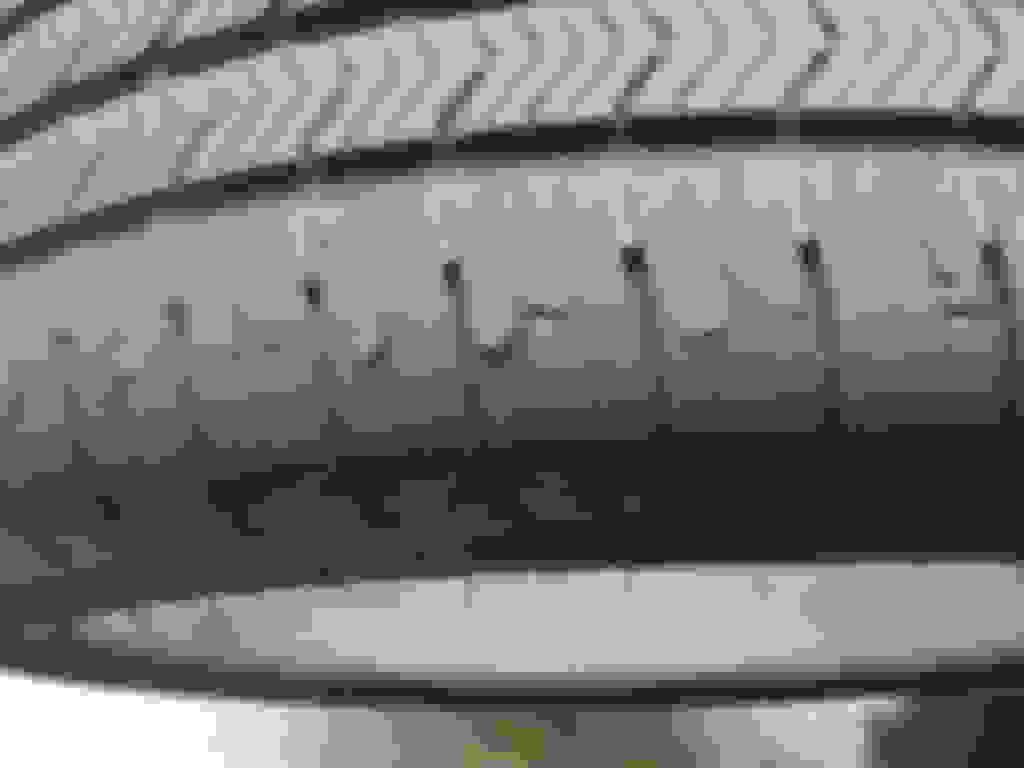
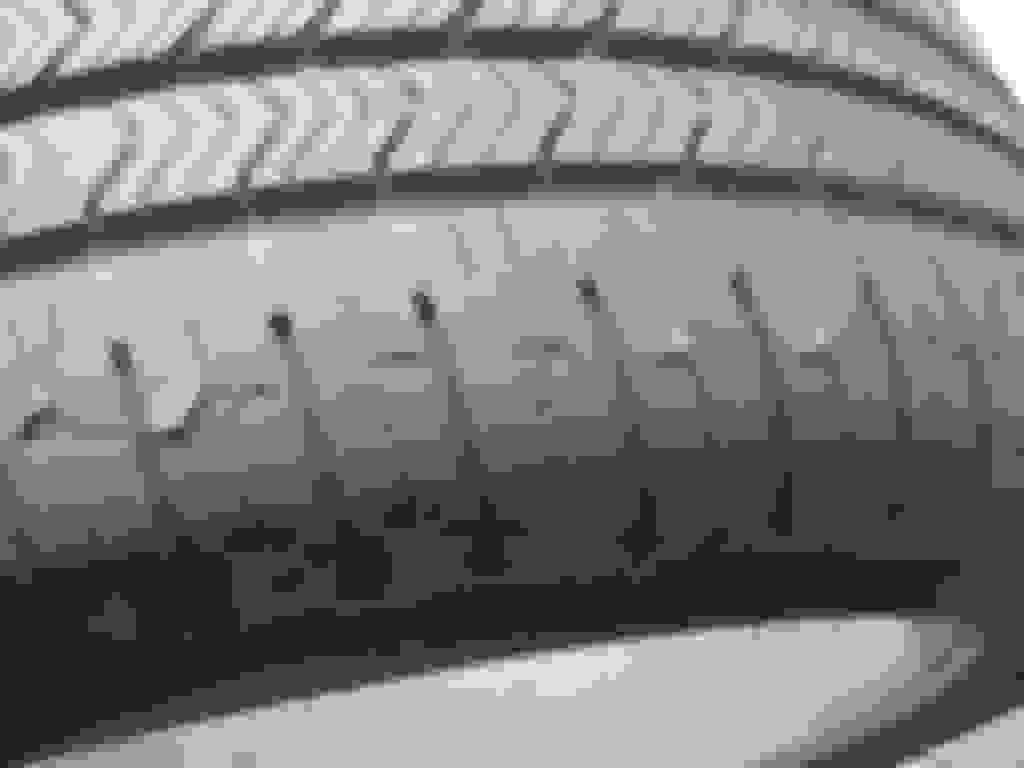
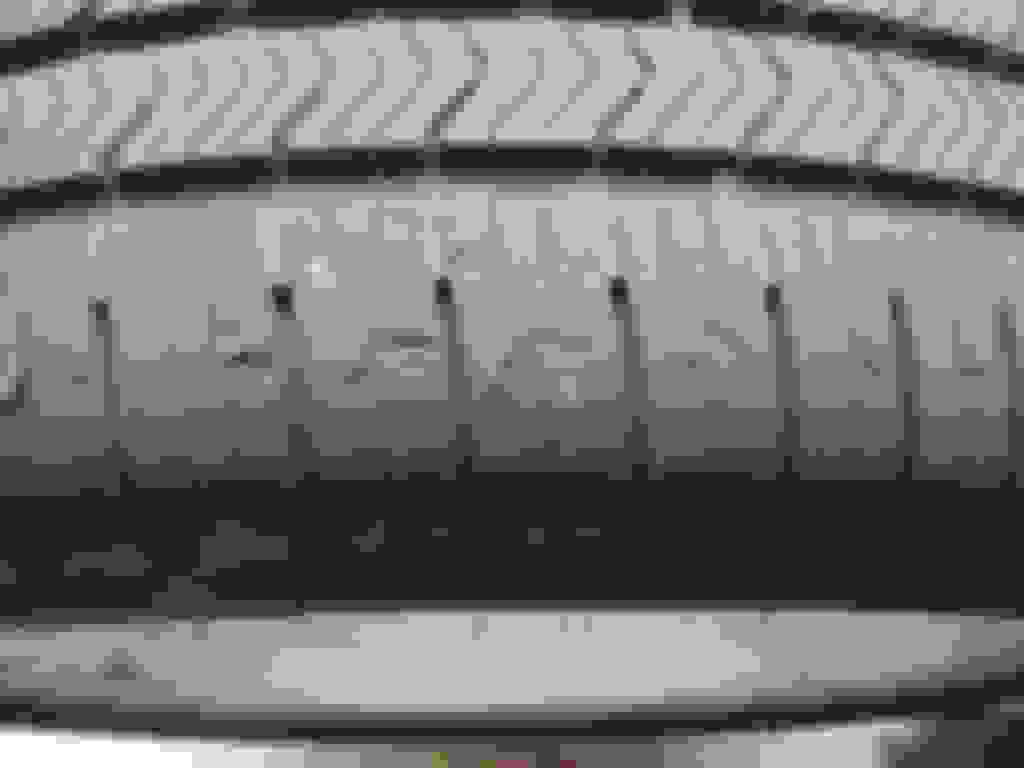
After posting that I haven't had any abnormal tire wear issues in 20K miles this pops up. Tires are about 1/2 worn. The damage in the pictures happened between 15K and 20k miles and showed up on the right front tire during a 5K rotation. I took it to my tire dealer for advise
. Never once did he (the owner) say anything about alignment and in fact said the tire wear was very good across the tread. He said he's seen the same type of damage on high performance cars with independent suspension but doesn't know why. He said it was most common on Porsche. Look where the chunks are coming out. Consistent with the location on pictures of tires that I've seen that went down to the belts. He's a Goodyear dealer and said there wasn't any bulletins that would explain it. Even though the tire is out of warranty he suggested I ask Goodyear so I sent them an email requesting a way to send them the pics. They haven't answered yet.
Somewhere between 13,500mi and the current 19,000mi, 3 of my 4 tires have done this.
They mentioned possible alignment problems. Not sure how this could happen in 5,500mi. Had it for a year and it's very gently driven. Could it be a tire defect? If it is alignment problems is it going to continue 🤷🏼♀️ Sounds like I'm not alone on the issue.
Originally Posted by rbr
Hi all, problem with a 2018 sportbrake here, 26k mi., no damage, potholes or curbed tires.
I know this has been discussed before, and I tried search but got a bunch of garbage. Had a flat today, and both rear tires are worn through the steel belts, only on the inner 1.5 inches of the tread. Over half the tread remains on the rest of the affected rear tires. Clearly an alignment issue, so, have any of you who have had this issue received a satisfactory explanation and/or repair? Car is still under warranty, so if there is a TSB or other service advice that would be helpful, too. Thanks.
Having had this problem I ran my new tyres for six months around 4000 and took the car to my tyre garage to have the tyres checked and rotated. No adverse wear on the inner edges yet. I asked for the tyres to be rotated on the rims only to be told the tyres are directional so it can't be done. Changing the left rear to the right rear still means it is the same inner edge on the road. Stupid tyre.
I think this is a fault with the rear alignment on the XF that Jaguar are fully aware of but don't want anything to do with. They might even have corrected the problem with the newer model as mine is a 2013 car and there was a new model I think after 2015. I would suggest anyone with a XF get the tracking laser checked and adjusted to as near perfect as possible. Change the rear suspension bushes every couple of years and keep an eye on those inner edges a sit seems to be OK one minute and then tearing chunks off the inner edge the next.
...I think this is a fault with the rear alignment on the XF that Jaguar are fully aware of but don't want anything to do with.......
My $.02 ........... The drive wheel is the right rear on all cars (that I'm aware of). With IRS you get just that corner squatting down under acceleration and it changes the alignment dynamics. If the suspension were made more stiff to prevent the squatting it would make the ride too stiff for a sedan. Hence the tire on that corner gets beat up more than the others.
I thought the drive wheels were both the left and right rear, with the differential powering both wheels and allowing different rotational speeds for each wheel as the car goes around corners.
I thought the drive wheels were both the left and right rear, with the differential powering both wheels and allowing different rotational speeds for each wheel as the car goes around corners.
Unless you have a limited slip differential (LSD) only one wheel drives. Unless I'm wrong the X260 doesn't come with LSD or offer it as an option. But you are correct about the purpose of the differential in cornering.
Well, that does surprise me. I agree that a LSD allows power to be directed to the rear wheel that has traction. This solves the issue of when one rear wheel loses traction (on ice or in snow for example), a standard differential directs all the power to this wheel which just spins, rendering forward motion impossible. But surely, normally when both rear wheels have traction, the differential (either standard or LSD) directs power to both rear wheels? That's why each rear wheel has a drive shaft.
Well, that does surprise me. I agree that a LSD allows power to be directed to the rear wheel that has traction. This solves the issue of when one rear wheel loses traction (on ice or in snow for example), a standard differential directs all the power to this wheel which just spins, rendering forward motion impossible. But surely, normally when both rear wheels have traction, the differential (either standard or LSD) directs power to both rear wheels? That's why each rear wheel has a drive shaft.
The way it was explained to me, by someone much more knowledgeable on the subject (that wouldn't take much I admit ) the power to both wheels is equal because it comes from the same ring gear but one takes the lead due to clearances in the differential gears, and there's several of them.. The explanation came from a tire dealer when I asked him why on all my cars the right rear always exhibited more wear than the other tires on all my cars. "It's because that's the main drive wheel" even though power is routed to both axles. Positraction was developed to in effect (but not actually) lock the axles together when going straight. Someone correct me if after all these years of believing there's a main drive wheel is wrong. Look at your right rear inner tread ..... you'll see it wears quicker than the other tires.
Last edited by mleskovar; Apr 9, 2022 at 07:32 PM.
The way it was explained to me, by someone much more knowledgeable on the subject (that wouldn't take much I admit ) the power to both wheels is equal because it comes from the same ring gear but one takes the lead due to clearances in the differential gears, and there's several of them.. The explanation came from a tire dealer when I asked him why on all my cars the right rear always exhibited more wear than the other tires on all my cars. "It's because that's the main drive wheel" even though power is routed to both axles. Positraction was developed to in effect (but not actually) lock the axles together when going straight. Someone correct me if after all these years of believing there's a main drive wheel is wrong. Look at your right rear inner tread ..... you'll see it wears quicker than the other tires.
You need to take the car to a real suspension shop. They will use these. They will grind out the bolt holes
Also these are required to be replaced when doing suspension work. They are a wear part. Did they look at this? It senses ride height so if the car thinks it is riding higher than it it really less it will settle down and wear the side and vica versa.
THIS IS WORDING FROM PARTS CATALOG: RED DOLOR MY EMPHASIS
Arm. Nut. Retainer. Control. Cntl. (Rear, Lower)
Part Number: T2H3176 Part cannot be reused/reinstalled. Suspension Control Arm Nut. Suspension Ride Height Sensor Bracket.. Lock. Suspension Ride Height Sensor Bracket.
Suspension Control Arm NutSuspension Ride Height Sensor Bracket
Fits E-Pace, F-Pace, I-Pace, XE, XF
Suspension Control Arm - Repair or Replace
Control arms often don’t fail on their own, although their associated bushings can break or wear causing a clunk noise when your Jaguar goes over bumps or changes speed rapidly—whether braking or under hard acceleration. Control arms can also sometimes become bent, causing your vehicle to pull to the left or right.
Interesting seeing this old thread resurrected. FWIW, a tad more toe solved my problem and I now have almost 40K on the replacement tires with very even wear.
Interesting seeing this old thread resurrected. FWIW, a tad more toe solved my problem and I now have almost 40K on the replacement tires with very even wear.
Hi all, problem with a 2018 sportbrake here, 26k mi., no damage, potholes or curbed tires.
I know this has been discussed before, and I tried search but got a bunch of garbage. Had a flat today, and both rear tires are worn through the steel belts, only on the inner 1.5 inches of the tread. Over half the tread remains on the rest of the affected rear tires. Clearly an alignment issue, so, have any of you who have had this issue received a satisfactory explanation and/or repair? Car is still under warranty, so if there is a TSB or other service advice that would be helpful, too. Thanks.
I had this issue on 2017 XF. Its the bushings in the rear lateral link. They have worn and their radial rate is too compliant. Have the tech pry on bushing when wheel up off load. Statically as in on an alignment rack they will center and will be fine so alignment will not detect. But in reverse, especially backing and turning (into parking spot) the link is weaker and allows the suspension to toe in significantly , putting wheel off square and wearing edges. I had both rear links replaced as I didnt want to source cheap bushings and then pay as much labor so just buy the link. No problems since replaced. ( I have experience as a suspension engineer.)
I'm fairly certain that my XF has the very same rear alignment issue thanks to the information provided in this Forum.
I recently purchased an AWD 2018 XF that is just beyond factory warranty. Over the past 4,000 miles I've noticed a vibration through the steering wheel but mostly through the seat and floor board at speeds greater than 60 mph. Tire air pressure changes only provided temporary relief.
Prior to purchasing the car I noticed from the CarFax that the previous owner had numerous wheel alignments along with tire and wheel replacements. I assumed regular pothole damage but now sense that the issue is a poor design. So...I'm off to see if the rear toe can be brought in. If that doesn't solve the problem I'll look to replace the upper links. I'll provide updates as I go through the process. Ugh.
This is my second XF. My previous one was a 2016 35t Prestige and I have since regretted trading it in on a SUV. Ergo, buying this 2016 XF 35t Portfolio.
....Prior to purchasing the car I noticed from the CarFax that the previous owner had numerous wheel alignments along with tire and wheel replacements. I assumed regular pothole damage but now sense that the issue is a poor design.....
If it's a design problem we'd all have it. Check your rims for damage. Just rotating tires may point it out unless the fronts have a damaged rim as well.






 ) the power to both wheels is equal because it comes from the same ring gear but one takes the lead due to clearances in the differential gears, and there's several of them.. The explanation came from a tire dealer when I asked him why on all my cars the right rear always exhibited more wear than the other tires on all my cars. "It's because that's the main drive wheel" even though power is routed to both axles. Positraction was developed to in effect (but not actually) lock the axles together when going straight. Someone correct me if after all these years of believing there's a main drive wheel is wrong. Look at your right rear inner tread ..... you'll see it wears quicker than the other tires.