


Low common rail fuel pressure


Thread Starter
|
Junior Member
Joined: Aug 2017
Posts: 3
Likes: 0
From: Chelmsford
 Low common rail fuel pressure
2008 XF 2.7D has intermittant starting problem, took it to a specialist and they said it has an intermittant low pressure in the common rail which stops it starting. Once running it runs fine but may have to crank it over for twenty seconds first. They have suggested it could be a leaky injector or the high pressure fuel pump. Has anyone else come across this problem before?

Senior Member
Joined: Mar 2016
Posts: 859
Likes: 322
From: Auckland NZ/ Houston, TX
Hi Jeff
Do you have any DTC's that might be logged? If not, one thing to look at is the fuel pressure on the high side while cranking. The pressure needs to be at 150 or higher. I had a vehicle doing something the same thing, but found that at cranking, it was taking several revolutions to make over 150bar, then the engine would start. This was caused by a weak high pressure pump ( which sits in the center of engine, in rear ). It "could" be injectors as well. There is a spill test that can be done to make sure the return amount is the same, if not, then you have a faulty injector. I would see about taking it to someone who can watch the pressure while cranking to rule out the high pressure pump. Below is information directly from Topix, hope this helps.
Published: 11-May-2011
2008.25 X250, 303-04
Fuel Charging and Controls - TDV6 2.7L Diesel
Fuel Charging and Controls - System Operation and Component Description (G970138)
DESCRIPTION AND OPERATION
Loading...
System Operation
Engine Starting
During starting, the fuel rail pressure must be at least 150 bar (2175 lbf/in²). Should the pressure be below this figure, the injectors will not operate, resulting in the vehicle not starting.
Engine Stopped
To stop the engine the ECM (engine control module) stops energizing the piezo actuators, therefore, no fuel is injected and the engine speed drops to zero.
Refer to: Electronic Engine Controls (303-14 Electronic Engine Controls - 2.7L Diesel, Description and Operation).
Component Description
LP System
In-tank Fuel Pump
The electric fuel pump is located inside the fuel tank. Fuel is pumped from the tank via the in-tank fuel pump, to the HP pump via the fuel filter.
Refer to: Fuel Tank and Lines (310-01 Fuel Tank and Lines - 2.7L Diesel, Description and Operation).
Fuel Filter
The fuel filter is located in the engine compartment on the left hand side, packaged to be protected against damage. Incorporated in the fuel filter housing is a bimetallic temperature valve, which will start to close at 30 °C (86 °F) and will fully close at 50 °C (122 °F). This allows pre-heated diesel fuel to circulate inside the fuel filter to prevent waxing in cold operating conditions.
Refer to: Fuel Tank and Lines (310-01 Fuel Tank and Lines - 2.7L Diesel, Description and Operation).
Fuel Cooler
Two fuel coolers are fitted to the vehicle. One is located in the 'vee' of the engine block, and has a coolant system connection to aid heat transfer. The second cooler is located in the fuel return line and is a fuel to air cooler.
Refer to: Fuel Tank and Lines (310-01 Fuel Tank and Lines - 2.7L Diesel, Description and Operation).
HP System
HP Pump

The HP pump is a three-piston (120 degree apart) radial plunger pump with a HP displacement of 0.8 cc (0.05 in³). As mentioned, it has the ability to produce a maximum pressure of 1650 bar (23930 lbf/in²). The housing is cast from iron, the flange is cast from aluminum.
The HP pump is driven from the camshaft via a toothed belt. It does not need to be timed to the engine during belt replacement in service.
The required supply pressure to the HP pump is -0.3 to +0.5 bar (-4.4 to 7.25 lbf/in²). The return pressure is -0.3 bar to +0.8 bar (-4.4 to 11.6 lbf/in²).
The pump is sized to deliver sufficient fuel to the fuel rails for all engine-operating conditions.
The HP pump consists of the following components:
The VCV is a variable position solenoid valve electronically controlled by the ECM. The VCV is located between the ITP and the HP pumping elements. The VCV determines the amount of fuel that is delivered to the HP pumping elements. When there is no signal to the VCV the valve is closed and there is no fuel delivery.
The three HP pumping elements are connected together in a fuel ring circuit within the pump. There is a single HP outlet connection for the HP pipe to the HP diverter rail.
The PCV is a variable position solenoid valve electronically controlled by the ECM. The PCV is located between the HP pumping elements and the HP outlet connection. The PCV regulates the amount of fuel pressure in the fuel rails. When there is no signal to the PCV the valve is open, therefore no fuel rail pressure can be generated.
Component Location
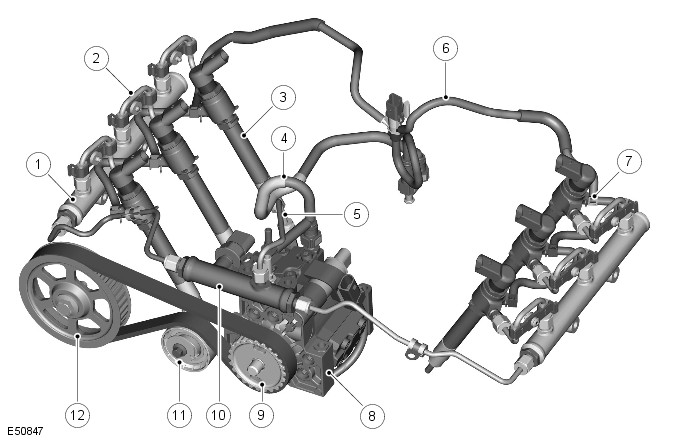
ItemDescription1Fuel rail (2 off)
2HP (high pressure) pipe - fuel rail to injector (6 off)
3Fuel injector (6 off)
4LP (low pressure) pipe - fuel return
5HP pipe - HP pump to fuel diverter rail
6LP pipe - injector leak-back
7LP pipe connection to injector
8HP pump
9HP pump pulley
10HP diverter rail
11READ (rear end accessory drive) belt tensioner
12LH (left-hand) exhaust camshaft pulley
Do you have any DTC's that might be logged? If not, one thing to look at is the fuel pressure on the high side while cranking. The pressure needs to be at 150 or higher. I had a vehicle doing something the same thing, but found that at cranking, it was taking several revolutions to make over 150bar, then the engine would start. This was caused by a weak high pressure pump ( which sits in the center of engine, in rear ). It "could" be injectors as well. There is a spill test that can be done to make sure the return amount is the same, if not, then you have a faulty injector. I would see about taking it to someone who can watch the pressure while cranking to rule out the high pressure pump. Below is information directly from Topix, hope this helps.
Published: 11-May-2011
2008.25 X250, 303-04
Fuel Charging and Controls - TDV6 2.7L Diesel
Fuel Charging and Controls - System Operation and Component Description (G970138)
DESCRIPTION AND OPERATION
Loading...
System Operation
Engine Starting
During starting, the fuel rail pressure must be at least 150 bar (2175 lbf/in²). Should the pressure be below this figure, the injectors will not operate, resulting in the vehicle not starting.
Engine Stopped
To stop the engine the ECM (engine control module) stops energizing the piezo actuators, therefore, no fuel is injected and the engine speed drops to zero.
Refer to: Electronic Engine Controls (303-14 Electronic Engine Controls - 2.7L Diesel, Description and Operation).
Component Description
LP System
In-tank Fuel Pump
The electric fuel pump is located inside the fuel tank. Fuel is pumped from the tank via the in-tank fuel pump, to the HP pump via the fuel filter.
Refer to: Fuel Tank and Lines (310-01 Fuel Tank and Lines - 2.7L Diesel, Description and Operation).
Fuel Filter
The fuel filter is located in the engine compartment on the left hand side, packaged to be protected against damage. Incorporated in the fuel filter housing is a bimetallic temperature valve, which will start to close at 30 °C (86 °F) and will fully close at 50 °C (122 °F). This allows pre-heated diesel fuel to circulate inside the fuel filter to prevent waxing in cold operating conditions.
Refer to: Fuel Tank and Lines (310-01 Fuel Tank and Lines - 2.7L Diesel, Description and Operation).
Fuel Cooler
Two fuel coolers are fitted to the vehicle. One is located in the 'vee' of the engine block, and has a coolant system connection to aid heat transfer. The second cooler is located in the fuel return line and is a fuel to air cooler.
Refer to: Fuel Tank and Lines (310-01 Fuel Tank and Lines - 2.7L Diesel, Description and Operation).
HP System
HP Pump
The HP pump is a three-piston (120 degree apart) radial plunger pump with a HP displacement of 0.8 cc (0.05 in³). As mentioned, it has the ability to produce a maximum pressure of 1650 bar (23930 lbf/in²). The housing is cast from iron, the flange is cast from aluminum.
The HP pump is driven from the camshaft via a toothed belt. It does not need to be timed to the engine during belt replacement in service.
The required supply pressure to the HP pump is -0.3 to +0.5 bar (-4.4 to 7.25 lbf/in²). The return pressure is -0.3 bar to +0.8 bar (-4.4 to 11.6 lbf/in²).
The pump is sized to deliver sufficient fuel to the fuel rails for all engine-operating conditions.
The HP pump consists of the following components:
- ITP (internal transfer pump).
- VCV (volume control valve).
- HP pumping elements (3 off).
- PCV (pressure control valve).
The VCV is a variable position solenoid valve electronically controlled by the ECM. The VCV is located between the ITP and the HP pumping elements. The VCV determines the amount of fuel that is delivered to the HP pumping elements. When there is no signal to the VCV the valve is closed and there is no fuel delivery.
The three HP pumping elements are connected together in a fuel ring circuit within the pump. There is a single HP outlet connection for the HP pipe to the HP diverter rail.
The PCV is a variable position solenoid valve electronically controlled by the ECM. The PCV is located between the HP pumping elements and the HP outlet connection. The PCV regulates the amount of fuel pressure in the fuel rails. When there is no signal to the PCV the valve is open, therefore no fuel rail pressure can be generated.
Component Location
ItemDescription1Fuel rail (2 off)
2HP (high pressure) pipe - fuel rail to injector (6 off)
3Fuel injector (6 off)
4LP (low pressure) pipe - fuel return
5HP pipe - HP pump to fuel diverter rail
6LP pipe - injector leak-back
7LP pipe connection to injector
8HP pump
9HP pump pulley
10HP diverter rail
11READ (rear end accessory drive) belt tensioner
12LH (left-hand) exhaust camshaft pulley
Veteran Member


Joined: Feb 2014
Posts: 9,021
Likes: 3,658
From: Adelaide, South Australia
It's funny how every XF and F-Type Workshop Manual I have downloaded (four so far) and every tOPIX report I have seen all say "2 off" or "4 off" or "6 off" when referring to multiple identical parts, when they really mean "of" not "off". I reckon they must all be compiled in China!
Thread Starter
|
Junior Member
Joined: Aug 2017
Posts: 3
Likes: 0
From: Chelmsford
The place I took it to did say that on cranking it sometimes was low but he could not say whether that was caused by a faulty injector or the high pressure pump. He suggested getting an old injector pipe blocking it off then trying it in each outlet from the rail to 'isolate each injector one at a time to see which one may be causing the problem. Trouble is though, as its intermittent it may not be so obvious. Not sure whether to just get a second hand hp pump and try that first? Injectors could end up costing around £200 each to be overhauled so just trying to think of the cheapest option, or second hand sets of injectors are around £300 on ebay, but there is no guarantee second hand parts are fine either. Its a bit of a conundrum, but sending it to a dealer at £168 an hour is an expensive option......

Joined: Jun 2021
Posts: 1
Likes: 0
2008 XF 2.7D has intermittant starting problem, took it to a specialist and they said it has an intermittant low pressure in the common rail which stops it starting. Once running it runs fine but may have to crank it over for twenty seconds first. They have suggested it could be a leaky injector or the high pressure fuel pump. Has anyone else come across this problem before?

Junior Member
Joined: Mar 2024
Posts: 2
Likes: 0
Hi,
I have the same problem. There is no DTC recorded, sometimes takes up to 10 seconds and sometimes it start up inmediatly.
Checked battery, start engine, changed filters using genuine, checked fuel pump with 0.5 bar after and before fuel filter, and finally checked rail pressure with SDD when goes fine pressure is 200bar but when fails it goes up to 140bar so slowly and then start up.
Next step, leaking test to the injectors.
I have the same problem. There is no DTC recorded, sometimes takes up to 10 seconds and sometimes it start up inmediatly.
Checked battery, start engine, changed filters using genuine, checked fuel pump with 0.5 bar after and before fuel filter, and finally checked rail pressure with SDD when goes fine pressure is 200bar but when fails it goes up to 140bar so slowly and then start up.
Next step, leaking test to the injectors.

Thread
Thread Starter
Forum
Replies
Last Post
KenAdamson
S-Type / S type R Supercharged V8 ( X200 )
37
May 26, 2020 04:40 AM
Currently Active Users Viewing This Thread: 1 (0 members and 1 guests)