When you click on links to various merchants on this site and make a purchase, this can result in this site earning a commission. Affiliate programs and affiliations include, but are not limited to, the eBay Partner Network.
Low miles , one owner. Mechanics here in LA have me scared about the coolant lines in that car, telling me they leak a lot because they're made of plastic?
What's your experience with the most beautiful cat on earth?
Thank you Cheers!
Be afraid. It's the number 1 problem that sends these cars to the junkyard because when the coolant system fails, very likely you will need a engine. Do a search on here to see all the solutions. I personally switch to waterless coolant that eliminates the pressure in the cooling system because there is no water to turn to steam. The pressure is what cracks open the plastic and also causes the water pump seals to leak.
Very good thanks, I didn't know water less coolant existed. I shall do that after I receive the car in January.
Cheers
Yes, the sooner the better. These cars can have coolant system failures very early in their life with low miles. I have seen just a few years old with 20K miles have a plastic pipe start leaking.
Yes a known problem that you can solve?
Do you check the fluid levels in your car regularly?
There are Aluminum replacement pipes which we have dozen of threads on. You can find all you need with some simple searches.
If you can't DIY the repairs and your out of warranty a used Jaguar will be very expensive to own.
.
.
.
Low miles , one owner. Mechanics here in LA have me scared about the coolant lines in that car, telling me they leak a lot because they're made of plastic?
What's your experience with the most beautiful cat on earth?
Thank you Cheers!
Mine is a 2019 XJL Portfolio. At only 24,000 miles it sprung a leak in the thermostat housing. Cost about $700.00 and just a month out of warranty.
Be afraid. It's the number 1 problem that sends these cars to the junkyard because when the coolant system fails, very likely you will need a engine. Do a search on here to see all the solutions. I personally switch to waterless coolant that eliminates the pressure in the cooling system because there is no water to turn to steam. The pressure is what cracks open the plastic and also causes the water pump seals to leak.
Do you have any scientific reasons why I should pay 5x the cost of normal ethylene glycol-based coolant to switch to waterless besides "lower pressure", anecdotal evidence, and whatever self-serving drivel the Evans marketing team has come up with? Fact 1: The Evans coolant is over $50 per gallon. Fact 2: You're never going to be able to flush the cooling system clean enough to match their advertised chemistry unless you start with bare block. Fact 3: The Evans coolant has much poorer thermal conductivity (so bad that they won't publish it) and specific heat than the 50/50 mix of OE specified coolant and water which means your thermostat will be running a higher duty cycle to maintain the same engine temp. Jaguar designed in an undisclosed amount of thermal capacity "headroom" in the cooling system and using a poorer thermal conductor reduces that headroom.
If high system pressure is the root cause of coolant system part failure, of which a significant percentage are under warranty (regardless of brand), why wouldn't OEs specify it from the factory?
The real key for me was all the information from this forum. When I saw all the cooling pipe issues I understood where and what the car's problems are.
If you stay on top of fluid levels and open the hood to check things. You can catch any leaks when they first start.
The disasters come from clueless owners who treat the car like an appliance and drive it until destruction occurs! We have had multiple people who even after getting the engine replaced STILL refuse to check fluid levels. One guy blew up his engine 3 weeks after it had been replaced. He had NEVER checked fluid levels since he got the car back from the shop.
Again and again when you get any over heating shut the car down NOW! DO NOT drive home or to the next exit. Wherever your at turn the car off and call for a tow.
.
.
.
My coolant level seems to be low after they just put in the new thermostat housing. I went back and they topped it off but now it's at the "low" line. I'll keep watch! EDIT: Just noticed an air hose is disconnected! See top center in this photo. I can perhaps fix that, but maybe the mechanic should do the job right?
The disasters come from clueless owners who treat the car like an appliance and drive it until destruction occurs! We have had multiple people who even after getting the engine replaced STILL refuse to check fluid levels. One guy blew up his engine 3 weeks after it had been replaced. He had NEVER checked fluid levels since he got the car back from the shop.
.
Very true. But for the mass majority of drivers, that's just what a car is.
The relative few such as those of us that are regulars to The Forum consider our vehicles (and other stuff too) as something more than a black box of magic that does mystical things that are only for the enlightened to understand.
They get in their cars, turn the key & go where they need to get to.
We get in, look, listen & feel & think about what's going on in & around our machine that doesn't seem right.
Just think how the farmer & hunter sees the mass majority of people (especially urbanites like NYC & LA types) that couldn't feed themselves without a well-stocked grocery store and restaurants that they rely on to survive,
Same things.
Do you have any scientific reasons why I should pay 5x the cost of normal ethylene glycol-based coolant to switch to waterless besides "lower pressure", anecdotal evidence, and whatever self-serving drivel the Evans marketing team has come up with? Fact 1: The Evans coolant is over $50 per gallon. Fact 2: You're never going to be able to flush the cooling system clean enough to match their advertised chemistry unless you start with bare block. Fact 3: The Evans coolant has much poorer thermal conductivity (so bad that they won't publish it) and specific heat than the 50/50 mix of OE specified coolant and water which means your thermostat will be running a higher duty cycle to maintain the same engine temp. Jaguar designed in an undisclosed amount of thermal capacity "headroom" in the cooling system and using a poorer thermal conductor reduces that headroom.
If high system pressure is the root cause of coolant system part failure, of which a significant percentage are under warranty (regardless of brand), why wouldn't OEs specify it from the factory?
First of all, you're a jerk. Second of all, it's the last time you ever have to change coolant, so it saves money over the long run, and how much does a water pump, a whole set of new plastic pipes, or an overheated and destroyed engine cost?? Geez. Yes, up to 29 psi in the system (cap pressure) is what blows out water pump seals, oil cooler seals, and plastic coolant pipes and thermostat.
Third, you are 100% wrong about being able not being able to flush out the system. The amount of water in the coolant is measured with a low cost and very accurate instrument. On our Mercedes, I got water down to almost zero by blowing out the old coolant, and on the Jags and Range Rovers, down under 3%. Man are you're arrogant and ignorant. Bad combo.
Duty cycle for a thermostat?? That's just a very stupid thing to bring up. Do you think an elf runs into the engine bay to open and close the thermostat?? Look up how they work before saying something so irrelevant as if it's important.
Our Range Rover Sport is at 100K miles on Evans coolant. It never overheats, or even gets hotter than normal, in the brutal South Texas heat and humidity. I just did a Blackstone Labs oil analysis and it came back in excellent condition. It has its original water pump from 2014 with 150K miles on it and all the original plastic. No coolant leaks whatsoever. So all your fear mongering with fabrications you made up in your head pretending to be a scientist is ridiculous. If it was bad for the engine, after 100K miles, it would show up in the oil analysis.
Why doesn't Jag run it?? Why didn't they get rid of the plastic in the first place?? Because car manufacturers do stupid things. Look at all the design problems with current diesel engines, GM's cylinder deactivation, gas engines with wet cam belts, Porsche with their IMS for over 10 years, etc. Try to think before posting rubbish on here.
Last edited by lotusespritse; Feb 7, 2025 at 10:03 PM.
When using 50-50 mix should we top off the coolant tank to the cold full line or the cold low line? What I mean is, from the standpoint of pressure in the system should we leave space for expansion? The mechanic at Jag over filled it.
The coolant level in the expansion tank continues to go down after replacing the thermostat housing. I'm wondering if pressure testing the system, if done wrong, can cause another leak somewhere else? So far, I don't see any water leaks, but the level in the tank drops from the high mark to the low mark after only about 5 miles.
The coolant level in the expansion tank continues to go down after replacing the thermostat housing. I'm wondering if pressure testing the system, if done wrong, can cause another leak somewhere else? So far, I don't see any water leaks, but the level in the tank drops from the high mark to the low mark after only about 5 miles.
Very likely it's just the system burping air out. Keep topping it up, keep an eye on it, it should stop going down soon but if not get a leak test done.
Very likely it's just the system burping air out. Keep topping it up, keep an eye on it, it should stop going down soon but if not get a leak test done.
OK thanks. I think the water pump is on the passenger side (left as you look at the motor) and I noticed some fluid on the under tray in that area. Not a lot but enough to worry about it. They did a leak test before replacing the thermostat housing. I just hope they didn't over-pressurize it and cause a new leak.
Just to expand a bit on what OzXFR said about air burping. I have posted before that after using a vacuum filler on my cars I no longer fight any of that.
It really is a superior way to fill the coolant system on these complicated late model cars. I was surprised after the first use as it just worked. No additional fluid or even air bleeding using the bleed screws.
.
.
.
it's the last time you ever have to change coolant,
Except when you need to replace the water pump because the bearings have gone bad. Or need to pull the radiator to service the timing chain. Or need to disconnect the coolant lines to service the supercharger, spark plugs, or valve cover gaskets (which is what I'm doing this weekend, and only required $25 worth of coolant/distilled water versus $150 in Evans coolant).
Originally Posted by lotusespritse
Third, you are 100% wrong about being able not being able to flush out the system... On our Mercedes, I got water down to almost zero by blowing out the old coolant, and on the Jags and Range Rovers, down under 3%.
]
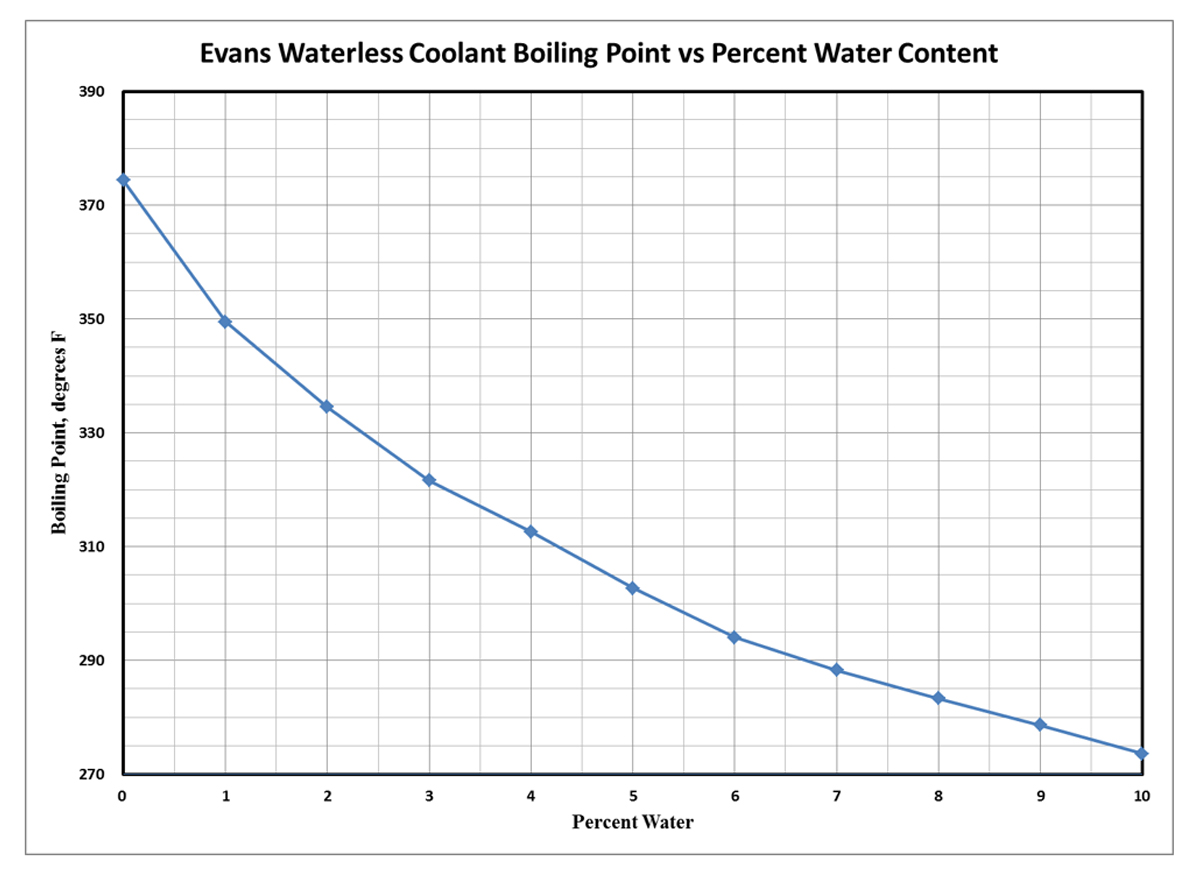
This is anecdotal evidence, and single digit percentages of contamination still make a difference, reference the chart below. But don't worry, Evans will sell you a flush chemical for $30 per gallon. Multiply that by however many times you have to service any of the above.
Originally Posted by lotusespritse
Man are you're arrogant and ignorant. Bad combo.
*you.
Originally Posted by lotusespritse
Duty cycle for a thermostat?? That's just a very stupid thing to bring up.
No, it's quite relevant. Every moving part in a vehicle is designed with duty cycle in mind. By using an objectively less effective coolant, you're increasing the duty cycle which shortens the lifespan of the part.
You didn't even address the issue of specific heat and thermal conductivity, which is probably the biggest drawback of switching to waterless. On our cars the coolant is shared with the charge air cooling system after the supercharger. I'd be curious to see your IATs land in the hot Texas summer, and if your IAM values have been affected compared to a car running 50/50. That has consequences for gas mileage and performance in the extremes.
Originally Posted by lotusespritse
Do you think an elf runs into the engine bay to open and close the thermostat??
No, I think he crawls up your tailpipe and swings a golf club around. Notice how I'm not the one calling you ignorant and stupid. I simply asked you to back up your assertions with empirical data and you are so far unable to do that.
Originally Posted by lotusespritse
Our Range Rover Sport is at 100K miles on Evans coolant. It never overheats, or even gets hotter than normal, in the brutal South Texas heat and humidity. I just did a Blackstone Labs oil analysis and it came back in excellent condition. It has its original water pump from 2014 with 150K miles on it and all the original plastic. No coolant leaks whatsoever.
150K miles on stock cooling components is impressive, but that's still anecdotal evidence.
Originally Posted by lotusespritse
Why didn't they get rid of the plastic in the first place??
Who knows? They may have calculated the cost of in-warranty replacements to be cheaper than cast aluminum parts at first. You may notice that JLR recently updated the coolant crossover pipes to an aluminum design. They don't mandate replacing the coolant with waterless.
You're just WRONG about everything. WRONG!! You can die on this hill, but you are WRONG!!!
So stupid to post that chart and pretend like you a clue what you're talking about. Post what Evans tells you to do. Less than 3%! Geez!
And no, you don't have to replace the coolant when you do service. Absolutely idiotic to claim that you do. Idiotic!! You can catch the coolant, and if needed strain out anything that got in it. You're not going to have to though because the bearings on a water pump fail when the coolant pressure causes the seals to fail. No pressure.
Just quit pretending like you know anything that you are talking about. It just makes you look stupid.
My point stands, it's more expensive and performs worse. Which is why nobody uses it besides museums, owners of pre-war vehicles who never drive them, and one ill-informed XJ owner. I'll exit the thread now though, hopefully some other forum members have learned something from the discussion.
Low miles , one owner. Mechanics here in LA have me scared about the coolant lines in that car, telling me they leak a lot because they're made of plastic?
What's your experience with the most beautiful cat on earth?
Thank you Cheers!
2018 and 2019 XJs have upgraded, seamless plastic pipes. No worries like before, but keep watch on the thermostat, the coolant tank float and the water pump.



 2019 xjl port