When you click on links to various merchants on this site and make a purchase, this can result in this site earning a commission. Affiliate programs and affiliations include, but are not limited to, the eBay Partner Network.
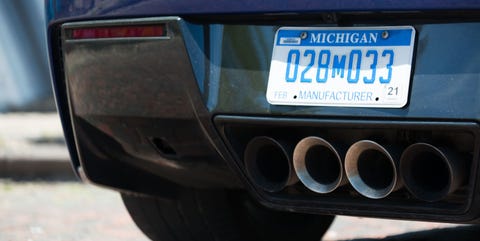
Does anyone else get an insane amount of soot stuck all over the back of the car after driving just a few miles. Is it just my particular car, or is it normal? I've only had it for about 3 weeks, so it's new to me.
No sign of any soot ever on my 2021 R-Dynamic after 2,500 miles.
Even the exhaust pipe endsa er clean
Sounds ike you are running very rich
( you do know it does not like diesel??)
You should expect a fair amount of soot in the exhaust pipes, especially if your running the active exhaust most/all of the time. There are products that will make it a bit less likely to build up and easier to wash off - even a little car wax will help.
If you getting soot on a larger scale across the rear end, then it sounds like something is amiss.
It's definitely a coating across the back of the car. You can run your finger across it and end up with a black finger. I'll have to take a picture of it.
My 2018 V6 soots up the exhaust tips and gets a dusting on the back especially if it’s run in dynamic mode. It’s white so it shows more than darker colors might.
No sign of any soot ever on my 2021 R-Dynamic after 2,500 miles.
Even the exhaust pipe endsa er clean
Sounds ike you are running very rich
( you do know it does not like diesel??)
Modern diesels with DPF have almost zero soot, my old 2010 XFS (3.0 V6 twin turbo diesel) had the cleanest exhaust by far of any car I have ever owned and the exhaust tips stayed perfectly clean for months.
Unlike my V6 F-Type where the insides of the exhaust tips blacken up fairly quickly.
That said I have never noticed any build up of soot on the back end, just in the exhaust tips.
I still think there is big differnce between sooty pipes (preferably inside) and soot deposits on your bodywork.
Perhaps, you are running too rich OR pehaps you are running too SLOW!!
See below:
Why Are Modern Cars' Tailpipes Often Dirty?
Although cars run cleaner than ever, a phenomenon with direct-injection systems makes it not always appear that way.
BY K.C. COLWELL AND BENJAMIN PRESTON
SEP 4, 2018
MICHAEL SIMARI CAR AND DRIVERIn the past, a black tailpipe in a gasoline-powered car meant one thing: a fuel mix that was too rich, or sub-stoichiometric, causing unburned hydrocarbons to coat the inside of the tailpipe. Today’s engines run three-way catalysts to scrub any unburned hydrocarbons that escape the various other emission-control systems, leaving very few to darken our tailpipes.
And yet, many modern tailpipes are blackened. According to John Hoard, an associate research scientist in the mechanical engineering department at the University of Michigan, gasoline direct-injection engines, like diesel engines, have a tendency to produce particulate matter, also known as soot. This unfortunate byproduct is a result of direct injection engines' tendency to produce small clusters of rich air/fuel mixture, as well as coat the cylinder walls with liquid gasoline, leading to what are known as pool fires. These conditions are particularly apparent not during aggressive driving but under low load conditions because the intake velocity isn't sufficient to generate the swirling effect needed to effectively mix fuel and air and eliminate any rich areas. Toyota and Ford, among others, have switched to dual injection (both port and direct fuel injectors) in part to combat this phenomenon and increase overall efficiency.
Modern diesel engines have particulate filters to counter soot production. Diesel particulate filters occasionally run a regeneration mode in which the exhaust temperature is increased and the trapped soot burns off, reducing filter pressure. In most cars this happens in the background without the driver having any knowledge of its occurrence, though owners of modern diesel vehicles know when this happens as fuel economy drops precipitously. Gas engines in the States are soon to follow their compression-ignition brethren and Volkswagen has even introduced particulate filters for a few of its engines in overseas markets, notably the turbocharged 1.0-liter inline-three in the Up! GTI.
I still think there is big differnce between sooty pipes (preferably inside) and soot deposits on your bodywork.
Perhaps, you are running too rich OR pehaps you are running too SLOW!!
See below:
Why Are Modern Cars' Tailpipes Often Dirty?
Although cars run cleaner than ever, a phenomenon with direct-injection systems makes it not always appear that way.
BY K.C. COLWELL AND BENJAMIN PRESTON
SEP 4, 2018
MICHAEL SIMARI CAR AND DRIVERIn the past, a black tailpipe in a gasoline-powered car meant one thing: a fuel mix that was too rich, or sub-stoichiometric, causing unburned hydrocarbons to coat the inside of the tailpipe. Today’s engines run three-way catalysts to scrub any unburned hydrocarbons that escape the various other emission-control systems, leaving very few to darken our tailpipes.
And yet, many modern tailpipes are blackened. According to John Hoard, an associate research scientist in the mechanical engineering department at the University of Michigan, gasoline direct-injection engines, like diesel engines, have a tendency to produce particulate matter, also known as soot. This unfortunate byproduct is a result of direct injection engines' tendency to produce small clusters of rich air/fuel mixture, as well as coat the cylinder walls with liquid gasoline, leading to what are known as pool fires. These conditions are particularly apparent not during aggressive driving but under low load conditions because the intake velocity isn't sufficient to generate the swirling effect needed to effectively mix fuel and air and eliminate any rich areas. Toyota and Ford, among others, have switched to dual injection (both port and direct fuel injectors) in part to combat this phenomenon and increase overall efficiency.
Modern diesel engines have particulate filters to counter soot production. Diesel particulate filters occasionally run a regeneration mode in which the exhaust temperature is increased and the trapped soot burns off, reducing filter pressure. In most cars this happens in the background without the driver having any knowledge of its occurrence, though owners of modern diesel vehicles know when this happens as fuel economy drops precipitously. Gas engines in the States are soon to follow their compression-ignition brethren and Volkswagen has even introduced particulate filters for a few of its engines in overseas markets, notably the turbocharged 1.0-liter inline-three in the Up! GTI.
Makes sense, I notice the insides of the tailpipes blacken up much quicker if I just pootle about in the 'burbs but not so after a spirited run.
Interesting. I could never figure out why the pipes would soot up whenever my wife is going along for a ride.
A film of soot should take much more than a day of driving to build up on the rear bodywork. I’d have the mixture looked at. Do you have any obvious oil consumption?
I would expect most of any soot discharge to be left in your wake, not on the car, suggesting the problem is probably bigger than you think.
I’ve only had it for about 3 weeks and other than the ~700 mile trip home, I’ve only had a chance to drive it a few times. I’ll have to check the oil. I didn’t bother when I got it because the dealer had just done an oil change.
It also has another 18 months on the factory warranty and was sold as a CPO through 12/24. I’m not worried about the repair bill, but wasn’t sure if this was normal or not?
I used to be a tuner, but forgive my ignorance when it comes to these cars. My experience lies with 4G63T motors. Had one of those little buggers putting down 436WHP at 29psi of boost. Anyway, I would think things would be similar.
Wouldn’t a rich condition cause a fuel trim malfunction CEL? Unless all the soot is being generated at WOT in which case the O2 sensor voltage is probably ignored. Provided it’s like what I’m used to tuning.
Originally Posted by Unhingd
I’d have the mixture looked at.
Other than a WBO2, which I don’t have anymore, I don’t know of any way for me to check the AFR.
Interesting article. Wasn't the idea of Direct Injection is to reduce emissions, not increase them? How did this pass EPA?
Only coz the EPA is fixated on the eeeevil CO2 as an "emission" (it's not a pollutant in any sense) and GDI increases combustion efficiency thereby increasing fuel economy and reducing CO2.
I have a new to me 2017 white AWD S with 27k miles.
I have the same issue, under normal driving the soot collects moderately fast, with spirited driving the soot collects like crazy.
No issue - it's a byproduct of our delightful exhaust tones. Effectively, you're getting small backfires and the soot is the residual. It's gas, not oil. You can coat the tips to slow down the accumulation, but it's pretty easy to just wipe off.
Brake dust is more of a pain, since there are 4 wheels with nooks and crannies. For that, the Porterfield pads are a definite improvement.
Does anyone else get an insane amount of soot stuck all over the back of the car after driving just a few miles. Is it just my particular car, or is it normal? I've only had it for about 3 weeks, so it's new to me.
There’s no doubt that here and there I’ve removed a bit of soot from the exhaust tips, but I’ve never had any sense that there was soot buildup on the paint on the entire back of the car. Nothing like that at all, granted my car is pretty new.



 Exhaust Soot