When you click on links to various merchants on this site and make a purchase, this can result in this site earning a commission. Affiliate programs and affiliations include, but are not limited to, the eBay Partner Network.
They didn't teach us about thermo-dynamics in grammar school, so I am hoping someone here can answer my question. I recently bought my 1963 Mk2 online and I am really enjoying the driving experience. The car was 'restored' in the mid 90's and air conditioning was installed at that time. Because the owner lived in Louisiana (?) the air-con upgrade was apparently a significant feature. He enveloped the majority of the pipework and associated parts with some kind of adhesive heat-shield material, presumably to maintain cooler temperatures in the pipes and condensers.
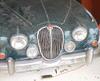
As you can see in the attached photo, he also covered the entire under-surface of the bonnet with the same material. I live here in North Dakota and this summer it got pretty warm. So I was able to see how efficient this configuration was. The blower does blow a good amount of cold air into the cab but my concern is with the incredible heat that builds up under the bonnet. Is this normal for the Mk2 or does my version have a modification that perhaps could (should) be removed?
Cozy under-bonnet
Of all the cars in my collection, this Mk2 definitely has the tightest layout under the hood! Thank goodness I have 'lady-hands' now I just need to get fire-proof gloves.
That silver stuff is frequently used. It looks wrong but is pretty normal. Jaguar originally used a glass fibre material. This is original from an S Type. I think the Mk2 used Hardura felt. You need to check a parts manual.
This is original S Type and best preserved I know of.
credit Alan Wiedie
Barratts used to sell this kit. This is what I used sans the scuttle piece which is not original:
Mine:
Here is another car using a variation of that silver stuff.
Last edited by Glyn M Ruck; Jul 8, 2023 at 02:40 AM.
Yeah Bill ~ wise advice as usual. They get damn hot under the bonnet other than the innards of the carbs which get darn cold. Close to freezing point. I've jury rigged a Fluke into mine and seen 4 deg C & they get colder. Don't mess with the dashpot SAE 20W. (which is now synthetic & even better as it is high VI ~ Viscosity Index)
Last edited by Glyn M Ruck; Jul 8, 2023 at 04:50 AM.
My car has no lining to the bonnet. I don't remember it ever having anything. If it was lost, it must have been in its first five years. There is the usual spray on treatment, the same as the bulkhead and inner wings. However, the stiffening frame looks as if it was designed to accommodate a lining. I wonder if it's one of those items that the factory wasn't too consistent about.
The main purpose of under bonnet lining in a luxury sedan is, I think, to isolate engine noise rather than heat. I'm not sure how well it works as reducing sound transmission; it is a lot more difficult than heat and most often amounts to adding weight. The shiny silver material probably works as well as anything, but, at least to me, looks a bit out of place on an old car especially a Jaguar.
As Bill and Glyn have written, it's very crowded under a Jaguar bonnet, possibly due to the cars being designed for smaller engines. Powerful engines create a lot of heat. To make things worse, the XK has well cooled exhaust ports, taking heat into the coolant that might have gone down the exhaust. And the air flow isn't all that it might be - Primaz and others have discussed modifs to improve it.
Last edited by Peter3442; Jul 8, 2023 at 08:15 AM.
I want to put A/C in our 1960 MK2 living in Florida.
Could you show us picture of your system?
Was it a kit from a vendor?
Where is the evaporator- under dash, in engine compartment, in trunk?
How and where is the compressor mounted?
I assume car now has an alternator - width or without power steering?
What is the size of the condenser used?
Forgive me for asking so many questions, but I have researched other posts on adding A/C and there seem to be many paths. I am just trying to find the best setup for optimal performance.
Peter ~ if your car has/had 2 metal strips at the rear of the bonnet held on by 3 pop rivets each it had an under-bonnet lining. Look for rivet holes
I checked mine. There are no rivet holes, retaining strips, or signs that they have ever been fitted. They must have skipped them when they built my car, December 1962 to January 1963.
I checked mine. There are no rivet holes, retaining strips, or signs that they have ever been fitted. They must have skipped them when they built my car, December 1962 to January 1963.
OK. Then never fitted to your car. You just had thick anti drumming spray under the bonnet.
Last edited by Glyn M Ruck; Jul 8, 2023 at 12:31 PM.
Would you have any photos of the under dash evaporator?
Also of the compressor mount?
I am leaning towards making my own design modeling after the ClassicAir system that puts the well in insulated evaporator where the battery sits. Of course the battery has to be relocated to the trunk which does not bother me about originality. My car is already been highly modified with a 3.8 replacing a 2.4.
I already have got a cheap under dash evaporator which is way to big to mount under the dash and I am just going to use parts. I am wondering about the size and fitment of the under dash unit you have, hence the request for photos.
Yes I have spoken with them. Nice system but very expensive. I think it would be possible to model their system by piecing together individual parts for a lot less money.
Would be helpful if any forum members actually have installed the system and report on how it works.
Problem MK2's have is the limited under dash space to hang an evaporator. Classic's system put it where the battery is, with battery going to the trunk.
Hey all.
I would think a lining would retain all that heat under there, would it not?
Mine has no lining. Will check for rivet holes.
Please, no offense meant to Puddlin or anyone, but I can't stand the look of that silver stuff on any old car!
Prof Gregory's unit. (sov211) ~ says it works very well. Fitted a long time ago IIRC.
It was fitted by the dealer in 1966. I've recharged it for him and I was able to get air at 2°C out of the vents.
jjsandsms: Have a look at the JCNA guide to early Jaguar AC. It has drawings for the compressor mount for these cars. It was originally the York compressor, not one I would use today. I'd use a Sanden.
Yes JB ~ I would use a variable swash plate compressor that runs all the time ~ only the stroke length is varied. No clutched compressors. The old York thumper was a tough old unit but the clutching in & out would drive me mad & without modern microprocessors maintaining stable idle could be a challenge.
Benz, BMW & VAG Group, including Porsche use Nippon Denso units.
Last edited by Glyn M Ruck; Jul 13, 2023 at 09:02 PM.
without modern microprocessors maintaining stable idle could be a challenge.
Jaguar was clever. On the Series III XJ cars there is an electric solenoid valve that lets extra air into the intake manifold and it is tied into the clutch circuit. When the clutch engages, extra air is allowed to raise engine output to compensate, and it's cut out when the clutch disengages. In practice, it made the idle speed change so small it was virtually undetectable.



 Bonnet heat shield