When you click on links to various merchants on this site and make a purchase, this can result in this site earning a commission. Affiliate programs and affiliations include, but are not limited to, the eBay Partner Network.
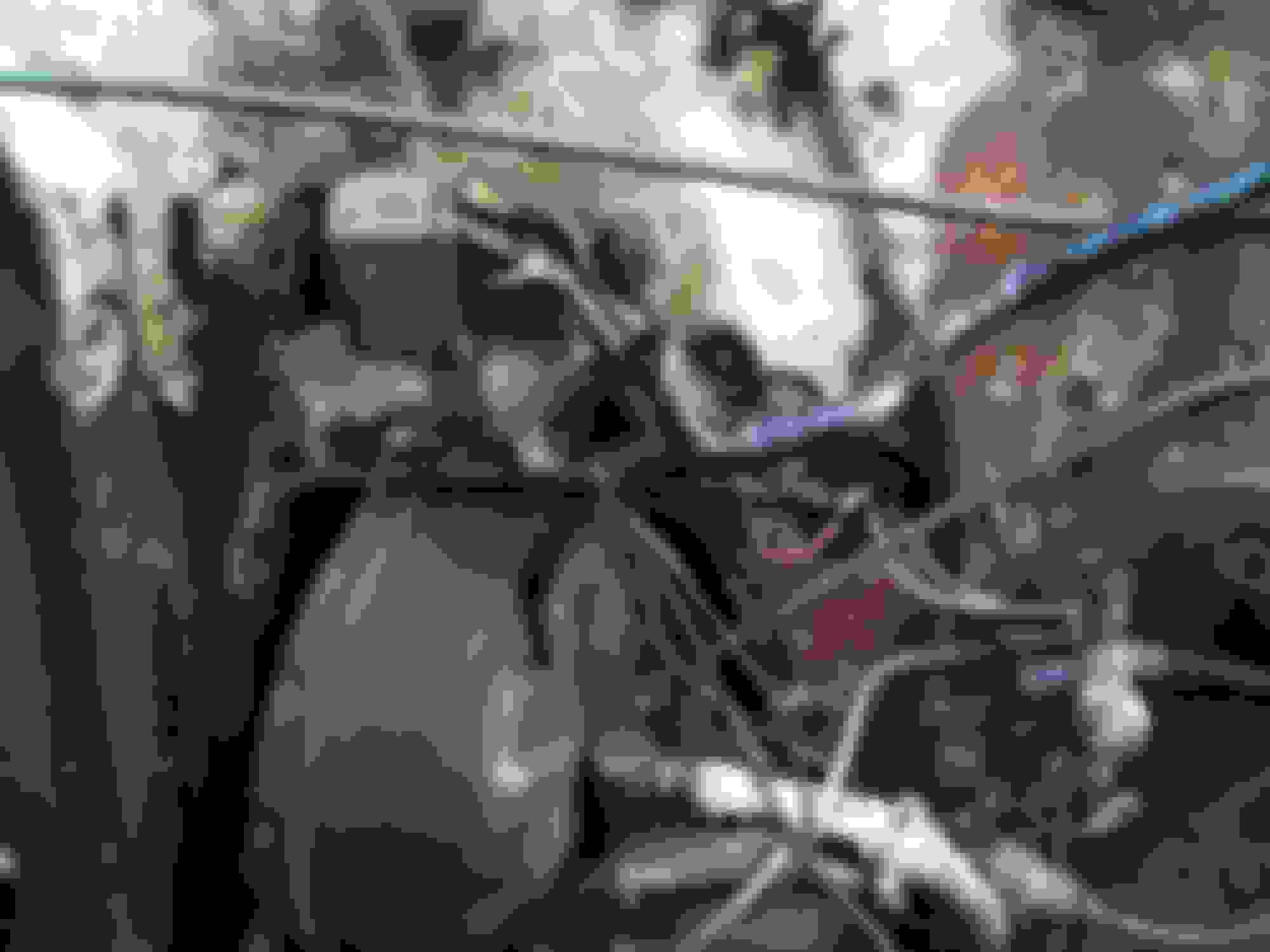
That's the left side (looking forwards) horn on my car. It's attached to the bumper iron by the triangular bracket that you can just make out. It also has a ground wire that is attached to the small bracket on the front cross member.
Glyn, I think the 4th edition of the service manual is the last one and, thanks to Brooklands Books, the one in widest circulation. Mine is a photocopy of one from a public library with a date stamp (from when the library bought it) of March 1976. I must have copied it around 1978 or so. The horns appear on page P23 (the scan in your post above) and also on pages P-s7 to Ps-9 where the WT and 9H types are mentioned. They are also in a drawing on page N11 where the manual covers the attachment of the front bumper. However, in that picture, they are either floating in the air or attached the front cross-member (that's cross member in front of the radiator, not the front suspension sub-frame). I'd guess that they were moved back to the sub-frame on the introduction of the S type with its slender bumpers in order to keep them out of sight.
Cass, I hadn't realised that the Varamatic box to had an oil cooler. Was it standard ? If so, it's something that I'll have to add to my list of parts to buy.
Cass, I hadn't realised that the Varamatic box to had an oil cooler. Was it standard ? If so, it's something that I'll have to add to my list of parts to buy.
There lies the rub as they say Peter. My car has the cooler and it looks original. I have nothing to doubt that it is original as my car had one owner before me. Sid Morris owned the car from the show room for 37 years and he did all his own servicing as far as I have been told but that said there is nothing else on the car that is not original. My car is a September 1967 build registered in February 1968. Built in the last year of production so anything could have changed. There is no diagram of the cooler in the parts book for the S Type but on page 323 it does mention C26401 Hose, Steering box to oil cooler and on page 233 C26403 Hose, Cooler to Reservoir. In the 420 parts manual which also uses the Variomatic steering there is no mention of a cooler or hoses.
The so called cooler is just a solid loop of pipe in the hydraulic hose with some fragile alloy vanes attached.
Is it required? I doubt it unless you are ragging the bloody thing around hairpin bends all day.
Yes, looking at the cooler in your photo, a long tube placed well in an air flow or clipped tight to the subframe might well be as effective. Anyway, it's something new to have fun thinking about...
That's the left side (looking forwards) horn on my car. It's attached to the bumper iron by the triangular bracket that you can just make out. It also has a ground wire that is attached to the small bracket on the front cross member.
Glyn, I think the 4th edition of the service manual is the last one and, thanks to Brooklands Books, the one in widest circulation. Mine is a photocopy of one from a public library with a date stamp (from when the library bought it) of March 1976. I must have copied it around 1978 or so. The horns appear on page P23 (the scan in your post above) and also on pages P-s7 to Ps-9 where the WT and 9H types are mentioned. They are also in a drawing on page N11 where the manual covers the attachment of the front bumper. However, in that picture, they are either floating in the air or attached the front cross-member (that's cross member in front of the radiator, not the front suspension sub-frame). I'd guess that they were moved back to the sub-frame on the introduction of the S type with its slender bumpers in order to keep them out of sight.
Cass, I hadn't realised that the Varamatic box to had an oil cooler. Was it standard ? If so, it's something that I'll have to add to my list of parts to buy.
Where is your date? It's usually on the outer back page but not on mine anywhere.
The date stamp is (or was) by Cheshire County Libraries from when they bought the book, not from the publisher, Jaguar Cars/British Leyland. Strangely enough, Ellesmere Port (a small industrial town on Merseyside in the north west of England) had a full set of Jaguar Services manuals from XK120 and Mk VII through to the 420 and 420G. There was no local connection with Jaguar.
My version doesn't have the bulletins. If there was a date or ISBN at the end of the book, I doubt I'd have had energy remaining to photocopy it. It's quite a big book to copy ... . Incidentally, doing the copying wasn't meanness on my part. Brooklands Books' reprints weren't around and factory service manuals were hen's teeth.
The date stamp is (or was) by Cheshire County Libraries from when they bought the book, not from the publisher, Jaguar Cars/British Leyland. Strangely enough, Ellesmere Port (a small industrial town on Merseyside in the north west of England) had a full set of Jaguar Services manuals from XK120 and Mk VII through to the 420 and 420G. There was no local connection with Jaguar.
My version doesn't have the bulletins. If there was a date or ISBN at the end of the book, I doubt I'd have had energy remaining to photocopy it. It's quite a big book to copy ... . Incidentally, doing the copying wasn't meanness on my part. Brooklands Books' reprints weren't around and factory service manuals were hen's teeth.
Peter, If you want a copy with bulletins PM me an email address. It's 27.2MB ~ too large to attach here.
I have "revived" quite a number of these horns. I won't use the word restored as that implies a complete overhaul.
A common problem is in the points which are typically corroded or burnt.
Cleaning them up with abrasive paper or fine file generally gets them going.
Another problem in this part of the world is having mud wasps and their ilk making nests in the trumpet.
On occasions poor earths also contribute to failure.
The latest horn repairs were on a friends 1956 Rolls Royce which had all of the aforementioned faults.
Why not move the horns inside the engine bay on either side of the rad (up high) _ without checking, I think there's room there ?
The sound will travel well enough through the rad.
The engine bay on a Mk2 is already fairly crowded especially on the right-hand side with distributor, carbs, brake booster breather etc.
I have already recommended putting screens on the RR horns.
cheers
Well I got the new horns and they work! Problem is they work all the time!
I have taken the horn push mechanism apart and that all looks OK. I have tried moving the steering column up and down but that does not help.
I guess I will have to take the steering column out and use one of the horn repair kits to fix it.
Have you checked the horn relay? It might be stuck open. I think it is the relay on the inside of the engine bay right hand side just above the Brake booster. Best picture I have of it during the strip down of my car during its restoration.
Relay is OK. Definitely in the steering column. I think it’s going to be steering column out. What a design for the horn! Might put a push button in until I get around to taking out the steering column.
Relay is OK. Definitely in the steering column. I think it’s going to be steering column out. What a design for the horn! Might put a push button in until I get around to taking out the steering column.
My Daimler has had such a temporary arrangement for more than 10 years. It had a short inside the column and sounded the horn when I turned the steering wheel. It's not a difficult fix ... when I get around to it.
Be sure to let the APK tester know about the temporary button.
One thing still puzzles me with the horn wiring. I understand that the push button provides an earth to the relay so the horns sound. What I don’t understand is what does the positive wire do that is attached to the base of the steering column? (Positive earth?)