When you click on links to various merchants on this site and make a purchase, this can result in this site earning a commission. Affiliate programs and affiliations include, but are not limited to, the eBay Partner Network.
I saw this on another web site recently and thought I would put it up here for comment.
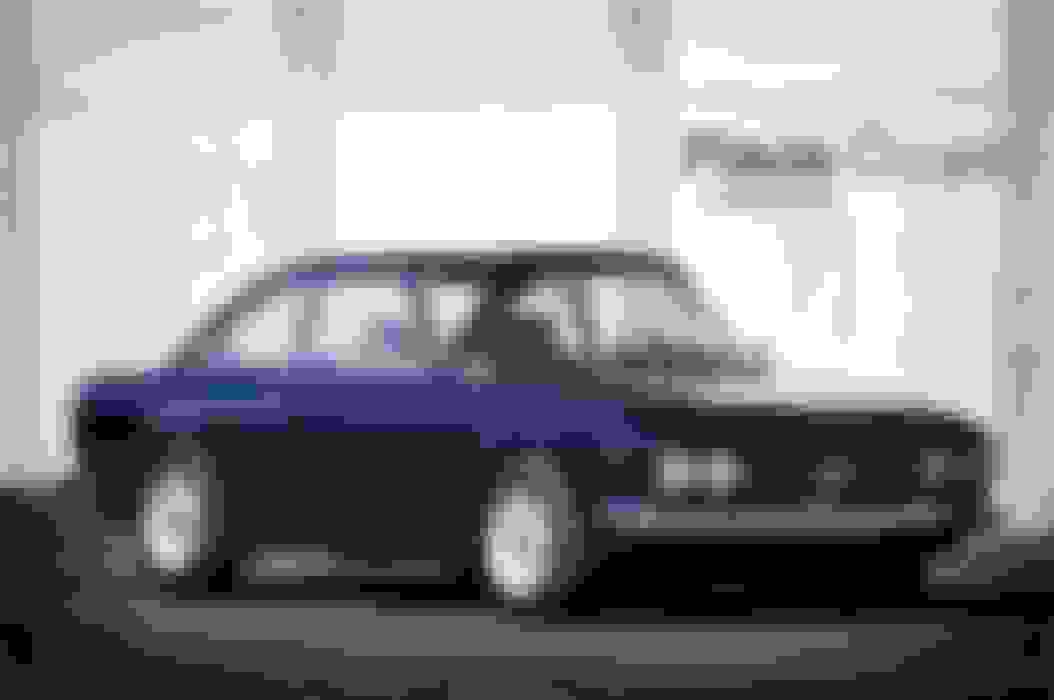
Allegedly designed by the Italian design studio Frua for a new 1960s S Type Jaguar. I can't find any history on it so I think it is a more modern paint shop take but I actually like it. A better design I think than the E Type plus 2.
Yes I know about that one and I actually prefer the red one. The blue one is too boxy and looks more like the 1970s Lancia Flavia coupe than a Jaguar. Perhaps Jaguar turned the design down and Lancia took it on.
Jaguar's projects in those days were not exactly planned. According to the literature, Lyons himself was thinking of (at least) two new cars (not Utah based) in the 1960s. One was XJ4, which became the series 1 XJ6; the other was a small coupe, which was very much inspired by the Alfa coupes. At the same time, Sayer, undoubtedly with input from Lyons was working on various possibilities for evolutions of and replacements for the E-type. Inevitably, there must have been a lot of cross-fertilisation. Truncating the nose and tail of the E-type and putting a bigger passenger space in the middle produced a shape close to the XJ6 and also close to the Alfa coupe; and it obviously pleased Lyons. In the end, we got the XJ6, but the E-type revisions were considered too expensive, and the coupe was lost in the horror that was British Leyland. My guess is that the coupe and E-type studies probably influenced the low lines of XJ6 and set an image of what a modern Jaguar saloon should be.
Concerning the coupe, apparently Lyons had a ride in one, was impressed, and thought he could do better, especially if it had his 'little V8' in it. The question is, was the little V8, the Daimler 2.5, the Coventry Climax V8, or the cut down V12?
Rob's picture at the top looks like an E-type with some Mk2 inserted into it. That doesn't seem to be the way Lyons or Sayer were thinking. The Mk2 was something in the past for most in Jaguar apart from possibly Bill Heynes. From how the cars are parked in the photo, it may be a drive on the right country and the general background makes me think of The Hague. Is it Dutch work?
I don't care for it. The e-type style headlight scoops don't play well with the upright grille. The bonnet is too long- I don't like the proportions. And there's no front vent windows!!!
I don't care for it. The e-type style headlight scoops don't play well with the upright grille. The bonnet is too long- I don't like the proportions. And there's no front vent windows!!!
Sometime around the late 1970s I had one of those Alfa Romeo coupes as in Glyn's post as a second car to my MK7 MOD.
From memory I think it's capacity was 1750cc.
It certainly was a great little performer, and my two children loved it as the "vroom-vroom" car.
Unfortunately/fortunately a third child arrived, and the family no longer fitted so it had to go.
Lyons himself was thinking of (at least) two new cars . . . in the 1960s. One was XJ4, which became the series 1 XJ6; the other was a small coupe, which was very much inspired by the Alfa coupes. At the same time, Sayer, undoubtedly with input from Lyons was working on various possibilities for evolutions of and replacements for the E-type.
Bur an Alfa inspired small sports replacement for the E-Type? Doubtful. Of what I recall, he was more commercially oriented to the huge US market and using the already committed XJ6 platform to develop a larger bodied GT. What emerged eventually was the Sayer inspired XJ-S. The far more lovely example below was built by the Italian,PininFarina, under Lyons' personal instigation . . . the XJ-Spyder. Apparently, the level of XJ6 parts sharing did not stack up so Jaguar opted for the controversial XJ-S design. Much as the XJ-S has grown on me since, what a lost opportunity . . .
Last edited by cat_as_trophy; Jun 14, 2024 at 04:58 AM.
Bur an Alfa inspired small sports replacement for the E-Type? Doubtful. Of what I recall, he was more commercially oriented to the huge US market and using the already committed XJ6 platform to develop a larger bodied GT. What emerged eventually was the Sayer inspired XJ-S. The far more lovely example below was built by the Italian,PininFarina, under Lyons' personal instigation . . . the XJ-Spyder. Apparently, the level of XJ6 parts sharing did not stack up so Jaguar opted for the controversial XJ-S design. Much as the XJ-S has grown on me since, what a lost opportunity . . .
The small coupe wasn't to replace the E-type, though Jaguar were playing with the shape of the E-type in styling exercises. The small coupe was intended to fit in more as a small saloon, if replacing anything it would have been closer to the spirit of the Mk2, but physically smaller. Lyons was still working on it at the formation of British Leyland, but was told that such a car had to be a Triumph. As you might expect, that was the end of it.
Lyons was heavily influenced by the mid 60's Alfa Romeo Giulia Sprint GT Veloce. I have an Alfa magazine that describes it in detail.
Giugiaro did his best work for Alfa. 'Heavily influenced' might be a bit too strong. The series XJ and the 105/115 Alfas are definitely amongst the most elegant and timeless designs of the 1960s which inevitably leads to some commonality of silhouette. However, the evolution from the Mk X and the E-type into the XJ6 (XJ4) is very clear. And Lyons understood gentle curves in a way that Giugiaro rarely if ever mastered.
I've had friends with various versions of the Giulia and they were all outstanding cars from the 1300 through to the 2000 GTV, as was my Alfetta GTV. Unfortunately, the steel in the Alfetta was not the most stable.
This has a bit of Corvette in it especially the rear end from this angle.
"Lyons was still working on it at the formation of British Leyland, but was told that such a car had to be a Triumph."
This was also typical of BL as the top men were apparently all Triumph men. MG were producing the MGB GT V8 and wanted to produce a factory soft top version of the V8 which Costello was producing as a conversion but BL were just bringing out the Stag at the same time and rather than make competition for it they only made 2591 MGB GT V8s and all of them were hard tops.
"Lyons was still working on it at the formation of British Leyland, but was told that such a car had to be a Triumph."
This was also typical of BL as the top men were apparently all Triumph men. MG were producing the MGB GT V8 and wanted to produce a factory soft top version of the V8 which Costello was producing as a conversion but BL were just bringing out the Stag at the same time and rather than make competition for it they only made 2591 MGB GT V8s and all of them were hard tops.
In the British Motor Museum at Gaydon, there are some very impressive MG prototypes. Incredibly, none of them saw the light of day, while that total dog's breakfast, the TR7, made it into production.



 Jaguar S Type