When you click on links to various merchants on this site and make a purchase, this can result in this site earning a commission. Affiliate programs and affiliations include, but are not limited to, the eBay Partner Network.
My 3.4 must be in fine tune as it always starts on first crank. I do have a question about the starting carb. I have a fellow club member with a 3.8 engine in his car and he had been having problems with his car stalling a few minutes after starting. It seems the starting carb was still dumping gas into the engine flooding it. A fix someone told him was after the engine had ran a few minutes to quickly switch the key off and then back on. This is supposed to shut the starting carb off. Is there any truth to this? I actually haven't ran my engine over 10 minutes or so at a time but was keeping this in mind.
I would doubt switching the ignition off and then back on would affect the starting carbs function because the way it is wired it is either on or off. Ie power goes to it or not but this is down to the otter switch which is the earth for the circuit and the temperature of the engine.
There are many posts on here over the last month talking about fitting over ride switches or bypassing the otter switch so I will not repeat them again.
The AED can be adjusted via the nut on the top of the needle to allow for different ambient air temperature.
The otter switch should be set for 37 degrees ie it cuts off the AED when the water temperature gets to 37 degrees but the otter switch being a bi metal switch is not accurate. It can be adjusted but bending the bi metal strip inside one way or the other to change the temp it switches off allowing the AED to stay on for longer or switches it off sooner. I find having an override switch which allows me to turn the AED on or off when I want works in both hot and cold weather.
My 3.4 must be in fine tune as it always starts on first crank. I do have a question about the starting carb. I have a fellow club member with a 3.8 engine in his car and he had been having problems with his car stalling a few minutes after starting. It seems the starting carb was still dumping gas into the engine flooding it. A fix someone told him was after the engine had ran a few minutes to quickly switch the key off and then back on. This is supposed to shut the starting carb off. Is there any truth to this? I actually haven't ran my engine over 10 minutes or so at a time but was keeping this in mind.
Doing this won't make any difference as the otter switch (the thermal switch in the inlet manifold that controls the auto choke) will still turn it back on until the water temperature increases and breaks the circuit.
On my S-Type I had a few years back I fitted an overide switch which has three positions, on, off and auto. I think I used an old headlight switch and simply wired it so that the cable to the otter switch went to the three position switch, in on it earthed it directly at the switch, in off it didn't have a connection and in auto I took a wire from the switch back to the otter switch.
Oxendine
I sounds like your friend might have a "dicky" thermocarb controller called an Otter switch which is at the front end of the inlet manifold.
A simple diagnosis is after starting the car and letting it warm up disconnect the wire from the otter switch. it is a push on spade connector, and you won't get an electric shock from 12 volts.
If the car then runs OK it has a crook otter switch.
The fixes are a new otter switch at about 60 English pounds.
Alternatively modify the car to have a manual control switch on which there is plenty of information in this forum.
My previous input mentioned a "crook" otter switch. Some people have queried what I meant
"Crook" is Australian slang for broken, unserviceable or non-functioning.
Sometimes i forget that we "colonials" have diversified our language in spite of TV, Internet and similar connections.
There is another possibility ~ listen to Cass ~ it is the likely cause.. That the needle in his AED is not set correctly for his ambient conditions & he thus does not have the correct enrichment at cold start.
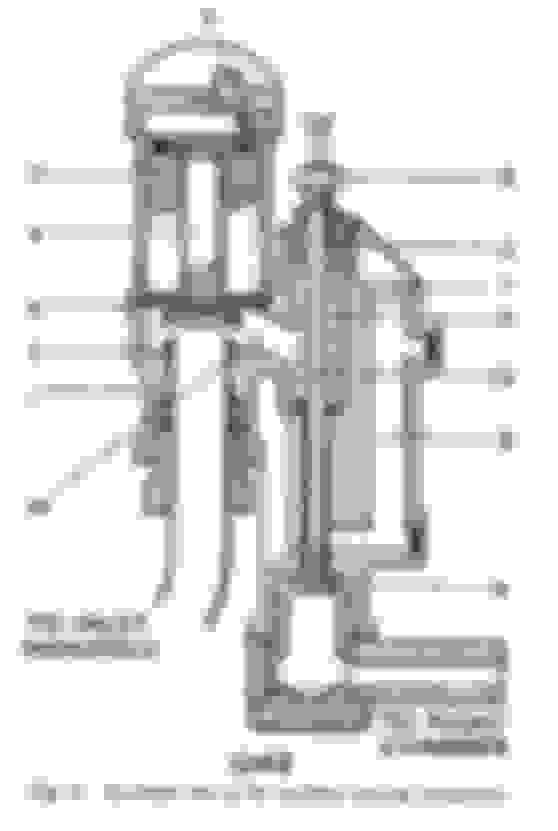
Adjust No 10 in diagram.
Last edited by Glyn M Ruck; Sep 10, 2022 at 06:19 PM.
The space 8 is air. The device provides extra air and extra gasoline. The total and the ratio depends on the manifold depression. The air and fuel mix just above the bottom of the pointed end of the needle. Adjusting the nut at the top of the needle controls the maximum gasoline flow. Manifold vacuum acts against the solenoid, tending to close the valve (2 and 3) and shut off flow of air and fuel through the device. That's why a dab on the throttle can help the hisser to get started.
All the above is how I understand things - feel free to tell me I'm wrong. I used to adjust the hisser when the engine was fully warmed up. Short the otter. Dab the throttle. Then richen the mixture from the hisser until the engine starts to cough. Finally, wind back a touch. If the hisser doesn't allow the engine to start or run when it's very cold, richen a little.
in the cross-section diagram, it's not clear to me if area "8" contains air or gasoline and if there's some sort of connection to section "14".
Be patient with me while I try and build a picture for you ~ i.e. this comment will grow. Any input from others is most welcome. More minds = better outcomes. e.g. I adjust the hisser when the engine is cold & steadily warming. We all have our own ways. Whatever works for you. I'm going to try Peter's method out of interest. My car starts & runs perfectly cold. We have a mild Mediterranean climate in Cape Town.
Fuel feed from the front carb to the AED ~ note in diagram above.
I think that should cover. Shout if you have further questions.
Last edited by Glyn M Ruck; Sep 11, 2022 at 07:34 AM.
The space 8 is air. The device provides extra air and extra gasoline. The total and the ratio depends on the manifold depression. The air and fuel mix just above the bottom of the pointed end of the needle. Adjusting the nut at the top of the needle controls the maximum gasoline flow. Manifold vacuum acts against the solenoid, tending to close the valve (2 and 3) and shut off flow of air and fuel through the device. That's why a dab on the throttle can help the hisser to get started.
All the above is how I understand things - feel free to tell me I'm wrong. I used to adjust the hisser when the engine was fully warmed up. Short the otter. Dab the throttle. Then richen the mixture from the hisser until the engine starts to cough. Finally, wind back a touch. If the hisser doesn't allow the engine to start or run when it's very cold, richen a little.
This helps my picture I'm trying to build above Peter ~ thank you. Space 8 is an air inlet. Space below 9 is fuel as can be seen from the front carb float chamber. I would like Huey to let us know when it is plain to him. (F1 GP about to start)
Last edited by Glyn M Ruck; Sep 11, 2022 at 10:32 AM.
Peter is correct.
Just to be different I have always adjusted the "hisser" mixture when cold to a slightly over rich setting
i am using it as a "choke" that is an enrichment device for starting but not for running for long periods as would be required in very cold climates.
Like Glyn I am in a temperate climate and seldom get colder than 5 C or 40 F in winter.
By the way the electric system for the "hisser" should normally be activated either by the otter switch or manual switch prior to any attempt to start the engine.
Rotating the engine without prior activation will end up with the solenoid plate valve stuck down with intake vacuum.
This can be alleviated by opening the throttle releasing intake manifold vacuum and allowing the valve to lift which leads people to think pushing on the throttle pumps fuel in as per an accelerator pump
i'm more interested in how the thing works than how to adjust it. i figure adjusting it will make more sense when i know how it works.
so, if section "8" and the gasoline from the parent carb's floatbowl meet at the tip of the needle, why doesn't section "8" fill with gasoline to the level of the gasoline in the parent carb's floatbowl? because it is my understanding that section "8" is vented to the atmosphere.
It may look archaic, but, at least to an old engineer like me, it's quite a clever design. It gives extra mixture, on the rich side, at idle, richens the mixture a bit more at part load for good throttle response, contributes little at high load (where it's not needed and you shouldn't be taking a cold engine), and closes completely on the over run to save fuel (and keep the engine internals clean). What more can you ask for? What more can you achieve without digital electronics?
How you tune it is a matter of what suits your climate and works. I found that the engine always started and ran OK when cold. I wanted to avoid it missing as the engine warmed up and approached the switch off temperature. In my drive to work in the morning, the engine was about reaching that point when I had to enter a busy road with fast moving traffic.
[QUOTE=hueyhoolihan;2565129
so, if section "8" and the gasoline from the parent carb's floatbowl meet at the tip of the needle, why doesn't section "8" fill with gasoline to the level of the gasoline in the parent carb's floatbowl? because it is my understanding that section "8" is vented to the atmosphere.[/QUOTE]
As far as I know Section 8 does adopt parent carb float bowl level with gasoline awaiting the solenoid to rise triggered by the Otter switch. I will diligently read my SU Bible tonight but I'm pretty sure I'm right as are you Huey. 8 is open to ambient air intake. Hence "hisser" Plus opening to manifold for greater noise.
Last edited by Glyn M Ruck; Sep 11, 2022 at 06:00 PM.
Space 8 should fill to the level of the float chamber when the engine isn't running. I think that level should be around the bottom of space 8, but it's difficult to see from the drawings or on the car. As my car has been emptied of gasoline for a long time, I can't do a dipstick check. Of course, when there's suction on the hisser, 8 will empty of fuel.
I had a look at my workshop manual and it doesn't mention manifold vacuum pulling down on the solenoid and throttling the hisser, however I'm sure I've seen it in an old SU book and described as part of the operation.
I think it's higher up space 8 but I shall endeavour to measure on my spare pair of carbs & manifold depending what is piled on top of them. I've installed shelving in my garage to get everything off the floor & increase my space for the cars, Now I can't find everything. Found my weird size precious Gedore SU float bowl socket the other day. We are a metric country & I've put together a mainly Kennedy set of tools & wrenches for the Jag. They are beautifully made. I used to be a Hazet man. Kennedy make all these non metric sizes available here otherwise it's all metric. Being a Benz man everything is Torx or Reverse Torx
Last edited by Glyn M Ruck; Sep 11, 2022 at 12:31 PM.
That is more like a full standalone carburettor with built in Otter switch, It's own float chamber etc. than our simple device but follows the same principle and is extremely interesting. Thank you.



 Mark 2 Starting Carburettor