When you click on links to various merchants on this site and make a purchase, this can result in this site earning a commission. Affiliate programs and affiliations include, but are not limited to, the eBay Partner Network.
as much as I love the MK2, ive never been a huge fan of the original spats.
Coombs spats are a bit spendy. I have a spare set of standards that I was thinking of having modified to be more like the coombs units by a friend who does quality metal work, then I can always go back to stock if I like.
am I missing something obvious? is there something else to the coombs units I am not seeing? you figure if it was that easy it would be super common.
Genuine Coombs Mk2's had modified rear wheel arches. Zero spats.
Credit James Taylor
Original now owned by Jaguar Heritage Driving Experience (this car has been knocked around in racing & profile no longer perfect). Coombs did a great job.
Last edited by Glyn M Ruck; Dec 2, 2020 at 06:32 AM.
I wish that I had a friend who is so good at panel beating! I agree with you on appearance and with Glyn on what exactly a Coombs (non)spat is. I think that I prefer the original Coombs.
I bought a pair of the steel Coomb's style for my Mk2. They are definitely pricey! One advantage of the Coombs style is that it is reversible. My body guy is going to prep and paint both the originals and the new Coomb's style spats just in case someone wants to return the car to a more stock look at some point. Rolling the fender bead probably does look the best but there is no turning back once done.
My understanding is that you can also fit a wider wheel/tire combo with the Coomb's style. I have a set of 15x6 inch wires ready for mine!
I do really like the look and I think it was worth the money.
maybe I was confused by the below and similar being referred to as "Coombs Style" spats.
z
This is a photo of my car. The "spats" are referred to as Coombs style spats but as has been stated there really is no such thing. The ones on my car (above) are metal, but there are less expensive fibreglass spats available as well. I retained the original larger spats and they were refinished at the same time as the rest of the car, but have never been put on, and never will be!
I always preferred the original look with the wider spats !! Reason for having the cutaway spats is that they didn't need removing to get the wheel off and back on.
I bought the Martin Robey steel cut-down spats.
As received they do not fit very well and need skilled panel work. This is no doubt due to the narrow width as compared with the originals, these being more rigid.
My body shop, Avenue Auto Body Boston MA USA, did a superb job making them fit and they were attached at the front with screws made to look like Dzus fasteners. An additional clamp piece was made to hold them close to the
body profile.Since they never need to be removed, no problem.
So this was not a trivial job and way beyond my skill set!
I can verify what you have written about the fit of the metal "Coombs" spats - because in the restoration of my car the restoration shop had to cut the spats into 3 sections (as I recall) and remake them so they would fit to "concours" standards (as your also do) - but once done, they improve the look of the Mk 2 enormously over the original large spats (opinions may vary...):
Thanks Glyn (and I can certainly return the compliment). I acquired my car about 18 years ago when it had just 16,000 documented miles on it (just under 27,000 today). It had been used so little that everything that could leak did leak: transmission, brakes....and the paint was tired. No corrosion of any kind anywhere, no accidents...the interior was almost pristine although the headliner showed some soiling. It was the issue of the brakes and the transmission that made me begin the restoration, the goal being a sympathetic and conservative restoration so that the car would look as it did at purchse in 1966 and run as new, the Coombs-style spats being the only visual anomally. I think that goal has largely been accomplished, the proof being that I can watch the needle on the fuel gauge move as it consumes the $1.20 per litre premium fuel (when the car was built, January 4, 1966) the cost of fuel here was $0.35 per litre...
Everything was dismantled, engine out, every ancillary component examined and renewed as and if necessary but almost everything was as new, transmission sent to have a new seal kit fitted, brakes redone completely - except that the discs and pads were almost as new and therefore are still in use today, a modern brake booster was fitted and the result is that the brakes are very effective; every component of the suspension was examined, new bushings everywhere, new front springs, new shock absorbers all around, Pertronix ignition fitted, electronic SU fuel pump, but the car has retained its radio (one speaker!) and positive ground. The original 1966 dealer-installed AC with York compressor is fully functional and produces very cold air but still has a slight leak. Every electrical component was removed, heater fan, wiper motor, starter motor, generator, everything, examined and if necessary refurbished or replaced...but actually, apart from fitting new light bulbs, almost nothing needed renewal. The original Lucas generator works just fine. All belts, hoses and fluids changed, carbs rebuilt. Steering box resealed. The engine itself has not been touched.
Much of the above took place while the body was at the restoration shop (Coachwerks Restorations, Victoria). The body was stripped and taken down to bare metal; more than 300 hours went into the work, which included improving the factory panel gaps among other things - and reshaping the metal Coombs spats! Most of the chrome is original except for the bumpers, both of which had scratches, so they were rechromed locally.
The car is in its original colour of Pale Primrose (introduced in the Mk 2 palette in 1964) but in base coat/clearcoat formulation. On purpose I left the trunk and the engine compartment as it was in the factory paint, and I decided not to bring the engine compartment to the same standard as the rest of the car. I have done that on too many Jags (V12 XJ cars mostly) and found that I was reluctant to use those cars as often or as hard as I wanted. This one is used all year long (today in fact for a lovely 2 hour winter country run) as long as the roads are dry. It is even used for grocery shopping (I can see the expression on your face, but so far the car has not acquired even a single mark on it...perhaps I shouldn't have said that....).
The interior needed very little - new headliner from BAS, and as every but was removed from the car, everything was cleaned, conditioned and polished. The carpets are factory original and perfect. I like a firm seat so I did have the driver's seat base refoamed.
The original wheels were painted steel. I fitted instead chrome tubeless Dayton wheels and radial tires in the original size with 1966-correct white band. (Every Jaguar sold in Canada, including E-Types, up to 1982 was factory -fitted with whitewall tires. The band width depended on the width in vogue at the time. The 1965-66-67 width was quite narrow).
All in all, a joy...yes, the steering is a bit vague, but on the highway it has left many a BMW behind.
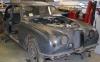
Some photos pre-restoration:
As the car came to me...does it need restoration?:
And underneath:
Completely sound sills:
Dirty, but fully intact:
Being dismantled, and pictured with random parts from other cars...
As you can see, once cleaned, the original electrical bits were virtually as new:
Ready to remove the engine and transmission:
And now at Coachwerks:
Almost ready for paint:
And finally, immediately after the restoration was complete:
That does look fantastic! I'm 3 years into a (hopefully) 5 year restoration and you car is inspirational.
My body guy has not done a test fit of the "Coombs Style" spats that I bought yet. Maybe I should warn him!
I have an E-type in Pale Primrose and I really like the color. I do need to correct people when they call it "yellow", though.
I just got mine back from the blaster today. It was sitting in primer for the last 20 years and rust had started to form under the primer so I had it taken back to bare metal (again). The body is in excellent shape (yea!!). Just a few minor dents and dings.
Not an expense I was expecting but better to do it right the first time.
A few dings & dents are of minor concern. A good, rust free shell is far more important. My car had the odd minor scrape but zero rust including the middle of the rear door skins where Jag stuck those felt pads where the window frame touches the skin & always remain damp. Now every cavity is plastered with Tectyl.
VB - here's a shot of an original spat from my build. It's a fairly simple matter to deconstruct the back (attachment brackets) and roll a bead. I welded them in at this point, but there's no reason you couldn't reattach the brackets and leave the tub undisturbed. Good luck with your build.
It is several years since I bought any repro body panels, however, when I did they always seemed to need so much 'adjustment' that I wondered if I saved much time over making some of them from scratch. For some parts, I can accept that original bodies varied, but this is a wheel arch. In the day these were the first part of the car to suffer corrosion and Jaguar (or the Pressed Steel Company) made and supplied numerous replacement spats. I am sure that, though not perfect, they reasonably matched the surround wing. Considering how much these cost and the claims made by the suppliers for their technology, it is dissapointing.
Looking at your lovely car, how I wish I could have my Mark 2 back again, but I don't have a garage large enough to put one in. My TF fits in OK but that's about it. All my other cars have to sit outside in the rain, and we're getting an awful lot at the moment ! Your Mark 2 looks just the same sort of condition mine was in just before I sold it in 1988. I believe it went to Japan as the UK registration mark is deleted. Japan also drive on the left.




 Spats
Spats