When you click on links to various merchants on this site and make a purchase, this can result in this site earning a commission. Affiliate programs and affiliations include, but are not limited to, the eBay Partner Network.
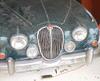
Sometimes (annoyingly) called "the John Wayne of Japan," film actor Toshiro Mifune had a taste for classic cars. One of his is listed in the link below. A long ago Japanese girlfriend told me that wealthy persons in the Land of the Rising sun would sometimes order British cars in LHD, so that folks who were into educated in automobiles would know that they were "imported" and thus expensive:
Those white wall tires and chromed air cleaner doesn't work for me.
White walls with the MK 2's fender skirts just don't work, it hides all the "black" of the tire and looks odd.
It makes it appear that the white wall in the rear goes right out to the edge of the tire.
Those white wall tires and chromed air cleaner doesn't work for me.
White walls with the MK 2's fender skirts just don't work, it hides all the "black" of the tire and looks odd.
It makes it appear that the white wall in the rear goes right out to the edge of the tire.
These wide whitewalls on the Mk 2 do indeed look overpowering, I agree, and depending upon the model year of the car, may be incorrect in the width of the white band. If the car is a 1959 or 1960 model, perhaps…
But as a matter of record, every Jaguar that came to Canada and the US from the late 30’s to 1982, every single one regardless of model, was fitted as standard equipment with “whitewall” tires with white bands of varying width depending upon the tastes of the day. By 1965 the white bands were less than an inch in width. By 1966, 5/8 of an inch.
Apart from the Triumph TR6 with red-band tires, most other British cars also came with white band tires, including my 1974 MGB, which I purchased new in Toronto.
I am aware that this thread is about a car in Japan.
Those white wall tires and chromed air cleaner doesn't work for me.
White walls with the MK 2's fender skirts just don't work, it hides all the "black" of the tire and looks odd.
It makes it appear that the white wall in the rear goes right out to the edge of the tire.
These wide whitewalls on the Mk 2 do indeed look overpowering, I agree, and depending upon the model year of the car, may be incorrect in the width of the white band. If the car is a 1959 or 1960 model, perhaps…
But as a matter of record, every Jaguar that came to Canada and the US from the late 30’s to 1982, every single one regardless of model, was fitted as standard equipment with “whitewall” tires with white bands of varying width depending upon the tastes of the day. By 1965 the white bands were less than an inch in width. By 1966, 5/8 of an inch..
I had no idea, and as an extreme auto history dork, I find that info very interesting. I'm likely in the minority, but do like '60s models with wires to have thin whitewalls. I like them on the S Type and the 420 compact. Even the E-Type.
And with wide whites on US cars at least, 1960 was the last year for them in all cases that I know of.
Just so we can see the actual car on this thread rather than dipping in and out of the link I have transferred a copy over.
In my opinion it makes the front wheel tiny as you can't see the outer section against the black of the inner arch. Looks like one of those bouncy low riders from LA with the stupid tiny diameter wheels. Just saying.
Not a fan of narrow or wide white walls and they certainly don't look right on an S Type.
Prof Gregory's (sov211) beautiful car always looks right to me irrespective of year. Yes early cars has wide whitewall tyres. My Dad liked whitewall tyres ~ I had to scrub them every Sunday. I'm a blackwall person.
Last edited by Glyn M Ruck; Aug 1, 2023 at 04:56 AM.
Glyn it might also have something to do with the size of the rear spats. The Japanese car has the big wide rear spats which come down to the edge of the white wall stripe where as the thin stripe on Profs Mk2 looks presentable but as you said a bugger to keep clean. My mate with his Alvis had white walls and was forever having to repaint them so in the end turned the tyres around on the rims so the white wall was on the inside and just has black walls now.
Just so we can see the actual car on this thread rather than dipping in and out of the link I have transferred a copy over.
In my opinion it makes the front wheel tiny as you can't see the outer section against the black of the inner arch. Looks like one of those bouncy low riders from LA with the stupid tiny diameter wheels. Just saying.
Not a fan of narrow or wide white walls and they certainly don't look right on an S Type.
I agree that the wide whitewalls do not enhance the appearance of the car.
But as a matter of comparison, here is my 1966 Mk 2 with the correct 1965-66 white-band band Dunlop tread tires (and Coombs-style spats) - quite different from the other. This, apart from the Coombs spats, is the way it would have looked as delivered with chrome wires in 1966 in Winnipeg: The colour is the original Pale Primrose:
I don't remember white wall tyres being standard on Australian delivered Jags.
White walls never really "took off" in Australia and when they were available in the aftermarket most people seemed to avoid them.
I remember seeing them on hot rods and restored American cars but not on everyday cars.
Cheers
I'd take Gregory's car over Toshiro's a thousand times, tyres, spats, and primrose paint included. Without seeing it in the metal, I'd never have imagined a Mk2 would look so good in Primrose.
Broad whitewalls were mainly for the very American Vauxhalls in England in the 1960s. The local garage owner wanted to fit them to everything, but most resisted. His taste was particular. He owned a pink Chevy Impala - the one with the Concorde wings before anyone had thought of Concorde.
Somewhere about 1980 my wife had an XC Ford Falcon which needed new tyres.
She was offered a set at a reasonable price, but they had white walls.
She bought them but insisted that the white walls be installed on the inside leaving black rubber on the outside as she did not want to be a "hoon" which is Australian for flamboyant out of control car person.
Maybe we Aussies are less flamboyant by nature.
I'd take Gregory's car over Toshiro's a thousand times, tyres, spats, and primrose paint included. Without seeing it in the metal, I'd never have imagined a Mk2 would look so good in Primrose.
.
Pale Primrose was first introduced for the 1964 model year. In fact similar pale yellows were offered by virtually every British and North American auto makers during the mid 60's. The Jaguar colour is very delicate in the sense that it is a soft yellow, quite buttery, with a very slight greenish cast visible only under certain conditions:
When I found this car it had just 16,000 documented miles on it and it looked like this:
But with very little use, everything that could leak DID leak. And the paint was tired. So...:the restoration started. Engine and transmission out, every bit of the car was removed, examined, refurbished or replaced as necessary. the transmission needed new seals only (and there is a very interesting story about the transmission), the ancillaries (generator, starter, etc) were found to be as new. The internals of the engine needed nothing (170 compression on all six cylinders), all new suspension rubbers, new shocks, AC serviced, carburetors rebuilt, interior removed, glass out and then the fun began. This was a no rust, no accident car. It needed no significant bodywork except what the restoration shop felt they could "correct": 300+ hours of "correction" of factory defects and refinishing:
The bumpers were rechromed but the rest of the chrome-work is in its original condition; the interior is almost completely original: carpets, wood and leather but the soiled headliner was replaced.
The wood was cleaned and polished but not refinished. The original AC unit (dealer installed in 1966) remains in place:
Seat belts fitted:
Even the 3.8 grille badge is original (note the colour; reproductions are red instead of the correct burgundy colour):
The car came from the factory with the narrow white-band tires so they were replaced with similar tires:
This photo shows the underside: the sills BEFORE the body was refinished. Not a speck of corrosion:
Original electrical bits cleaned (only) found as new, and ready to re-install - the car remains on the original positive ground. The only concessions to the 21st century are a Pertronix ignition and an electronic SU pump in place of the original points pump...although Glyn has convinced me to buy a Hardi pump instead!). The clock was also given updated internals. The original Canadian-market turn signal lenses front and rear were amber in colour. I found that the deep amber colour did not play very well with the Pale Primrose at the front of the car so I replaced the front glass lenses with US-mandated clear lenses and used amber bulbs instead (see the photo above):
As I was determined to USE this car, the engine went back in without any repainting or detailing of the engine compartment (and as a result I do use it 12 months of the year providing the roads are dry):
The trunk was also left in its original factory paint:
The result of the 300+ hours: acceptable fit and finish:
Back to the original issue, or one of them: tires/tyres: this is the cover of the Canadian 1966 Mercury brochure...note the tires:
I spotted a Series 1 XJ6 recently that had "whitewalls". They appeared to be an insert of some sort, as at the outer periphery of the white portion it was about an inch away from the tire. Different to say the least!
[QUOTE=Jagboi64;2666034]I spotted a Series 1 XJ6 recently that had "whitewalls". They appeared to be an insert of some sort, as at the outer periphery of the white portion it was about an inch away from the tire. Different to say the least!
Well, this is a PERFECT example of an inappropriate, ugly retro-fit. The Series I and II and early III XJ cars for North America did indeed come from Browns Lane with white BAND tires, very narrow-white-band Dunlops…but these things are simply grotesque, not period correct and utterly nauseating. They hurt my eyes.
Hurts my eyes and my soul. Those were popular in the way-back times and looked fine when applied correctly with rubber cement, I believe.
And on the right car! 1960 & older US cars of course!



 Toshiro Mifune's Jaguar MK-2