


Junior Member
Sorry if I missed this part, what do you do with the refrigerant that is in the system before you start removing the compressor. Do you follow the Charging link instructions and vacuum the Low Pressure for 45 min, then loosen and remove the Compressor, after new one is on, fill?
Also, I see a wide range in price for a compressor, from 125 to 450, Is there anything special to look for when ordering a replacement?
Thanks,
MZ
Also, I see a wide range in price for a compressor, from 125 to 450, Is there anything special to look for when ordering a replacement?
Thanks,
MZ

clubairth1
Veteran Member
close


Yesterday
- Join DateMay 2009
- Locationhome
- Posts:12,065
-
Likes:5
-
Liked:3,355 Times in 2,620 Posts
No you vacuum after all the new stuff is installed. Then wait and check that it holds vacuum. The longer you wait and the longer you pull a vacuum the more moisture you can get out. This will help the AC to perform it's best.
Then when you are satisfied the system will hold pressure you start charging. For us amateur guys always charge thru the low side only and keep the can upright.
I used PAG100 oil. 7 oz system capacity. 3-4 oz in the compressor.
R134a 26.5 oz capacity.
.
.
.
Then when you are satisfied the system will hold pressure you start charging. For us amateur guys always charge thru the low side only and keep the can upright.
I used PAG100 oil. 7 oz system capacity. 3-4 oz in the compressor.
R134a 26.5 oz capacity.
.
.
.

Junior Member
The original information by Joycejag is really great. I have a 2000 Jag S-Type 3.0 with 144,500miles on the clock and the A/C needed replacement. The 10A fuse in the engine compartment which feeds the A/C clutch started failing. I increased it to 15A and it worked for another year, then started to fail. So determined the clutch was done (not sure how well the compressor was still doing, after 14 years). Obtained a quote for compressor & Accumulator/ Drier replacement which was around $1,650-. Decided to do it myself. Followed Joicejag's instructions. I am not an expert at all (I am a retired businessman). The job is easy. I had the refrigerant sucked out by a local shop, who agreed to give me a discount for the 1,35lb they sucked out when I had it re-charged later.
Only additional info I would have:
1) I bought my parts from "discountacparts.com". They are excellent. Purchased a complete kit with a OEM (made in the USA) compressor for $465.00 and Accumulator/Drier for $45.00. I chose not to buy the cheapest Chinese compressor, although they may be fine.
2) Once I removed the compressor, I found that the oil was still clean, so the compressor had not ceased. This meant that I did not have to replace the Expansion Device, which is recommended when the system is contaminated (obviously this made the job easier, as I did not have to remove the dashboard).
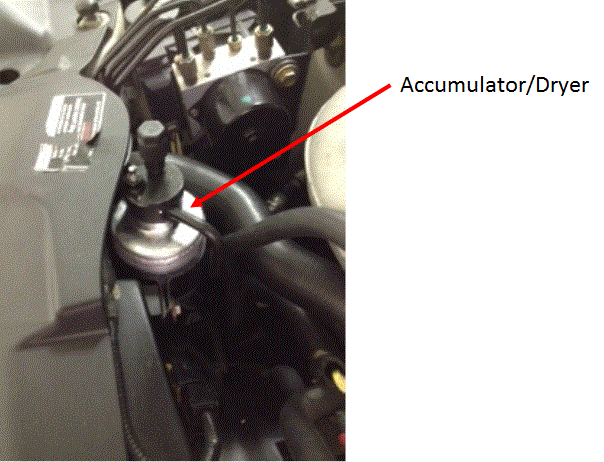
3) One thing JoyceJag did not comment to, was the replacement of the Accumulator/Dryer. Easy job. It is located on the passenger side of the radiator. A lid containing the two pipes on its top connected with one stud/nut. Just make sure the new seals which come with the new Accumulator/Drier are in their grooves and tighten down well. One bracket wraps around the unit. Photo attached shows where it is mounted:
So after I had the system evacuated and re-charged by the shop, the job cost me around $650- so I saved myself $1,000-. Thanks again for your great information Joycejag.
Only additional info I would have:
1) I bought my parts from "discountacparts.com". They are excellent. Purchased a complete kit with a OEM (made in the USA) compressor for $465.00 and Accumulator/Drier for $45.00. I chose not to buy the cheapest Chinese compressor, although they may be fine.
2) Once I removed the compressor, I found that the oil was still clean, so the compressor had not ceased. This meant that I did not have to replace the Expansion Device, which is recommended when the system is contaminated (obviously this made the job easier, as I did not have to remove the dashboard).
3) One thing JoyceJag did not comment to, was the replacement of the Accumulator/Dryer. Easy job. It is located on the passenger side of the radiator. A lid containing the two pipes on its top connected with one stud/nut. Just make sure the new seals which come with the new Accumulator/Drier are in their grooves and tighten down well. One bracket wraps around the unit. Photo attached shows where it is mounted:
So after I had the system evacuated and re-charged by the shop, the job cost me around $650- so I saved myself $1,000-. Thanks again for your great information Joycejag.

joycesjag
Veteran Member
close


Yesterday
- Join DateFeb 2009
- LocationSunny South Carolina
- Posts:8,020
-
Likes:1,457
-
Liked:1,731 Times in 1,223 Posts
Thanks for the kind words above Starbucksjack. I am glad that this DIY was beneficial to you and your pocket book.
To be honest and for the record. You are correct I did not replace the Accumulator/Drier simply because I did not think about it. Its been 3 and 1/2 years since I did this write up with pics, I believe, (I am to lazy to back track and look), but the original Accumulator/Drier is holding up just as good as new! I happened to drive Joyces Jag for the first time in a long time late last week (when the talking gas gauge reminded me it needed fuel desperately), and I am happy to report the AC was as cool as when I did replace the compressor.
To be honest and for the record. You are correct I did not replace the Accumulator/Drier simply because I did not think about it. Its been 3 and 1/2 years since I did this write up with pics, I believe, (I am to lazy to back track and look), but the original Accumulator/Drier is holding up just as good as new! I happened to drive Joyces Jag for the first time in a long time late last week (when the talking gas gauge reminded me it needed fuel desperately), and I am happy to report the AC was as cool as when I did replace the compressor.

NBCat

close

Yesterday
- Join DateJan 2012
- LocationNewport Beach, California
- Posts:6,068
-
Likes:1,608
-
Liked:2,982 Times in 2,027 Posts
The procedure is very similar for the 4.0 litre cars. Refer to JTIS for the correct procedures and compressor oil volume.
Prior to removing the compressor, the refrigerant must be discharged. Many jurisdictions have regulations making it an offence to intentionally discharge refrigerant into the atmosphere. Have an air conditioning specialist discharge and then correctly recharge the system for you after the compressor has been replaced as refrigerant is added by weight.
Prior to removing the compressor, the refrigerant must be discharged. Many jurisdictions have regulations making it an offence to intentionally discharge refrigerant into the atmosphere. Have an air conditioning specialist discharge and then correctly recharge the system for you after the compressor has been replaced as refrigerant is added by weight.

Member
Quote:
To be honest and for the record. You are correct I did not replace the Accumulator/Drier simply because I did not think about it. Its been 3 and 1/2 years since I did this write up with pics, I believe, (I am to lazy to back track and look), but the original Accumulator/Drier is holding up just as good as new! I happened to drive Joyces Jag for the first time in a long time late last week (when the talking gas gauge reminded me it needed fuel desperately), and I am happy to report the AC was as cool as when I did replace the compressor.
Thank You both for giving me the confidence to do this job!Originally Posted by joycesjag
Thanks for the kind words above Starbucksjack. I am glad that this DIY was beneficial to you and your pocket book.To be honest and for the record. You are correct I did not replace the Accumulator/Drier simply because I did not think about it. Its been 3 and 1/2 years since I did this write up with pics, I believe, (I am to lazy to back track and look), but the original Accumulator/Drier is holding up just as good as new! I happened to drive Joyces Jag for the first time in a long time late last week (when the talking gas gauge reminded me it needed fuel desperately), and I am happy to report the AC was as cool as when I did replace the compressor.
What is the "right" compressor to replace the one on my 2000 S type 3.0?

Member
No one mentioned it in this excellent thread (Thanks Rick!) but am assuming that this would be an excellent time to replace the belt and tensioner pully?
I am dealing with a 2005 S-type that has 193k miles on it and the previous owner refused to give me any service history so thinking it would be better to do some preventative maintenance while in there installing a new A/C compressor.
I am dealing with a 2005 S-type that has 193k miles on it and the previous owner refused to give me any service history so thinking it would be better to do some preventative maintenance while in there installing a new A/C compressor.

aholbro1
Veteran Member
close
Apr 20, 2026
- Join DateAug 2010
- LocationDecatur, TX
- Posts:4,618
-
Likes:927
-
Liked:1,656 Times in 1,071 Posts
Belt, for sure as you have to remove and replace it anyway. If of unknown heritage, may's well fit a new, known one. Tensioner? Why? I'd only do that if it was squealing or wobbly.