


Ways oil can travel in to intake system.


Thread Starter
|
Senior Member
Joined: Jan 2011
Posts: 386
Likes: 32
From: Indio CA

Sure I'll have it finished up in a few hours. The inside diameter of the hose is simular to the size of the factory hose. Its a hardware store special, it wont look very nice but I can hook it back up to stock pretty quick if need be.
Thread Starter
|
Senior Member
Joined: Jan 2011
Posts: 386
Likes: 32
From: Indio CA
I'm going to try to not double post. I put the pictures in the thread with the topic of the problem I was having.
https://www.jaguarforums.com/forum/s...s-66204/page2/
https://www.jaguarforums.com/forum/s...s-66204/page2/

Veteran member
Joined: Jan 2009
Posts: 3,390
Likes: 195
From: Akron, Ohio USA
OK Michael and 03XType... It looks like the actual PCV valve is on the passenger side and there is a standard breather on the driver's side. The PCV is routed to the intake and the breather tube goes into the intake air tube. Correct?
Also, any 3.0 owners want to jump in?
Also, any 3.0 owners want to jump in?
Thread Starter
|
Senior Member
Joined: Jan 2011
Posts: 386
Likes: 32
From: Indio CA
that is correct, extra caution should be taken with the pcv vacuum line, it degrades quite abit over time and it cracks easy, and its a pain to replace unless you route it a different way.

Veteran member
Joined: Sep 2010
Posts: 2,327
Likes: 251
From: Bowling Green, KY
I will take a pick of the pass side, but I don't think there is anything on that side for the PCV system. Couldn't I just run the line out of the valve cover, to a catch can, then the other side of the catch can back into the intake?
Veteran member
Joined: Jan 2009
Posts: 3,390
Likes: 195
From: Akron, Ohio USA
The PCV valve vents into the intake manifold itself (or a part of the throttle body) that is downstream from the butterfly valve.
What I'd like to see is the raw connection at the PCV and intake. On my car it is just a hose barb that is 1/2". Just cut some 1/2" hose to length and patch it in. In the picture above, you run a hose from the PCV housing hose barb to the catch can. Then you run the other hose from the catch can to the intake manifold hose barb. You don't even need hose clamps...
Oh yea, I'll post pictures of mine tomorrow after I do the oil change.. You'll be amazed at what's in there after only 3,000 miles..
Last edited by JOsworth; Jan 23, 2012 at 04:35 PM. Reason: more details

Veteran Member


Joined: May 2009
Posts: 27,522
Likes: 4,911
From: Yorkshire, England
Sorry to be dumb but what's wrong with just letting the PCV work as it was designed to work? It just adds some oil vapour and other vapours into the cylinders (more or less where they came from) and what's so bad about that?
Veteran member
Joined: Jan 2009
Posts: 3,390
Likes: 195
From: Akron, Ohio USA
Here is a link to the LX Forums thread that get's into it some more. Catch can ?'s - Lx Forums | Dodge Charger Challenger Magnum | SRT8 | Chrysler 300 Forum
(Post #14 has links to other threads as well for the really inspired! LOL)
(I hope I'm not breaking the rules by doing that...)
To be honest, it cleans up the blow by that is recirculated by the PCV. In newer cars they go back into the intake manifold. Remember the old days? When you had that little white filter in your air cleaner that got all oily and dirty? Well, that dirty air is now sent back to be burnt in the combustion chamber. The problem is that it doesn't all make it to combustion and pools in the intake, then into the valves.
Yes, there is always the argument that "my car ran fine for 5 billion miles with out one of those".... My reason for one is why not? If you can clean things for a real reasonable price why wouldn't you. Why not stop the oil that pools up in the intake (and drips out on the 3.0)? So that is my logic behind it.
And why don't the OEM's put them on... Look at how bad the general public is about just simple oil changes.. Could you imagine giving them a filter can to empty as well????? Just let it pool in the intake is their take on it...I'm sure..
Veteran Member
Joined: May 2009
Posts: 27,522
Likes: 4,911
From: Yorkshire, England
Thanks.
I suppose they intended it be sucked into the engine rather than pooling anywhere, but goofed
If they get/got it right (maybe they do on the 4.2?) then it can't matter burning it since there's not much and some oil gets into the cyls anyway. The non-liquid stuff, which is not nice, just goes round and back into the cyls either way.
I used to have a car where they really messed up the PCV routing. It went via the input side of the air filter, via some foam first but that was pretty useless, and from there of course to the MAF. So that was a MAF that really really needed fairly frequent cleaning!
I suppose they intended it be sucked into the engine rather than pooling anywhere, but goofed
If they get/got it right (maybe they do on the 4.2?) then it can't matter burning it since there's not much and some oil gets into the cyls anyway. The non-liquid stuff, which is not nice, just goes round and back into the cyls either way.
I used to have a car where they really messed up the PCV routing. It went via the input side of the air filter, via some foam first but that was pretty useless, and from there of course to the MAF. So that was a MAF that really really needed fairly frequent cleaning!
Veteran member
Joined: Jan 2009
Posts: 3,390
Likes: 195
From: Akron, Ohio USA
So here are the pictures of the catch can on my 300 like I promised a while back.
As you can see, it is mounted on an existing mount tab on the fender. Yes the bolt that mounts it is huge. They machine the bracket to fit the hole size.
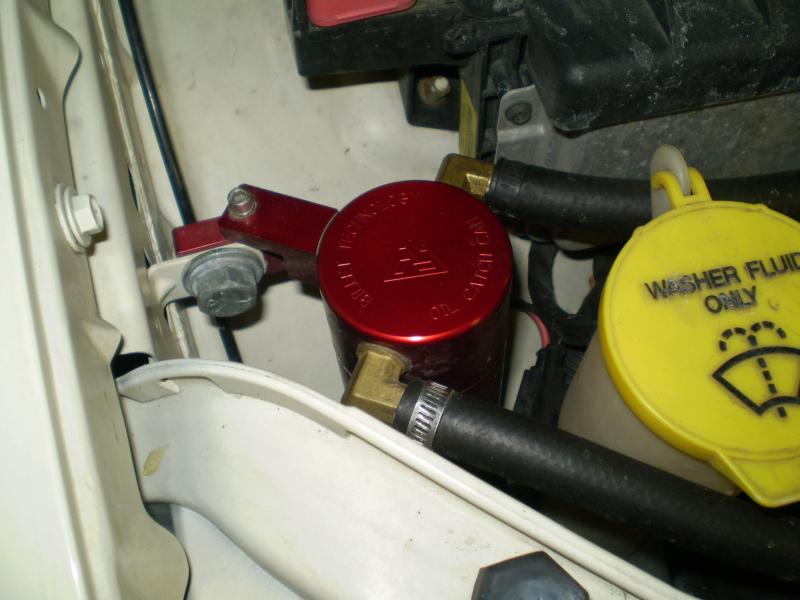
It uses 1/2 hose. Excuse the 1 hose clamp. I am in the process of making a hard line so it is a little out of sorts. Anyway, to empty you only have to unbolt the allen screw and pull it up.

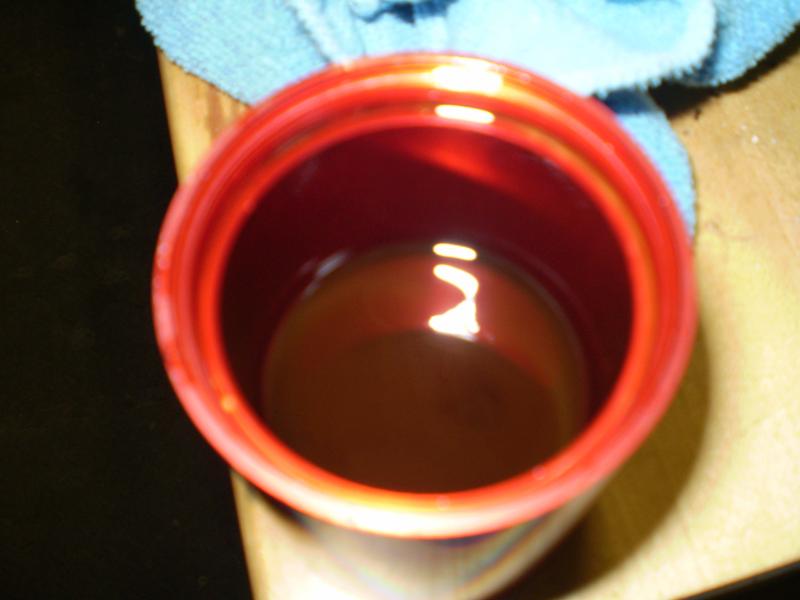
So, after 3,000 miles the can is half full with oil. I find it amazing that this thing catches that much oil in such a short time. And, there is nothing wrong with the PCV system or my engine. This is actually typical for anyone else using this system on a 5.7. It's sure nice to know that this oil isn't pooling up in my intake.
Again, if anyone has any questions about this, I'll do my best to answer.
As you can see, it is mounted on an existing mount tab on the fender. Yes the bolt that mounts it is huge. They machine the bracket to fit the hole size.
It uses 1/2 hose. Excuse the 1 hose clamp. I am in the process of making a hard line so it is a little out of sorts. Anyway, to empty you only have to unbolt the allen screw and pull it up.
So, after 3,000 miles the can is half full with oil. I find it amazing that this thing catches that much oil in such a short time. And, there is nothing wrong with the PCV system or my engine. This is actually typical for anyone else using this system on a 5.7. It's sure nice to know that this oil isn't pooling up in my intake.
Again, if anyone has any questions about this, I'll do my best to answer.
Thread Starter
|
Senior Member
Joined: Jan 2011
Posts: 386
Likes: 32
From: Indio CA
It wont matter unless over them the oil evolves in to a less liquid form. The only issue I can for see over time is the intercooler map sensor getting so many deposits that it stops working correctly. I'm not sure how mine was working with how bad it was covered.
Thread Starter
|
Senior Member
Joined: Jan 2011
Posts: 386
Likes: 32
From: Indio CA
C2C22616 - map SENSOR S-Type; 4.2L; w/Supercharger; At Intake Manifold
AJ812337 - map SENSOR S-Type; 4.2L; w/Supercharger; At Throttle Elbow

Senior Member
Joined: Apr 2011
Posts: 396
Likes: 32
From: marietta/ GA
I have been runnig a catch can on my STR for a while. Keeps the TB and blower rotors from getting coated with oil. I get about half the container filled every month or so when I dump it. Oil on the pistons also promotes detention especially on cars running higher boost and mods. I dont know why everybody loves the factory pcv hose? Mine is silicone 1/2" hose from the pcv to the can to my custom intake tube, no craking and it bends around like you want it.