When you click on links to various merchants on this site and make a purchase, this can result in this site earning a commission. Affiliate programs and affiliations include, but are not limited to, the eBay Partner Network.
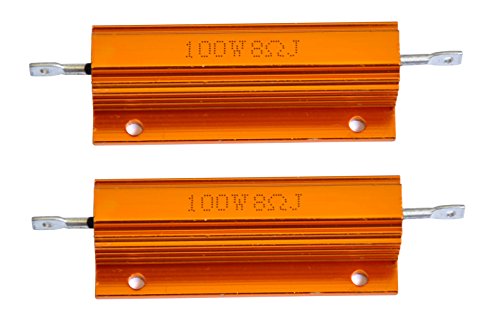
Please keep in mind from a safety standpoint the 100W, 6 ohm resistor will generate the same amount of heat ( I*V) as the lower power rated 6 ohm resistor. I expect the resistor heat sink will eventually heat sufficiently to detach from the double sided tape. Those resistor have mounting holes for a reason..... mechanical/thermal attachment. I assume you are going to replace the trunk liner (carpet) which will tend to trap the heat.
I'll correct my prior post but 12 VDC, 6 ohms actually produced 2 Amps of current.... all dissipated as heat.
I agree that the calculation is for 2 amps but looking at the very fine wire, could this carry a 2 amp current?
I also agree that the heat dissipated through the tape will cause it to not support the resistor hence I will mount it using the 2 holes as you suggested.
Do you have a preference whether it is better to instal the resistor vertically or horizontally?
Also, I assume that I need to scrape off any paintwork so the the resistor is mounted on clear metal? to help dissipate the heat?
Many thanks for your help!
I vaguely recall a forum member having scoped the CATS system signals. It's not simply a DC 12V signal across that resistor, I want to say it's something like a 400 Hz square wave (PWM controlled most likely).
Mounting vertical or horizontal should not matter.
I would recommend attaching that resistor to one of the body struts in the side of the trunk where there is plenty of air space from any plastic or combustible materials.
The only electrical connection to the airsprings are for Active Dampening ( a solenoid, aka coil, aka inductor). A PWM signal makes sense. The coil will look like a very high 'resistance' (impedance) load on the very sharp edges (rising & falling) of the PWM signal. What this would mean is while the peak voltage is 12 V, the average power dissipation would be as for a lower voltage. This would also explain why such small gauge coil wires don't fuse open. The x350 Technical Guide describes Active Dampening as either 'on' or 'off' so the coil would be expected to operate with at least two different signals.
Now I'm curious to look at this signal and see what it looks like. I'll see if I can get some photos.
djpxk8;
If this is the actual situation a larger value resistor will work. Generally speaking, a resistor can only oppose direct current whereas a coil can impede time varying current ( like a PWM signal).
Obviously it is your call but you can certainly sense I'm trying to influence you to a solution that generates less heat and draws less current from the ASM. I don't know what the output FETs or relays on the ASM are rated but both high currents and high temps are known accelerators for semiconductor wear out.
"Yes" I am recommending a higher value resistor in order to limit the current when 12 V is applied. I will admit I have not done this myself (I have the OEM Bilstein setup) and it will take me a few days to try out several different resistors to see how high you can go before the ASM 'thinks' there is an open circuit. You've probably already figured this out but limiting the current means a lower power rated resistor will work safely in this application.
You could simply terminate the connections by putting some resistors in the plugs, at least 5.4Ohms and capable of 65watts. I know of at least one S-Type where the resistor trick has worked, he used 10Ohm resistors. This stopped the error messages.
Thank for the links you Mike! Are you still able to see the waveforms Cambo posted in the link? I'm unable to see or open it.
I ask because with the airspring connector disconnected I see what looks like a DC, battery potential, signal.
I'm using a Ghz scope and at the scale below I should be able to see a 400 Hz (2.5 mS period) signal.
Ground potential is the BOTTOM of these waveforms so the signal is essentially DC.
Thank for the links you Mike! Are you still able to see the waveforms Cambo posted in the link? I'm unable to see or open it.
I ask because with the airspring connector disconnected I see what looks like a DC, battery potential, signal.
I'm using a Ghz scope and at the scale below I should be able to see a 400 Hz (2.5 mS period) signal.
Ground potential is the BOTTOM of these waveforms so the signal is essentially DC.
Best Regards, William
No waveforms show up on the old post--when you made your measurement was it at a standstill? At 0mph the shocks should have 0v on the coils. Once you start moving above 5-10mph they should turn on to go into soft mode.
You made the measurement with the shock connector unplugged? ASM could be low side controlled and without the load to complete the circuit it won't pull down. Not sure.
Some good news for you and others wanting to eliminate the CATS FAULT error having replaced your airsprings with a non-CATS compatible alternative:
I pulled the airspring solenoid connector on my 04 XJR and as expected a CATS FAULT error was generated.
I then plugged a 1 kohm resistor into the connector and the error was eliminated. The good news here is 1 kohm of resistance limits current to ~20 mA both reducing heating significantly and reducing the demand on you charging system. I suggest a resistor with 1/4 watt or higher power rating.
For those interested I also tried a 10 Mohm resistor and this did not remove the CATS FAULT. This is consistent with EsRay's (post # 19 above) observation from the troubleshooting procedure. I did not try any other resistors so I do not know where the pass/fail threshold is.
Best Regards, William
Last edited by wwr; Nov 18, 2019 at 05:40 PM.
Reason: correct units: Mohms vs. kohms
I then plugged a 1 kohm resistor into the connector and the error was eliminated. The good news here is 1 kohm of resistance limits current to ~20 mA both reducing heating significantly and reducing the demand on you charging system. I suggest a resistor with 1/4 watt or higher power rating.Best Regards, William
Hello William, do you have a link to the resistor you bought please?
Any 1 kohm with sufficient power rating will get the job done.
1/4 W is what I calculate as sufficient; go with 1 W if you want some extra margin.
The specific resistor I used was laying around but will be expensive and difficult to source: HVR C2654A102J, APC 1K Ohm 5% 5600 Joule