When you click on links to various merchants on this site and make a purchase, this can result in this site earning a commission. Affiliate programs and affiliations include, but are not limited to, the eBay Partner Network.
Chain Tensioners and P0171 P0174 - the scoop and a question
Hello one and all.
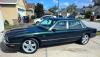
Thanks to the incredible resources available on this site, I was able last Saturday to perform the much-hyped upper timing chain tensioners mod. I say ‘mod’ and not ‘repair’ because somehow miraculously my 2001 VDP managed to get to 129,800 miles with the old tensioners. Not that they were free of fault: when removed, both had ominous cracks.
I should like to offer my 2¢ about the process, and say that following the instructions provided here by some illustrious home mechanics I was able to do the job relying exclusively on zip ties. My intention is to encourage anyone who wants to do it this way that this method posed no challenges. As far as other common hurdles: no (at least on XJ8s), the coolant reservoir or, for that matter, the molded coolant lines need not be removed. The driver’s side cover lifts nicely and clears without any obstruction. And, again, the other matter that has challenged fellow Jag-owners, the oil dipstick tube bracket: it can easily be cut with wire cutters into a c shape that slides in and out of the stud no-problem.
There was one slight annoyance: the passenger’s side new tensioner is installed “upside-down”, meaning the retaining pin will be on the bottom, meaning you’ll either have to remove it before installation which might tense your chain a bit more than is comfortable for the cam to be replaced in position - or, you’ll have to leave it in which means you’ll have to use some dexterity and a pair of lock-pliers to remove it after installation. Either way, not a big problem.
All in all, the entire job took about 4 hours of slow, careful, leisurely work by a non-by-any-means pro (myself). The only cred I have to my name is two previous XJSs. As any V12 owner will confirm, a mere tune up in these cars will make any project on a XJ8 seem laughable.
So, not to reprimand us spoilt owners of these masterpieces of effortlessness, but to encourage anyone who has doubts about whether they can tackle this project successfully to do it. All it takes is some basic tools, common sense, and method.
On an altogether different note: I’ve been chasing a P0171 and P0174 Restricted Performance problem forever now. I’ve replaced the secondary breather hose, and inspected the large one on the passenger’s side. I’ve replaced the o-ring that sits on the throttle body. And I’ve cleaned my MAF sensor. The weird thing about this occurrence is that it only happens under load (on a slope for example). I’m thinking that if it was a vacuum leak, it would happen regardless of load, whereas if it’s a fuel pressure issue it would only manifest itself under load. Am I right in my thinking?
Taking the miles into consideration, perhaps the engine mount especially on the P/S is weak/broken which lifts the engine and has broken the underside of the intake bellows.
Sounds very plausible indeed - although my bellows look to be in very good shape. Still, if the mounts are shot and the engine moves (like I described, on slopes), it might be pushing the bellows about and creating a vacuum leak. I'm saying this because my air filter housing is actually not held by the bolt, like it should. The grommet has gone walkabout so it's basically just sitting in the holes by its pins. But not bolted. So any movement might be creating a slight opening: in the MAF to bellows connection, or even bellows to TB.
I shall investigate sharpish, namely this Saturday when I'm doing a brake flush and changing front upper shock bushings.
+1 clean the MAF. But maybe some other issues based on your changing the secondaries: check your work; gaskets on the cam cover that are not correctly sealing (torque or poor fit), leaking around part and full load breathers, bad fit of air pipe at throttle body, poor seal at MAF or air pipe at filter housing, even an air leak at the dipstick. Double check your plug torque.
171 and 174 are telling you you have a leaned out stoicheometry. A light mist of brake cleaner around any of these mated surface will likely expose the problem. Easier with a code reader.
Thank you both. I'll have LT and ST fuel trims today at idle and at 2500 RPM. I'm learning about them as I go and produced a log of a short drive in normal temp (inc idle, traffic, and highway driving), but it means naught to me, except seeing λ and trims having an inverse relation. I'm posting just for reference, though I'm pretty sure it's useless.
I'll update with simple idle and 2500 trims later today.
This is an excellent article I read awhile back regarding P171 P174 issues....yes, its a Range Rover, but the code symptoms are the same. It starts kind of techy, but it gets easier after the graphs....hope it helps. Mass Air Flow Sensor Testing,P0171-P0174 System Lean | MDH MOTORS
Thank you, Highhorse. I read it with much interest. And it inspired me to look at this huge log I extracted this morning.
So, basically, here's the pattern:
Every time the car found itself in over 45% "calculated load", regardless of speed of RPM, the LT trim shot to over 10 and as high as 11.7. The ST trim fluctuates wildly but it's at a full 25 during these periods. Then, when the load goes under ~40%, both trims fall, more so the LT - within less than a second.
I don't know the threshold for MIL and "Restricted Performance" but this was a trip that didn't at all push the car, on a pretty flat road. I'm imagining on a serious slope on the highway, at higher loads, it throws the 171 and 174 codes.
I'm not sure how much I learned from this that I didn't know before, but I probably need to look at these numbers more carefully.
nonfinito, albeit that article tells us all those neat little read outs....it still comes down to what most have said...check the MAF and use a MAF only cleaner (or you'll be buying a new one). Its the quickest cheapest fix and causes the fluctuating of the other sensors. If the MAF is incorrect, the air/fuel is incorrect and the O2's read incorrectly. Why over analyze the situation, even though it is really neat to use that OBD reader (I have one also). Overall stay with basic analysis before laying into intake and fuel trims first.
An update about the codes: I did a thorough clean of the MAF sensor. By 'thorough' I mean that, although I had sprayed it last week, upon inspection I saw that one of the two small wires was still black. This time I gave it a much better clean.
The car has been running significantly better since. And no codes.
It looks like that was it. I feel rather silly now.
I like to take it out and spray until sopping wet, a little dabbing
with a soft camel hair brush which is excess stock from her makeup
stash, then spray again. Air dry on dining table/workbench.
An update about the codes: I did a thorough clean of the MAF sensor. By 'thorough' I mean that, although I had sprayed it last week, upon inspection I saw that one of the two small wires was still black. This time I gave it a much better clean.
The car has been running significantly better since. And no codes.
It looks like that was it. I feel rather silly now.
Thank you.
Don't feel silly (being humble yes, but silly...no), you didn't spend a ton of cash and a bunch of time for a simple fix. Be happy it worked and on to more driving adventures.
The key to the MAF diagnosis was the worse trims required at high load. An intake manifold leak would be less significant there, and although low fuel pressure could do the same, that is not as often reported on these cars. Glad you found it.



 Chain Tensioners and P0171 P0174 - the scoop and a question