When you click on links to various merchants on this site and make a purchase, this can result in this site earning a commission. Affiliate programs and affiliations include, but are not limited to, the eBay Partner Network.
Bit of a bonus - I just took her out for a test drive and my A/C temps are a good 10 degrees f colder than they have been for the what seems like the last two years, at least this and last year!
That old valve has been on the fritz for some time by the look of it, pretty amazing result though, I was really surprised when I saw the temperature gauge!☺
Thanks Don, I hope it's the heater hose too, but even if it is (#5), it too seems well buried and out-of-sight.
Do you just remove the intake plumbing TB bellows etc to get at it or does it have to be changed from under the car?
My recollection is that it is not easy to access from under the car due to all the components in the way - steering rack, subframe, starter, oil filter, etc., and the intake manifold obstructs it from above. Every time I've replaced that hose I have just disconnected the intake manifold and tied it back away from the cylinder head. It's not nearly as difficult as it sounds. You remove the air intake plumbing and throttle body, disconnect the various breather hoses and electrical connectors, then remove the screws and nuts that secure the intake manifold and just carefully pull it back away from the head. Tie it back with a bungee cord padded and clipped to the wheel arch or such. Now you have access to everything on the left side of the engine. I wish I had taken photos one of the times I did the head gasket on our '88 and '93 (twice) but I was always in a hurry to get the job done over a weekend. But it's really not hard to pull the intake manifold.
Well, good news is that the valve WAS the source of the leak so we'll have to save the intake manifold job(s) for another day, hopefully way in the future or better still, never..
At least I have a couple of $3 intake manifold gaskets in stock now!
Well I'm afraid the source of the leak wasn't the water valve after all ...
Still, glad I replaced the valve anyway as my A/C is now performing at peak efficiency.
The leak source was, in fact, the water rail gaskets - or should I say the lack of water rail gaskets.... Much to update, but until the whole job is complete and the old bus is rolling again I'll delay further details. For now, I'll just say that PO's or their "mechanics" that install water rails without gaskets, just using silicone ....well, you can guess what I'd like to do to them.
Amazing that it lasted this long like that (7 years at least) ....however, this week, there were issues directly related to that silicone 'gasket' install that caused major clumps of hair to be pulled out while screaming profanities ..
more to come
Larry
Last edited by Lawrence; May 30, 2019 at 11:00 AM.
I'm sorry for your " inconvenience"... I need to change a starter, and I'm thinking while you're in there on yours, change your starter and mine will feel better for it.... Maybe?
Next time something "goes" down in that bottomless pit below the intake manifold, she'll be off to the knacker's yard, I can stands all I can stands and I can't stands no more!
As I have repeatedly tried to encourage you, disconnecting the intake manifold and pulling it away from the cylinder head for access to the left side of the engine is not nearly as difficult as you think. I've done it many times on AJ6s and AJ16s and it truly is the easiest way to gain access to all those leaky seals, the starter, etc. Below are links to some relevant photo albums - sorry the large images are still down but the thumbnails and descriptions will give you an idea of how beneficial it is to just pull the manifold.
Don, I appreciate the encouragement however my nightmare began AFTER I pulled the intake manifold back....will update with pics on the weekend when I can get to the car again.
Don, I looked at your "coolant hoses and water rail" link and was surprised to see that you didn't mention part number EAC9745, the water rail gasket(s)?
Don, I looked at your "coolant hoses and water rail" link and was surprised to see that you didn't mention part number EAC9745, the water rail gasket(s)?
On my '93 there were no gaskets - only silicone - so I think I used Permatex Ultra Grey RTV, which forms a more rigid bond than Ultra Black.
There were also no gaskets on the oil filter housing, but I used gaskets when reinstalling it because I got a good deal on the gaskets as part of a box of NOS parts I found somewhere.
I've never had any trouble with Permatex Ultra Grey RTV silicone where manufacturers used sealant in lieu of a physical gasket, and once I sealed our '93 it never leaked again. Right now, I have the engine out of a 2007 Mercedes SLK350, and like many modern engines the upper oil sump, cam covers and many other sealing points use liquid sealant instead of physical gaskets. As far as I can tell, Mercedes now uses gaskets only at high pressure junctures or where it would be difficult to clean silicone from the mating surfaces while replacing a component, such as the water pump.
The sealant did work for at least seven years on my car, possibly even from new (if the gaskets were a delete) - however, the parts catalogue shows gaskets at the water rail throughout the VIN range and even for the X300 models.
The gipe did seal the water rail from leaking, yes, but it did not isolate or seal the lower water rail bolts from the coolant completely, as evidenced by the severely rusted threads. One bolt was so heavily corroded that it seized solid in the block and sheared off as soon as I tried to remove it. I learned later that this is not the only case where this happened and apparently lucky that only ONE bolt snapped.
I don't think the coolant could have seeped to those bolts quite as easily if gasket material had been used on the rail in the first place.
I don't think the coolant could have seeped to those bolts quite as easily if gasket material had been used on the rail in the first place.
When sealant is properly applied along the insides of screw holes it should protect the screws from corrosion, unless the screw holes communicate with the coolant jackets/passages. I can't remember if this is true of the water rail screw holes but it would be worth checking the Workshop Manual. It may call for applying thread sealant to the screws and if it does, that would explain the excessive corrosion of some of the screws.
Sealant is normally fine for cooling system joints as long as the surfaces are properly cleaned and dried and the sealant properly applied. I think I remember that Haynes specifies sealant for the thermostat housing and water pump.
If it breaks,at least here is a good place to do it.
OK folks,last Sunday,my friend Larry from Victoria came by in the early afternoon,while we were sitting around in the middle of the street having our neighborhood BBQ.
We chatted for a bit,then he was off to see another friend up island.Larry said he might swing by later on in the day.
Well, after a great BBQ,and many beers in the hot sun,Larry did swing by,with a massive coolant leak!
We got the car into the back yard,got her up on stands and had a look.Water was coming out FAST!
Me being 3 sheets to the wind with the sun going down,am not going to have a go at this until tomorrow after work.
So, arrangements were made,Larry would come by next day and have a go at the problem.When I got home,there I found a very dejected Larry,and his buddy trying to wrestle with a broken bolt.
SOOOOO,I hauled out my welding machine,and made 20 or so attempts to weld a nut onto the broken stub,got it moving,but no go.
We as a tired group then removed the manifold,made more arrangements,and I would procure more tools and get them home the next day.
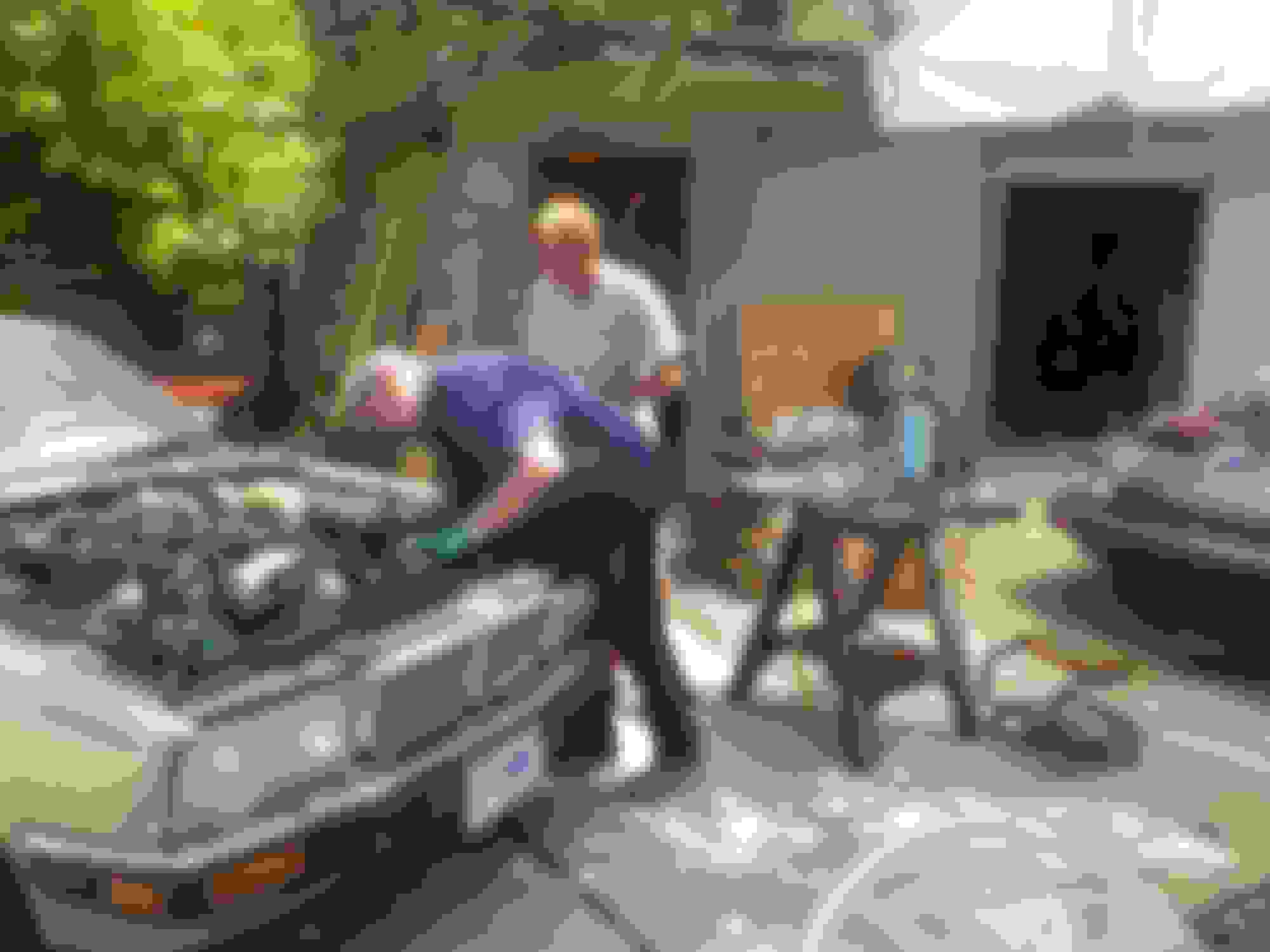
Larry's car up on the patio,with My Jag looking on After two hours of fighting,welding,and an acetylene torch,I got the bolt out
So we are left with a mangled flange,never mind the threads.It all had to be redone.
I proceeded to hand draw-file both flange surfaces back to flat and true,and fit the water rail to the block in a precise fashion. Drilling and tapping tools at the ready Block draw;filed,now the rail.... Gaskets cut from correct gasket materiel Tap going in... High quality inserts! Inserts going in,lots of room to work.
OK,now we have something we can work with.New threads,well fitted water rail,thin smear of sealer on the gaskets and wer'e done.WRONG!
It has to have a new water rail BI$CH hose,cause i have one here already,and Larry popped round on the Thursday with some other hoses in better shape than the ones currently in place. Water rail in place,properly! Larry arrives to check progress Fresh hoses,cleaned spigots,going back together Me,mechanic for 35 years,focused! Putting the Jag back together













 update on the leak