When you click on links to various merchants on this site and make a purchase, this can result in this site earning a commission. Affiliate programs and affiliations include, but are not limited to, the eBay Partner Network.
With what we know so far it sounds reasonable. A battery place like Battery World or any good auto electrician can load test you battery and confirm if its deteriorated and needs replacing. Unless of course you would prefer a new one, just to know where you are at. I do that sometimes with new cars.
Is your ignition standard or has it been converted to electronic? are there points under the distributor cap?
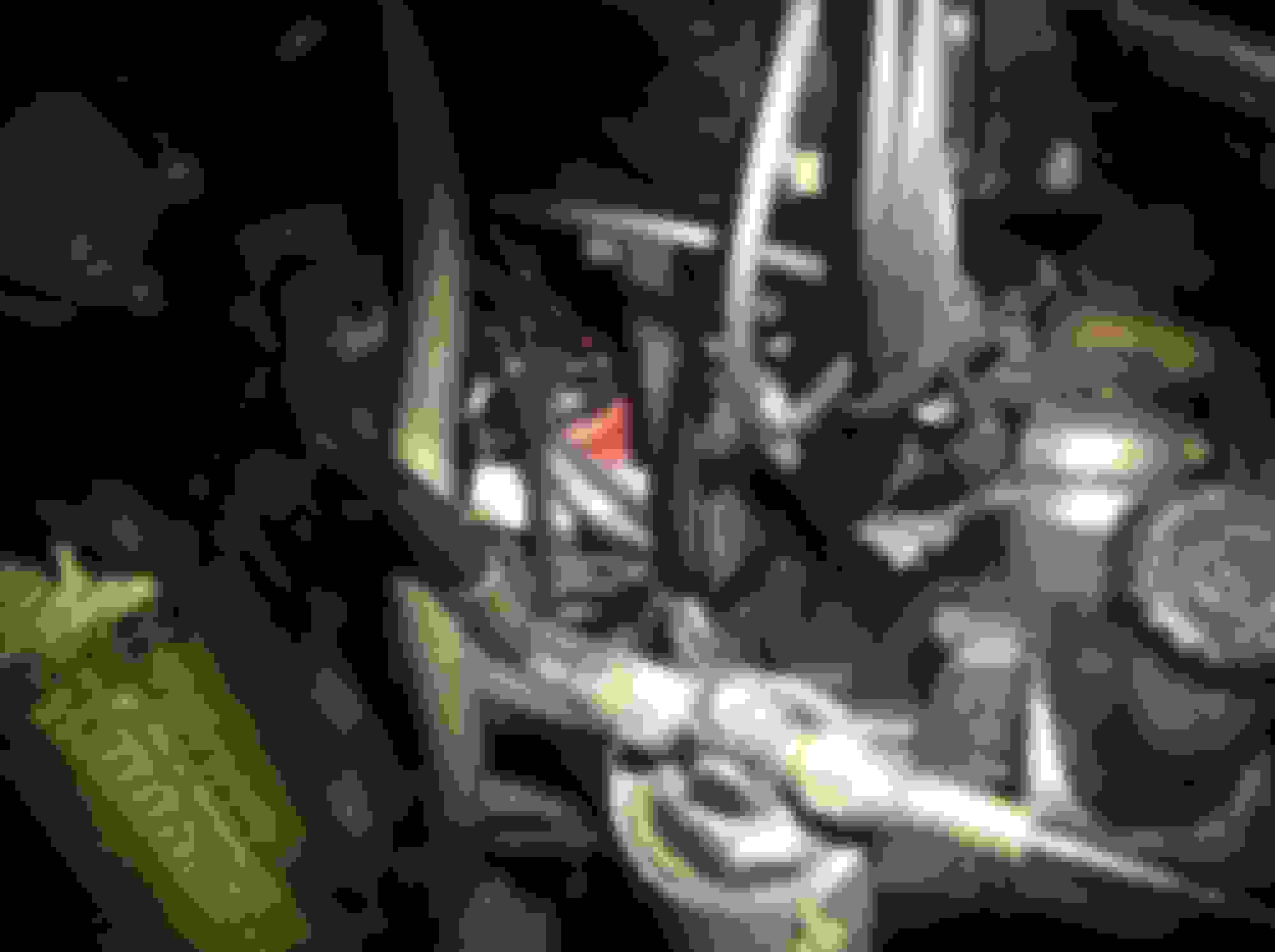
Just took a photo ,bit dark.....it appears to be normal dissy with rotor and the coil looks normal except for the white bit on the bottom....hope this helps.
I can duck out and take closer shot.
That white thing is the ballast resistor for that coil.
Now it gets specific.
That coils looks like a Bosch GT series. They come in either GT40, or GT40R.
The GT40R requires that ballast.
The GT40 does NOT require the ballast, but I have seen it fitted to the none R coil, and it reeks havoc.
Step1:
Volt meter set on DC 12V. Ign ON. Probe one end of that ballast. You need 12v ish on one end, and about 7v ish on the other end.
Then probe the +ve stud of the coil, and you should have the same volts as the lower end of that ballast.
I expect to see what I said, as it is a SIMPLE system.
Now pop the dizzy cap, and look at the innards. There should be a set of contact points inside, and a small cylinder with a wire coming out of one end , called a condensor.
The points are opened and closed by the rotation of the centre shaft, and the lobes (6) on that shaft. The points wear, and no longer open, and if that happens NO spark.
That is very SIMPLISTIC as to what goes on.
At some stage we need to confirm what spec that coil is, as in an "R" or a none "R". I am betting on an "R", and Bosch were very good at putting a sticker on them, stating GT40, or GT40R, simple. Other brands had a stamping IN the base, "use with ballast resistor", simple again.
Check those volts either end of the ballast first, and at the +ve of the coil, then lets go one step at a time until it starts up.
A great treatise on the "good old" days of condensor and points ignition.
I recently worked on a pair of one lung engines using these, but relying on a magneto for juice. But, this time, I used my VOM to detect continuity and lack there of across the points. In olden days, it was clean, set gap and hope! Then, up one. PUt a lamp in series on the - to coil wire. Crank engine. Bulb should go on and off. also a means of that critical time of "when the points just open. Static timing method of old.
Piece of cake on my VW beetles.
Grant, checked with m,meter and ballast has 10.7 left and 5.6 right (L&R as per photo). The positive on the coil (left side as per photo) has 5.3. So coil positive 5.3 ballast end 10.7. Also popped dizzy cap and saw points and condenser.
Just do the battery volts, should be 12.?, and that is what I would expect to see at the high side of the ballast, or very close.
If the battery is 12.? and the hi side is still 10.7, you got huge voltage drop, and that is NO good.
S2 cars have issue now with the electrical part of the ignition switch, age related, EASY fix, so panic not.
Once the battery/ballast volts is confirmed, leave that meter attached to the hi side, crank the engine. You can leave the cap off for this. Note the volts reading whilst cranking, they should be not far below battery readings, and I bet yours drops right OFF. Switch issues I reckon.
Readings I would expect are:
Battery volts of 12.5, cranking AT the ballast Hi side 11.7 MIN.
Battery at 10.7 (yours), cranking AT the Hi side of ballast 9.8 MIN, TOO LOW.
That coil is basically a 6 volt coil, and with the ballast runs on "about" 7-8 volts, and is just sweet. Anything lower than 6v and the coil will not supply a good enough spark.
Then the next thing we need to establish is the "start by-pass" for that ballast, but that can wait until the readings above are in.
I am off to pay for our trip to Honolulu and Vegas, so be back in few hours, HAVE FUN.
Last edited by Grant Francis; Jul 6, 2015 at 09:32 PM.
Hi all, after a great learning journey with the guidance of Grant Francis on PMs, telephone and emails ( my sincere thanks to Grant whom without I would not have gotten to where I am) the CAT ROARS!
We found the following;
Firstly we didn't have spark so checked battery at 12.5 then hot lead at alternator at 12.5 and hot terminal at fire wall near brake booster at 12.5. With ignition on we then checked coil ballast high side and was 10.8 and. Low side 5.3 and the coil +Ve was 5. On cranking the ballast and coil went up slightly. We bypassed the ballast and went direct to coil where on crank we got 9.5v. We havnt ascertained if the coil is 6 or 12v at this stage . With this bypass in place we got a good spark. So cranked it over and over and no start. We summized that with a good spark and no start it must be fuel. Having already checked the flow to the carbie bowls we needed to check if their was fuel in the bottom of the carbie itself. Taking the top off one carburettor the circlip / collet had fallen from the needle as the grub screw had come loose (I think that's what it's called) and the circlip rolled into the inlet opening. After some heart pupitations I managed to get it out and reassemble and refit. Checked the other carbie just to be sure.
Cranked her over and she fired up straight away. Next step is to check the coil for 6 or 12v to see if the ballast is required.
Once again my thanks to Grant.
If that coil turns out to be a 6v version, I would dump it. Ballast aka resistor is a huge waste of energy. Get a 12v coil and dump the ballast.
Eliminates extra circuitry as well.
Got my revised torque converter lock out relay and harness figured out. Solder in today. If weather permits. Gone from extreme heat to thunderstorm threats!!!
Hope it's ok to bump up this post as I've been referring to it as I work through the non-start issue I'm having with my car. I bought it about a year ago now, and after a few months had a non-start. Lots happened since then, but now trying to get this up and running again. It's a 1974 XJ6, which I believe is a Series 1.5. Have found it has a mixture of parts from both series 1 and 2.
Been following the steps above:
Step 1 Volt meter set on DC 12V. Ign ON. Probe one end of that ballast. You need 12v ish on one end, and about 7v ish on the other end.
Then probe the +ve stud of the coil, and you should have the same volts as the lower end of that ballast.
Have confirmed the coil is a GT40R, to rule that out of the equation I ordered a new one which has arrived and I've installed today. On one end of the ballast Im getting 11.5V, and the other around 6.5V.
When probing the +VE stud of the coil, I'm only getting 0-1V. Am I correct in assuming that the 7V end of the ballast should be wired directly to the +VE stud on the coil?
Welcome aboard Mate, when time permits place an introduction in the new members section where you’ll receive a warm welcome. I’ve added you to the NSW Roll.
Its been 5 years since I sorted this problem and most was done over the phone to Grant Francis so I cant answer your question....However I’m sure Grant will be along and will have answers for you.
Grant, thanks for the clarification about the car series. Will refer to it as a series 2 from now on, even though it runs series one brake pads (3 pot caliper, that was very confusing).
Run a fresh wire, as I suspect yours in broken, either inside the terminal (common as mud), or the wire itself (rare).
So I re-run some some wires, and ended up with 12V at one end of the ballast, 7V at the other side, which was then joined to the positive end of the coil (reading 7V).
I put a spark tester on cylinder 6, and crank it, there was some spark, but very very faint. I also tested it with a screwdriver to confirm, and it was very small. With my other cars, you normally get a bright white spark, this was more like a yellow sparkle.
I did replace the distributor parts a while ago, and the car was running fine. Have pulled down the dizzy again, and can't see any issues there. I don't suppose anyone has a photo of what wires are connected to their coil for me to cross reference?
OK, sounds like the coil is a "standard" 12v coil, and with a ballast your need a ballast coil.
PANIC NOT
Grab a wire, run it from the 12v side of the ballast, to the +ve of the coil, check you spark now, bet its good to go. If so, remove the ballast, and simply run the 12v wire to the coil and drive on.
There should be a 2nd wire om the coil +ve for start over ride, and I reckon that is missing.