When you click on links to various merchants on this site and make a purchase, this can result in this site earning a commission. Affiliate programs and affiliations include, but are not limited to, the eBay Partner Network.
Could you help me understand how the 2 MAF sensors on our XK/XKRS work?
Please chime in.
Bank2 is running +7% LTFT I've been hunting down the issue for some time now.
I've done a smoke check for vacuum leaks, none to be found.
I've installed matched OEM air filters.
Both MAF sensors have been cleaned with CRC MAF cleaner.
I'm trying to understand if the MAF sensors are tied to the BANKS for fuel trim,
even though they both go into one throttle body and one intake T.
How does a dual MAF system work, is it taking the average of both sensors?
When I unplug the drivers side MAF there is very little change in STFT which I find to be suspect.
When I unplug the passenger MAF sensor the STFT goes crazy on BOTH banks.
I did some serious reading in the workshop manual / training PDFs.
Airflow is measured by adding together the two MAF readings and outputting to ECM.
If one MAF is not reading correctly the engine defaults to other MAF and other sensor data.
I'm still unsure if this could be causing a difference in Bank1 and bank2 on fuel trims.
If you are not getting any codes, I wouldn't bother. Seems like a normal reading:
Since both intakes converge, you can't possibly trace a high trim reading in 1 bank to an air leak in 1 intake or the other. The oxygen sensors are responsible for making fuel trim adjustments.
Also, a vacuum leak and an air leak are not the same. Took me a lot of smoke pumping to fill the entire crank case and catch a vacuum leak in the oil filler tube. And with the intake off during the smoke test, I didn't see the air leak from the rubber intake coupler. Just some things to keep in mind...
Thanks for the input, I will remove and re-clean the drivers side MAF and see if I can get
a different result. if not I will swap drivers and passengers MAFs.
The reason I'm trying to get to balanced LTFT is cause I will soon flash a custom map
and I need a solid base line.
Update:
Bank2 MAF sensor reading +8% adding fuel
Bank1 MAF sensor reading normal about +2%
After unplugging Bank2 MAF, engine stumbles and LTFTs go high +23%
plug it back in and go to the other side,
After unplugging Bank1 MAF engine barely changes, fuel trims go up a bit
This leads me to believe that Bank2 MAF is receiving MOST of the air,
thus having a larger affect by unplugging Bank2 MAF.
I removed the upperhalf of of the entire intake system inspected for leaks
Both MAFS have been removed and properly cleaned.
I cleaned the throttle body, resintalled intakes, car is running well, LTFT is still 8% on bank2 though
Does anyone know how to clear LTFT without using SDD?
Update:................
I cleaned the throttle body, resintalled intakes, car is running well, LTFT is still 8% on bank2 though
Does anyone know how to clear LTFT without using SDD?
LTFT by its name takes a long term to adjust. Hence the "Long Term Fuel Trim".
Resetting it won't do much anyway.
Drive it as hard as you can for as long and far as you can. The LTFT will adjust itself.
This leads me to believe that Bank2 MAF is receiving MOST of the air,
thus having a larger affect by unplugging Bank2 MAF.
Does anyone know how to clear LTFT without using SDD?
Depending on what OBDII tool you have, you can actually monitor flow rate on each sensor. However, I feel like you are chasing problems that don't exist. From personal experience, this only causes more issues. 8% reading is normal, per the manual - especially if you are not getting any codes.
Update: I removed both MAF sensors, this CAN be done without removing the air boxes!!
I used an alan wrench to slowly remove the 2 screws securing the sensor to the sensor housing
the alan wrench can fit in a crevice behind the air box and works like a charm with a little patience.
Note that you cannot remove the sensor without rotating them carefully and removing in an exact
angle where it just slips out. Getting it back in is tricky as well.
After removal, I cleaned both MAF sensors, though they appeared clean.
I confirmed that the dual MAF system in fact measures one sensor against the other and gets
the resulting voltage to convert to airflow. MAF sensors are not bank specific, so this was not my problem.
I'm wondering if maybe my muffler delete and X-pipe could be causing 7% lean condition in bank 2.
Maybe I actually don't have any problem, and should just have the ECM remapped to correct my fueling?
Next step is to run fuel injector cleaner and intake valve cleaner through the MAP sensor port behind
the throttle body to decarbon the intake valves.
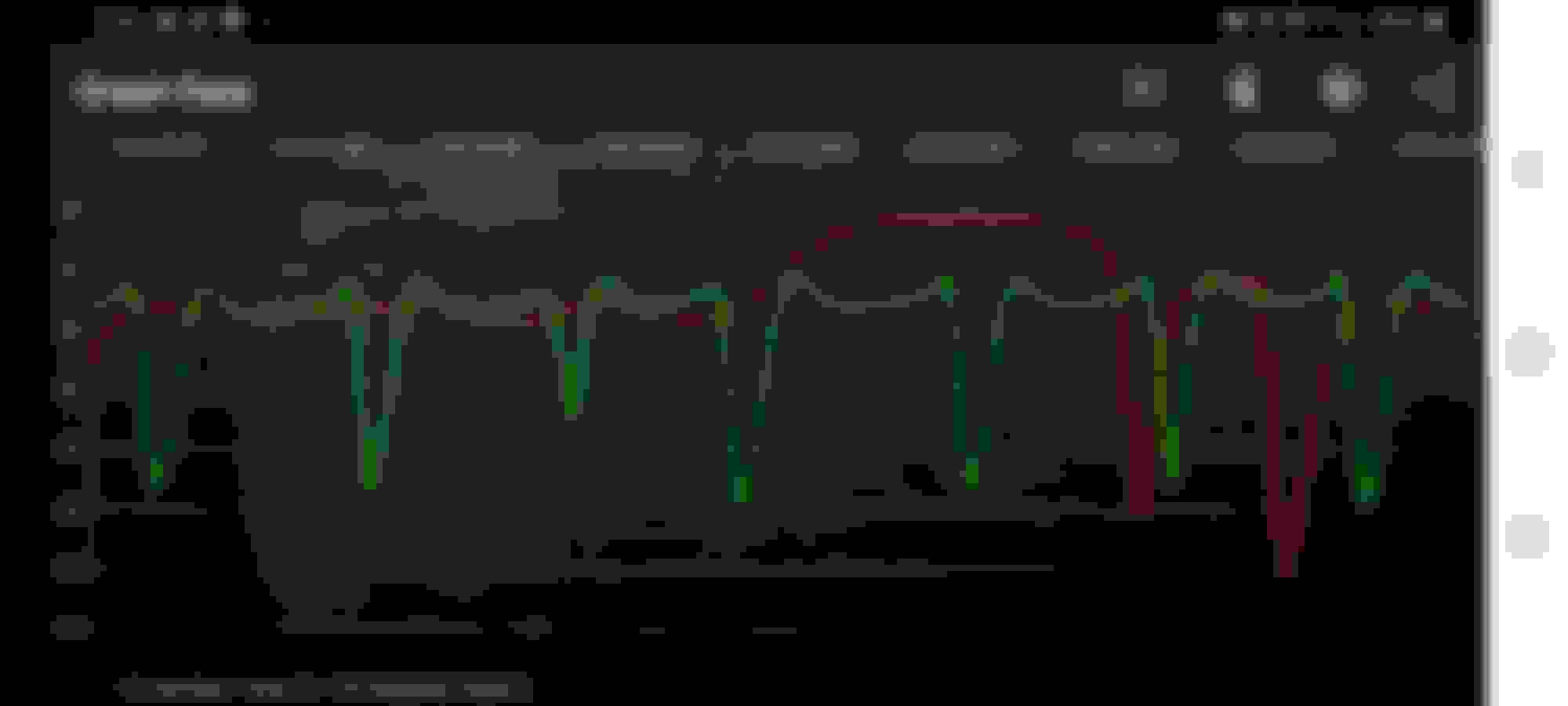
Update: I graphed my O2 sensor data while at idle and on a drive. both O2 sensors graph similarly
however O2 sensor for Bank2 shows a very sharp 90 degree dip every 5 seconds or so.
Maybe I have this wrong but the MAFs don't directly correspond to the cylinder banks though do they, after all they both feed into one supercharger. If you're getting fuel trim variance then surely that's down to something after the supercharger, e.g. a fuelling issue, failing cat, faulty O2 sensor etc.
It was described to me recently that the reason for dual intakes is to do with measuring resolution. A MAF in a larger tube is less accurate than one in a smaller tube, so they have dual small intakes and calculate the overall airflow in the ECU so as to improve driveability and fuel economy.
On other cars I have. I usually consider the oxygen sensors as a maintenance items and replace them at 150k-200k km at the same time when the spark plugs are normally due.
Here some other O2 data,
the data seems off to me,
Maybe someone with more expertise can chime in?
Thanks
Has the battery been disconnected in the last 500 miles? Sometimes the Readiness tests take a LONG time to finish after a disconnect. Last time for me it took about 350 miles to complete.



 Dual MAF sensors function and logic