When you click on links to various merchants on this site and make a purchase, this can result in this site earning a commission. Affiliate programs and affiliations include, but are not limited to, the eBay Partner Network.
That AJ6/16 engine is a tough & trouble free bugger.
I agree, but as I'm in the middle of a swap it's not as straightforward as I initially thought. The engine bay of the Daimler is much bigger than a S Type and I'm running into space issues.
I do know of a person who did put the XJR engine into a Mark 2, and the only thing that remains of the bodywork forward of the windscreen is the outer wings. Everything else he fabricated, and basically grafted an XJR front end under a Mark 2. Not simple!
Has the OP taken the head off their engine yet to see the magnitude of the problem? Its not difficult to get the head off albeit its a bit heavy but it will show you what the problem is (assuming they have tried the other things like turning the crank pulley with a big socket/bar etc.
Installing an AJ16 engine into the car is a lot of work and is like using a sledge hammer to crack a walnut.
I agree, but as I'm in the middle of a swap it's not as straightforward as I initially thought. The engine bay of the Daimler is much bigger than a S Type and I'm running into space issues.
I do know of a person who did put the XJR engine into a Mark 2, and the only thing that remains of the bodywork forward of the windscreen is the outer wings. Everything else he fabricated, and basically grafted an XJR front end under a Mark 2. Not simple!
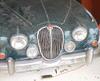
Ask Peter. It's his idea. I know of no one that has actually done it. I'm just commenting on what a tough engine it is. I mix with a bunch of Jaguar purists that only do subtle unseen mods. My car looks like it just came out of Browns Lane only better finished. All my little mods like greater capacity radiator & pointless ignition etc can't be seen. It's even still positive earthed & has helmet battery leads with centre screw. Alan Wiedie has just found me the washer bottle lead cover X 2 wire & correct decals for the blower motor. They are on the way with USPS.
Picture Courtesy of Alan Wiedie.
Last edited by Glyn M Ruck; Apr 24, 2022 at 06:58 PM.
My car looks like it just came out of Browns Lane only better finished.
If you ever find your way to Canada you must meet Gregory Andrachuk, his Mark 2 is the same. His cars are all perfect, and concours winners. I'm less of a purist, but I'd never consider a non-Jaguar engine. The curse of being an engineer, I always want to make machinery better.
If you ever find your way to Canada you must meet Gregory Andrachuk, his Mark 2 is the same. His cars are all perfect, and concours winners. I'm less of a purist, but I'd never consider a non-Jaguar engine. The curse of being an engineer, I always want to make machinery better.
He and I already communicate by e mail with his beautiful primrose Mk2. One day he just e mailed me out of the blue a few years back He's owned some beautiful cars. His 1992 Jaguar V12 Vanden Plas was magnificent. I think it's now in Beijing IIRC. He's now found a low mileage S Type.
Last edited by Glyn M Ruck; Apr 24, 2022 at 10:35 PM.
Space and fit is the first issue in swapping any component. It's particularly true of engines in the Mk2 engine bay. Even an XJ 4.2 is likely to have the oil filter in the same place as the Mk2 steering column. I raised the AJ6/16 for the reasons I mentioned: reliability, weight, power and it's a Jaguar straight 6 that's carries the XK's DNA. I looked into it for my car as the cost of one is very favourable compared with rebuilding an old XK to the same level. As Primaz has pointed out, parts for the XK can be very expensive especially if you are looking for a bit more performance, much more expensive than DIY sheet metal work on the inner wings. I eventually came down against the swap on originality and the possible loss of the car's historic registration. However, it is doable and several have. One of the most notable and better documented was FiBoy. Sadly, since his death, his website has expired. Though Beecham and the like have done it, I'd say that using the supercharged version of the AJ6 is very ambitious. The Eaton supercharger is a big lump on the side of a big engine. Even a relatively simple (???) mod like adding decent intake runners to the XK head hits major space problems between the steering column, the footwell, the inner wing ... .
Apologies for resurfacing an old thread, however I'm having some difficulty in finding straight answers for the nitty-picky questions. Following on from above, one of the common elements that keeps coming up is the idea that you could just swap out the the triple manifold on the 420 for the double 340 manifold, whilst in turn increasing the size of the SU carbs for the 4.2 to draw correctly.
With this logic, is it then possible to put a 420 manifold on a smaller 340 engine, in turn giving it triples? Would it fit in the engine bay?
Again apologies for resurfacing an old thread, just looking for some answers and another way to squeeze some more power out of a 3.4 which is already a great engine.
Just to clarify, there is a 420, which was a small saloon made from 1966-68 and there is the Mark 10/ 420G, which is a completely different car. Made from 1961-70. The 420G ("G" for grand, as in big) had triple 2" SU carbs, while the 420 had double 2" SU's.
A triple manifold will not fit in a small saloon like a 340 without cutting the bodywork. A triple carb setup is too much carb for a 3.4 anyway. A friend of mine is into vintage racing and did up a high performance E Type engine that actually did make 270 hp - it needed to run on 110 octane fuel. At full throttle on a dyno the pistons of the carbs were only about 2/3 of the way up, indicating they still had plenty more air that they could move, but the engine can't breathe any more.
To be honest, on a reasonably stock 3.4, a pair of standard 1-3/4" carbs are not a restriction to making more power.
Last edited by Jagboi64; Apr 25, 2023 at 11:11 PM.
Is the 340 a 340? Some early '340' sold in the US were effectively re-badged Mk2 and may well not have the straight port cylinder head. The genuine 340 has a 1J ... chassis number. The straight port head has the spark plugs of numbers 1 and 6 cylinder toward the end of the head (on the outer side of the respective combustion chambers). In fact, the genuine 340 engine is a very nice engine and I'd stick with it unless it's irreparable.
The inlet manifold from a straight port head 340 can be used with its original carbs or 2 inch carbs on a 4.2 engine. It's possible the manifold ports to the carbs are already 2 inch (i.e. Jaguar may have used the manifold of the 420 or XJ6). If not, it's easy to open them out.
As Jagboi said, fitting triple carbs requires moving things around and surgery to the inner wing.
My 340's VIN number is P181395 (so probably started out as a MK II ) and has the straight port head, I know it does as I did the engine many years ago.
I don't understand your statement "The straight port head has the spark plugs of numbers 1 and 6 cylinder toward the end of the head"
That's the same for all straight six's, not just Jaguars, but being different for Jags as number 1 is at the back of the engine rather then at the front.
Just because it's a straight port head doesn't change anything about the spark plugs and where 1 and 6 is.
The firing order of 153624 remains the same.
Even my Bentley is the same with it's different firing order of 142635, 1 and 6 are at the far opposite ends to each other.
I don't understand your statement "The straight port head has the spark plugs of numbers 1 and 6 cylinder toward the end of the head".
He means the placement of the plug within the combustion chamber. On a straight port head, on cylinder 6, the spark plug is on the forward side of the combustion chamber. On a B type head, the plug is on the rear side of the combustion chamber on that cylinder. The plugs are reversed on cylinder 1 as well between Straight port and B Type.
Last edited by Jagboi64; Apr 26, 2023 at 02:39 PM.
The picture above is a 'B' head
and the one below
is a straight port. You can see the difference in the positions of the outer spark plugs. For me, it's the most reliable way of telling the two types.
They're also visible from above where they swap places with the casting bosses.
My 340's VIN number is P181395 (so probably started out as a MK II ) and has the straight port head, I know it does as I did the engine many years ago.
I don't understand your statement "The straight port head has the spark plugs of numbers 1 and 6 cylinder toward the end of the head"
That's the same for all straight six's, not just Jaguars, but being different for Jags as number 1 is at the back of the engine rather then at the front.
Just because it's a straight port head doesn't change anything about the spark plugs and where 1 and 6 is.
The firing order of 153624 remains the same.
Even my Bentley is the same with it's different firing order of 142635, 1 and 6 are at the far opposite ends to each other.
According to the Heritage Trust 3.4 Mk2 LHD chassis numbers run out at 181571 in August 1967, which makes yours one of the last few. The P is power steering?
So the few of the last Mark II badged as a 340 _ it turns that it isn't a straight port head as I was told _ oh well... (and yes, it does have power steering)
Thanks for the clarification.
This is what mine is like with the plug nearest the front of the head.
Putting a 4.2 engine intoa MK2 is not as difficult as some make it out to be.
An acquaintance of mine living in the Northern Territory (Australia)discovered an abandoned 2.4 Mk2. which was minus the cylinder head and lots of other bits and pieces.
He contacted me for some guidance and information on what to do which subsequently led to dozens of E mails and the occasional phone call over a couple of years.
The major problem was the engine and Jaguars are as scarce as chicken teeth in that part of the world which is dominantly four-wheel drive.
By luck he came across an early rusty XJ6 with a 4.2 engine and asked me for advice. I said go for it but there will need to be some changes eg the oil filter system will need to use the filter body off the 2.4 engine.
There was also much discussion about crankshaft pulleys etc. He also put the 4.2 engine into a temporary mount and ran it to make sure it was OK.
Eventually it all came together and the project was finally completed and registered for road use. ABANDONED MK2 2.4
By the way I should have mentioned in my previous post on the Northern Territory MK2 that the bumpers and overriders on the finished car are stainless steel sourced from Vietnam.
I was not in favour of the "racing stripes" but that was my acquaintances decision!
Cheers