


Diy air spring leak diagnosis



 Diy air spring leak diagnosis
Well with all the air spring question and how to diag questions that come up not only here, but shops cant seem to get it right either.
I made individual test and air fitting with gauges. You screw them (if you make 4) in the air spring tops after you remove the air line. Then you fill them up with compressed air with an air chuck just like you fill a tire. I take them up to 100-125 psi and then watch to see if they go down. You have to make sure that they dont leak in the top where they screw in. use a bubble solution to check and teflon tape. I built these with brass fittings 1/8" pipe thread, gauges, and screw in schraeder valves, all sealed with teflon. The front takes a plain 1/8" pipe thread into the fronts, and the fittings you see on the second set are actually the front spring fitting taken out and these screw into the rear ports that have different thread sizes. This takes almost all the guess work out of determining how many of your air springs are leaking and how fast. The Jaguar way can even lead to misdiagnosis cause you measure height of each wheel arch to the ground. 1 air spring dropping will also pull down and lower the rest of the car front or rear. SO you dont know if that corner is leaking too, just less, or not at all. Ive thought about making more and selling, but I dont know they can be alittle pricey and a hassle to get all the parts and ship but who knows. If I get enough request I might. Another note is that Ive never ever seen lines leaking. Always air springs or new compressors that people didnt pay attantion to the air line fitting and proper sealing. 99% are always the air spring and predominatly behind the bellows where the lower seal seals against the shock body.
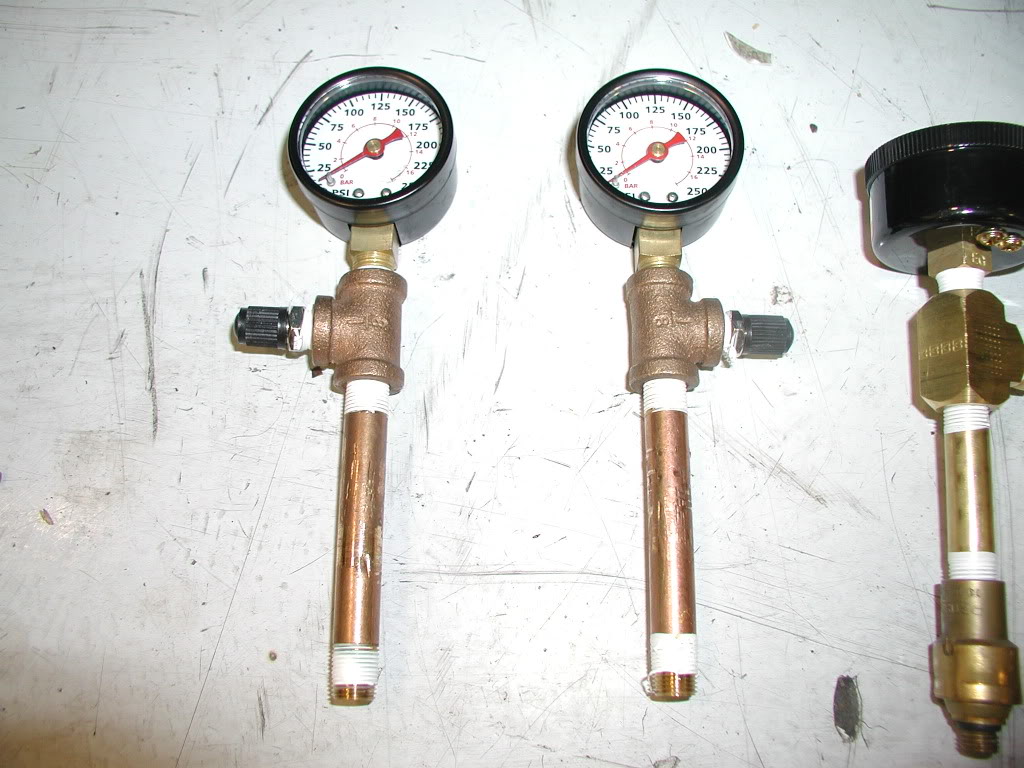

I made individual test and air fitting with gauges. You screw them (if you make 4) in the air spring tops after you remove the air line. Then you fill them up with compressed air with an air chuck just like you fill a tire. I take them up to 100-125 psi and then watch to see if they go down. You have to make sure that they dont leak in the top where they screw in. use a bubble solution to check and teflon tape. I built these with brass fittings 1/8" pipe thread, gauges, and screw in schraeder valves, all sealed with teflon. The front takes a plain 1/8" pipe thread into the fronts, and the fittings you see on the second set are actually the front spring fitting taken out and these screw into the rear ports that have different thread sizes. This takes almost all the guess work out of determining how many of your air springs are leaking and how fast. The Jaguar way can even lead to misdiagnosis cause you measure height of each wheel arch to the ground. 1 air spring dropping will also pull down and lower the rest of the car front or rear. SO you dont know if that corner is leaking too, just less, or not at all. Ive thought about making more and selling, but I dont know they can be alittle pricey and a hassle to get all the parts and ship but who knows. If I get enough request I might. Another note is that Ive never ever seen lines leaking. Always air springs or new compressors that people didnt pay attantion to the air line fitting and proper sealing. 99% are always the air spring and predominatly behind the bellows where the lower seal seals against the shock body.







Member
Joined: Sep 2010
Posts: 89
Likes: 20
From: Arizona
Diy air spring leak diagnosis
Nice job. Those brass fittings are expensive. So what is the spec for air spring leak down? Taking your idea one step further, I'm curious what it would take to permanently insert a digital pressure gauge inline ( at least on the front springs ). I've never used one, but I've seen digital tire gauges around for some time now.
Bob
Bob

Veteran Member


Joined: Dec 2009
Posts: 9,556
Likes: 2,555
From: Crewe, England
That is a really neat job ! It isolates the electronics so that the air pressure integrity is checked without interference. At one time basic checks like this would have been normal. We have become bedazzled by the electronics industry.
All Jaguar workshops should have a set.
All Jaguar workshops should have a set.

Veteran Member
Joined: Jan 2010
Posts: 2,941
Likes: 1,511
From: New Zealand
Leakage
1mm per day
10mm per week
1 deg C = 1.2mm change
I don't what this refers to though. It could be the maximum accepted or it could be the normal loss.
Great pressure gauges by the way!
Yeah 1mm thats pretty much nothing for drop. Ill have to see about how much 10mm equals in PSI next diag session on springs. I do know that say if 1 corner drop like in the front a couple inches which is about empty, the other side gets pulled down around 1/4-1/2". Whats nice too is ive been able to show that replacement springs need to be parts warrantied without question. (more worried about the arnots cause they have to be sent back and then they check them. With the gauges i have no doubt theyre leaking)
1 more thing. It helps too to bounce the car some as ive already found several springs hold air at static ride height, but leak when the car is raised and lowered...
1 more thing. It helps too to bounce the car some as ive already found several springs hold air at static ride height, but leak when the car is raised and lowered...

Veteran Member

Joined: Nov 2009
Posts: 3,145
Likes: 805
From: The beautiful Mornington Peninsula in OZ
DIY air spring diagnosis
Thanks for taking the time to post the information Brutal.
When you have screwed them in ,how do you close the bonnet?
It's just a joke man!
When you have screwed them in ,how do you close the bonnet?
It's just a joke man!
Trending Topics
Veteran Member
Joined: Jan 2010
Posts: 2,941
Likes: 1,511
From: New Zealand
The process involves putting the suspension in to transportation mode, measuring the height then measuring it again after 24 hours. This assumes that the car isn't touched during that period.
There is also a formula to apply if there is an ambient temperature difference of greater than 2 degrees at the time of the two readings.
Example. X = ((25ºC - 20ºC)x 1.5mm) + 8mm => X = 15.5mm
I have just noticed that there is a TSB about air spring diagnostics (JTB00067). It says a spring should be changed if there is an 8mm or greater drop over 24 hours.
The process involves putting the suspension in to transportation mode, measuring the height then measuring it again after 24 hours. This assumes that the car isn't touched during that period.
There is also a formula to apply if there is an ambient temperature difference of greater than 2 degrees at the time of the two readings.
Example. X = ((25ºC - 20ºC)x 1.5mm) + 8mm => X = 15.5mm
The process involves putting the suspension in to transportation mode, measuring the height then measuring it again after 24 hours. This assumes that the car isn't touched during that period.
There is also a formula to apply if there is an ambient temperature difference of greater than 2 degrees at the time of the two readings.
Example. X = ((25ºC - 20ºC)x 1.5mm) + 8mm => X = 15.5mm

Veteran Member
Joined: Jan 2010
Posts: 2,941
Likes: 1,511
From: New Zealand
For me personally, it would be easier and cheaper to pay a visit to my local friendly mechanic and use his IDS but not every one has access to that sort of service.

Banned
Joined: Sep 2009
Posts: 1,922
Likes: 258
Brutal - So I've assembeled the test device and I'm ready to begin. A few questions first:
1. Does the entire car settle down when you disconnect an air line or just that 1 corner.
2. Do you need to plug the open air line after disconnect?
3. Do I need to disconnect the battery or anything like that?
Thanks in advance.
1. Does the entire car settle down when you disconnect an air line or just that 1 corner.
2. Do you need to plug the open air line after disconnect?
3. Do I need to disconnect the battery or anything like that?
Thanks in advance.

brutal - so i've assembeled the test device and i'm ready to begin. A few questions first:
1. Does the entire car settle down when you disconnect an air line or just that 1 corner.
2. Do you need to plug the open air line after disconnect?
3. Do i need to disconnect the battery or anything like that?
Thanks in advance.
1. Does the entire car settle down when you disconnect an air line or just that 1 corner.
2. Do you need to plug the open air line after disconnect?
3. Do i need to disconnect the battery or anything like that?
Thanks in advance.
Banned
Joined: Sep 2009
Posts: 1,922
Likes: 258
Thanks Tex.
Your tester is now installed on what I think is the offending (leaking) air shock. You were sure right about checking that the connections are air tight. I had to do 5 full wraps of teflon tape on the tester to shock connection (1/8" pipe thread) to get it to seal.
The only thing I can't duplicate is the ambient temp issue. My failure mode causes the computer to throw a code and jump the shocks to full height and stiffness-- only if the outside air temp drops below 35 degrees F and thats hard to come buy here in central Fla. I had a hell of a time last week in Ashville, NC.
However, the front end drops approx 3/4" over night, every night, hot or cold weather. So I should see something going on. I'll keep you all informed of test results.
Your tester is now installed on what I think is the offending (leaking) air shock. You were sure right about checking that the connections are air tight. I had to do 5 full wraps of teflon tape on the tester to shock connection (1/8" pipe thread) to get it to seal.
The only thing I can't duplicate is the ambient temp issue. My failure mode causes the computer to throw a code and jump the shocks to full height and stiffness-- only if the outside air temp drops below 35 degrees F and thats hard to come buy here in central Fla. I had a hell of a time last week in Ashville, NC.
However, the front end drops approx 3/4" over night, every night, hot or cold weather. So I should see something going on. I'll keep you all informed of test results.


Banned
Joined: Sep 2009
Posts: 1,922
Likes: 258
Testing of the right front shock is complete. No leak detected. Now that's a surprise as I was sure it was the offender.
Tester is now installed on the left front. Results in the am.
Would't it be a nice surprise if both check out good?
Now that's a surprise as I was sure it was the offender.Tester is now installed on the left front. Results in the am.
Would't it be a nice surprise if both check out good?
Banned
Joined: Sep 2009
Posts: 1,922
Likes: 258
Okay, heres the deal so far. I have aired up each shock individually to 100 lbs. After 8 to 12 hours, each lost 1 lb of air and the suspension setteled 1/8" on its respective side. According to previous posts, this is in the normal range.
Conculsion, the air shocks themselves are "probably" okay and the problem is in the air supply to one or both shocks. I say "probably" because as you may recall the problem really gets critical in cold weather. Right now I have no cold weather to work with and none is forcast.
My further efforts will concentrate on the air lines. Don't know what to expect as our resident Jag Techs have stated they rarely find defects in this area. The car still setteles approx 1/2 or better every night.
Conculsion, the air shocks themselves are "probably" okay and the problem is in the air supply to one or both shocks. I say "probably" because as you may recall the problem really gets critical in cold weather. Right now I have no cold weather to work with and none is forcast.
My further efforts will concentrate on the air lines. Don't know what to expect as our resident Jag Techs have stated they rarely find defects in this area. The car still setteles approx 1/2 or better every night.
check the connections at the lines and shock. But I guess I should also mention that Ive found that the air springs can be tight and leak free in 1 area, and leak in another. I see this alot going up and down cycling the suspension.
Temp does play in and we see alot of air springs leaking when the temps go down, and compressors that dont air in the required amount of time.
Temp does play in and we see alot of air springs leaking when the temps go down, and compressors that dont air in the required amount of time.