When you click on links to various merchants on this site and make a purchase, this can result in this site earning a commission. Affiliate programs and affiliations include, but are not limited to, the eBay Partner Network.
Noticing this as I was working through stuff. I'm not even sure what it's a part of, but looks like it's something to do with the fuel lines. Straight to the picture - I'm point at what looks like a splice in a fuel line at the left of the picture and the line runs up into the fuel rail (top center), but I have no idea. Any info or problems with this would be totally awesome!
That is a fuel temperature sensor. When the fuel is hot it increases fuel pressure to reduce the chances of fuel vapourization. One vacuum line should go to the manifold, the other to the fuel pressure regulator. You're holding the manifold to sensor vacuum line.
Just for your interest, the device with the cladding held by the black hoops at the bottom of the photo is the fuel cooler. The refrigerant returning to the AC compressor after it has left the cabin is still cool, and that is used to cool the fuel and take away the heat it picked up going over the engine. The car is actually not emissions certified without that cooler, because in testing Jaguar was finding fuel temperatures went over 60C and the car failed on fuel vapour emissions.
If we are talking about hoses that you have your index finger on.
It is a vacuum hose to the heat valve on the rail. In the event of overheating of the fuel (and a large increase in volume),
it opens the outlet vacuum valve to allow the fuel to flow freely back into the tank.
Hey Y'all... Let me see if I have this right. A properly working valve there (the little brown/tan two way turned into the rail) will open up the fuel pressure regulator to allow heated fuel to leave the rail? So, one side is manifold vac and the other goes to the FPR? I think I aughta get me one of these... I need one. Didn't know it's function.
You're correct. The fuel pressure regulator has a manifold vacuum reference, so that way there is always a constant pressure difference between the manifold the fuel is spraying into it and the fuel rail. It makes for more accurate fuel metering, but that is relying on the fuel being liquid, not vapour. Just like the radiator, water under pressure will stay liquid and not boil when it's over 100 C at sea level, so raising the fuel pressure can resist boiling of the fuel.
They are rubber vacuum lines. The sensor is vacuum, not electrical.
Right.
Although, some V12s did indeed have an electric fuel temperature switch. I've never seen one, nor know how it operates. For that matter I'm not even sure if it serves the same function as the vacuum operated switch. Anyhow, it's EBC3182
I'll add the the type of vacuum fuel temp switch I'm accustomed to seeing looks different than the blue-capped switch Pirk has posted. I've only seen the brown EAC5086 type
Ok, so, yep, totally a vacuum line. I was really wondering why the split in the hose (subconsciously also was hoping ya'll would let me know what the heck it was for ). That's the first couple of pics.
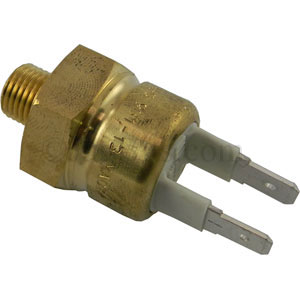
Last pic is hopefully a better look at the blue thingie...
I've seen that style of thermo-vac switch on various Jags over the years, used for various different functions. I don't think it's correct for the fuel rail of your '89....but I'm not on solid footing when I say that
I'd be tempted to bypass it and see if the engine runs differently. IF it is the incorrect switch your fuel pressure may be out of whack.
Vacuum hoses with joiner pieces are common on Jags so that, in and of itself, doesn't mean much. They're usually used to join two hoses of different diameter.
I had that blue style of switch on my 92 Series III saloon, but it was mounted behind the thermostat. I don't know if it was used for fuel pressure, or some other function. It was also Lucas ignition, not marelli like the XJS. I can't remember what (or if) it had a fuel temp switch.
It is temperature switch. You can take it out from the rail (there is no hole to rail, My USA MY 1988).
Put it in water and increase its temperature.
I think at 70 ° C the sensor will open.
This can be detected by blowing into the hoses, both must be connected and the ends must be above water.
When opened, the vacuum is released into the pressure valve, which opens and the fuel returns to the tank.




 Fuel line weirdness











 ). That's the first couple of pics.