
Mikey

close

Jan 14, 2020
- Join DateOct 2009
- LocationPerth Ontario Canada
- Posts:11,057
-
Likes:503
-
Liked:2,271 Times in 1,847 Posts
Quote:
Caliper seizures can be caused by many things other than contaminated fluid. Dust shield failure allowing dirt/salt/water ingress is the most common.Originally Posted by amcdonal86
Didn't I just provide you with an example of a seized brake caliper in my Miata? If that wasn't caused by old/contaminated brake fluid, I don't know what caused it.

Veteran Member
amcdonal86
Veteran Member
close
Jun 15, 2019
- Join DateMay 2010
- LocationArlington, VA USA
- Posts:6,290
-
Likes:848
-
Liked:485 Times in 406 Posts
Quote:
Sounds like baloney to me.Originally Posted by Mikey
Caliper seizures can be caused by many things other than contaminated fluid. Dust shield failure allowing dirt/salt/water ingress is the most common.
Mikey
close
Jan 14, 2020
- Join DateOct 2009
- LocationPerth Ontario Canada
- Posts:11,057
-
Likes:503
-
Liked:2,271 Times in 1,847 Posts
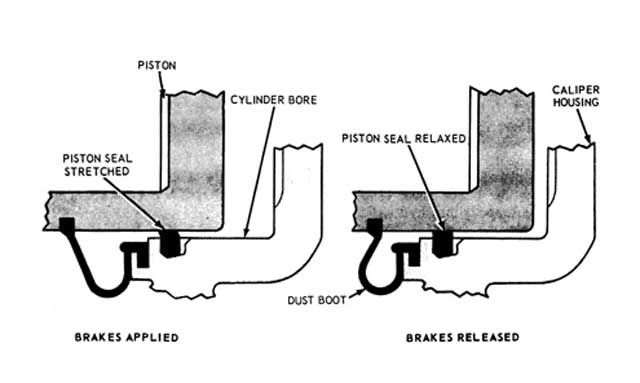
Here's a decent cross section

Most seized calipers exhibit corrosion in the cavity between the (failed) dust boot and piston seal. Corrosion on the brake fluid side is typically minor.
Most seized calipers exhibit corrosion in the cavity between the (failed) dust boot and piston seal. Corrosion on the brake fluid side is typically minor.

Member
I have become the devils advocate on this subject. I am not advocating not changing the brake fluid, but rather that 2 years is overly conservative. Many years ago (1970's) I was a chassis engineer with one of the Big 3. Co-works who were responsible for brakes told me that brake fluid change was based on the worst case scenario of someone checking the brake fluid every time the oil level was checked (which was every fuel fill)...and the location was humid Florida. They would say "if there is some way we could prevent them from pulling the lid off the reservoir we could extend the fluid change interval. Well that is now the case. How can 2 years still be the same change interval as it was in the 70's when we constantly opened up the reservoir to check the fluid? OK, maybe that is what the manufacturers insist on (their legal depts. want to cover the worst case scenario). When I stopped doing my own maintenance in the 80's (changing brake fluid was a pain) I had the dealer change the brake fluid.....and experienced poorly bled systems several times. Buying a new car every 5 years I just gave up on changing the brake fluid. Since I bought my '04 Lincoln LS I decided not to change the fluid and have not had any issues. I'm a sample size of "one" which is of no statistical consequence, but it will be difficult to convince me that a 5 year change interval in a dry environment is wrong. OK, maybe 4 years to placate the attorneys. But 2 or 3 years...be my guest. BTW, amcdonal 86, how old was your Miata when the brakes seized and what were the symptoms of the seizure (failed to brake or locked up)?
Another PS: my neighbor has an '08 car with over 90,000 miles and has never changed his engine oil. As wrong as that is, maybe I'm doing the same thing with my Lincoln's brakes. So, who am I to say. Hey, change your brake fluid every 2 years...forget what I said as nobody agrees, I'm just the guy who saw a flying saucer in my backyard.
Another PS: my neighbor has an '08 car with over 90,000 miles and has never changed his engine oil. As wrong as that is, maybe I'm doing the same thing with my Lincoln's brakes. So, who am I to say. Hey, change your brake fluid every 2 years...forget what I said as nobody agrees, I'm just the guy who saw a flying saucer in my backyard.
Mikey
close
Jan 14, 2020
- Join DateOct 2009
- LocationPerth Ontario Canada
- Posts:11,057
-
Likes:503
-
Liked:2,271 Times in 1,847 Posts
Quote:
You are not alone. What is the plural of advocate? Originally Posted by Steamer22
I have become the devils advocate on this subject. I am not advocating not changing the brake fluid, but rather that 2 years is overly conservative.


Stuart S
Veteran Member
close


Today
- Join DateAug 2010
- LocationAtlanta suburbs
- Posts:10,106
-
Likes:2,627
-
Liked:7,110 Times in 3,884 Posts
Quote:
Lawyers! Originally Posted by Mikey
...What is the plural of advocate?
Mikey
close
Jan 14, 2020
- Join DateOct 2009
- LocationPerth Ontario Canada
- Posts:11,057
-
Likes:503
-
Liked:2,271 Times in 1,847 Posts
Quote:
So saying 'devils advocate' is redundant? Originally Posted by Stuart S
Lawyers!


mosesbotbol
Veteran Member
close

Nov 26, 2025
- Join DateMay 2008
- LocationBoston, USA
- Posts:6,286
-
Likes:1,452
-
Liked:1,208 Times in 937 Posts
Just changed the brake fluid in our Range Rover, it has 70K and was looking dark/dirty. Brakes feel is better now.

Banned
I once had a 54 Buick that lived in Alabama. In the Winter of 60/61 (maybe 61/62) we had a freeze where the temp dipped below 20 degrees F and for 3 days. We thought the world was coming to an end.
Anyway, that car's brake fluid froze and locked the brakes for a week together with 100s of other cars in Huntsville. Some lessons come hard.
Anyway, that car's brake fluid froze and locked the brakes for a week together with 100s of other cars in Huntsville. Some lessons come hard.
Mikey
close
Jan 14, 2020
- Join DateOct 2009
- LocationPerth Ontario Canada
- Posts:11,057
-
Likes:503
-
Liked:2,271 Times in 1,847 Posts
Quote:
Anyway, that car's brake fluid froze and locked the brakes for a week together with 100s of other cars in Huntsville. Some lessons come hard.
That makes perfect sense. Cars in that era has open master cylinders- a vent hole in the lid that freely allowed air to enter/exit as the fluid level in the reservoir changed. That meant a fresh load of moisture-laden air with each application of the brake pedal. The fact that your car had enough water in the system to freeze when it was 6-8 years old is no surprise at all.Originally Posted by tarhealcracker
I once had a 54 Buick that lived in Alabama. In the Winter of 60/61 (maybe 61/62) we had a freeze where the temp dipped below 20 degrees F and for 3 days. We thought the world was coming to an end.Anyway, that car's brake fluid froze and locked the brakes for a week together with 100s of other cars in Huntsville. Some lessons come hard.
Cars since the late '60s-ish have had sealed master cylinders that isolate the fluid from the air by using a diaphragm or bellows. No more air entering the chamber through normal use.
In those days, we used to open the master to inspect the level on a frequent basis and add fluid as the shoes wore. Today's cars have see-though reservoirs and contain enough fluid to accommodate 100% wear on all four sets of pads- each of which obviates the need to remove the cap.