When you click on links to various merchants on this site and make a purchase, this can result in this site earning a commission. Affiliate programs and affiliations include, but are not limited to, the eBay Partner Network.
This is a fairly general question and probably applies to all early XK engined cars. I'm hoping someone on this forum can help. I have had a Driven Man T5 conversion kit for years and I'm now in the process of mating it to the block. Everything is fitting very nicely but the clutch fork has very little travel. I have read that some have zero clearance between the TO bearing and the clutch bearing surface when mated. I did some measurements and it looks like I have about a quarter inch so I think I am fine there. However, the TO bearing has very little travel as the TO bearing fork fouls the T5 transmission. I think I have about a half inch of travel. Subtract out the 1/4 inch of free play and the most TO engagement will be about a quarter inch. This does not seem like anywhere enough to disengage the clutch. I can see where some careful grinding will allow for more travel but I don't know how much I need. How much travel is available on a factory set up? How far does the slave cylinder push the fork or TO bearing with a full push of the clutch pedal? Thanks in advance! Craig
There were 2 slave cylinders fitted and 2 pressure plates. Sprung pressure plate 10" plate. Diaphragm 9.5" plate. Old sprung pressure plate was hard on the left leg in traffic.
Old spring pressure plate ran at a clearance from Carbon/Graphite throw out bearing of 1/16th of an inch to maintain this to the pressure plate interface and required constant adjustment.
With the Diaphragm clutch they fitted the so called "Hydrostatic" slave cylinder that was supposed to be self adjusting to a rough 0.75" at the slave cylinder to end of fork clevis pin. Effectively zero clearance at the throwout bearing interface which would accelerate TO bearing wear. This translates to small movement at the TO bearing.
I ignore Jaguar's setting procedure & operate a belt & bracers approach where I retain the external spring & then set the slave cylinder rod to where I like the clutch to take. This preserves the throw out/thrust bearing by pulling back the fork a little.
Operation perfect and nice light diaphragm clutch.
The movement is not great. Very little grinding will be necessary. I do not have a lift to measure for you.
1966 was right at the changeover point so you could have either. By that time they drilled & threaded the flywheel to accommodate either.
Last edited by Glyn M Ruck; Dec 9, 2022 at 05:48 AM.
Thanks for the input!! I should have mentioned that the kit includes a new flywheel, bell housing and 9.5 inch B&B diaphram clutch kit. All standard 4.2 E-Type stuff.
My car originally had a BW auto transmission and I am converting it to the 5 speed. The Driven Man kit includes a Tremec T5, beefed up and modified for this application.
I heard back from the tech guy at The Driven Man today and he implied that the gear box should have been relieved to allow for more clutch fork travel. Mine is not machined. This is something that I can do but I don't want to take more than necessary. I'm glad to hear that the TO bearing should only have a min clearance of 1/8 inch. I have about a 1/4 inch from my measurements with the TO bearing pushed as far toward the gearbox as possible, which did not seem like enough. But from your input, it sounds like I'm fine there. It's just a matter of how much I need to grind to get the TO bearing travel I need to reliably disengage the clutch. Would an inch be enough at the TO bearing? As I mentioned above, the current full travel is about 1/2 inch. Assuming a little clearance from the TO bearing to the interface and I have 3/8 inch of total "push" on the clutch at the TO bearing interface now. From Glyn's description, it doesn't sound like I need much.
Thanks again!
Read this carefully so as to ensure you understand it for a 9.5" plate, in fact most plates. Most single disc diaphragm clutches require between .300” and .400” travel AT THE FINGERS for full disengagement. Remember fork/yolk travel is not the same as travel at the fingers that attach to the side lugs of the throw out bearing. (law of the lever)
If you want to be safe make that .500" and then adjust to achieve the clutch take point that you are happy with. We are talking very small movement to achieve full disengagement with Diaphragm clutches.
This means you are pretty much there with your half of an inch of travel. Maybe the slightest of relief for safety sake would do the trick & give you comfort plus you don't really want the lever touching the casing/bellhousing. You might & I say might feel some vibration through the pedal if it does.
Last edited by Glyn M Ruck; Dec 10, 2022 at 02:48 AM.
Thank you, Glyn. I will aim for something around 3/4 or an inch TO bearing travel (finger travel at the hub, if I am understanding you correctly) which should be fairly easy to achieve with a little grinding on the gear box housing. Understood that travel on the fork (same as slave cylinder travel) will be more since the fulcrum is much closer to the TO bearing. When the Mrs. gets home I'm going to have her push the clutch pedal on my E-Type (with the same clutch setup) and see how long the slave cylinder push rod travels. I know that works well. My guess is that I'm going to be surprised at how little it actually moves.
Great, you got it! ~ that is a good Idea & will give you a known reference as your E Type is obviously fitted with the same B&B diaphragm clutch unit. How old is the throw out bearing in the E Type (mileage)? I don't think you need to achieve as far at the TO bearing. Just over half an inch is more than enough to excessive.
With Jaguar the parts are likely interchangeable. I don't have an E Type Parts Manual to check.
Last edited by Glyn M Ruck; Dec 10, 2022 at 02:31 PM.
The E-Type probably has 5000 or so miles on the full clutch assembly.
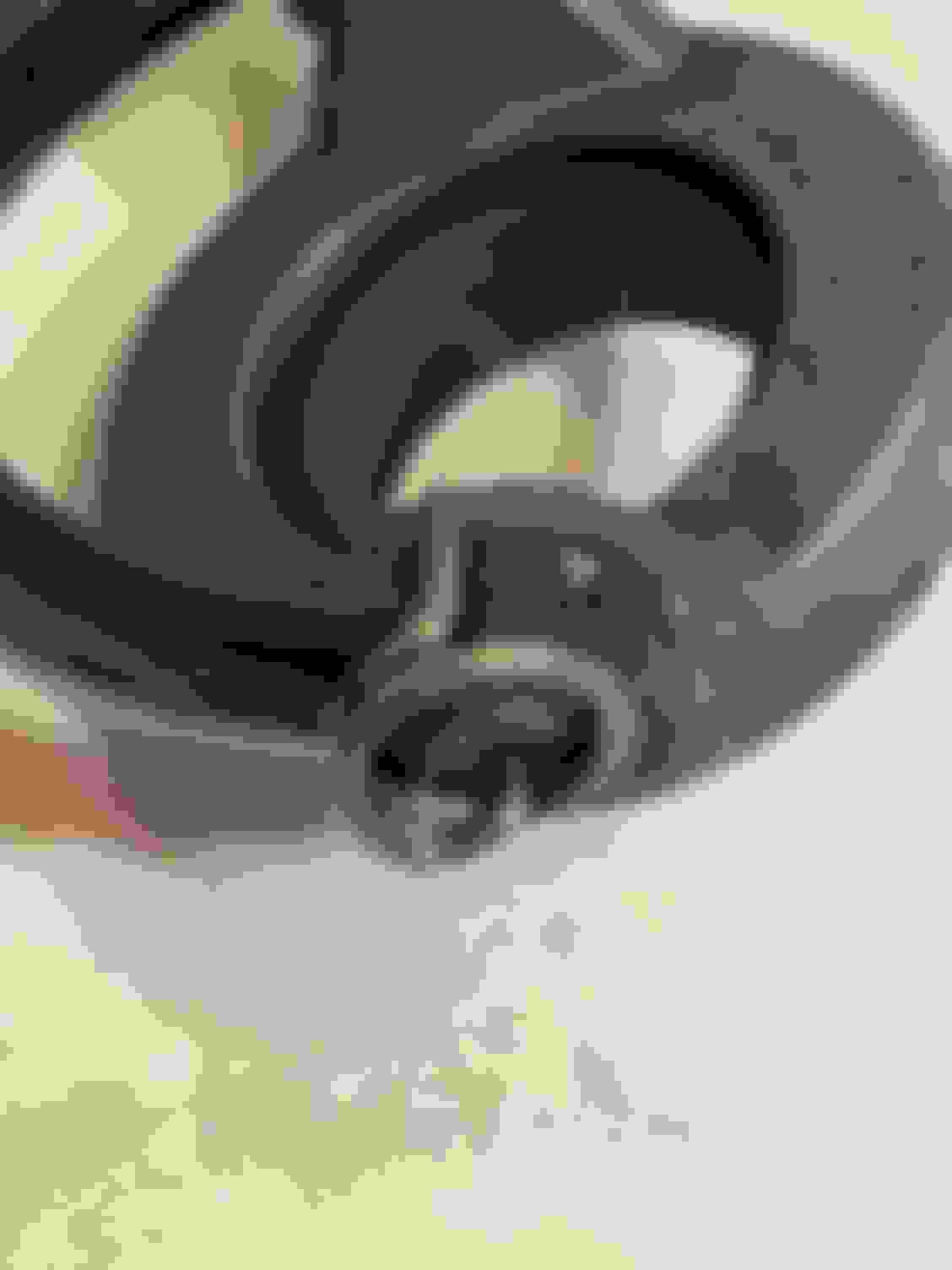
On a related subject, does anyone have any pictures of how the spring clips that hold the TO bearing in the fork are supposed to be oriented? I was surprised to see that they are handed, implying that it matters, but I cannot find any instructions. Even the factory repair manual does not address this that I can see. Picture is my current orientation. Current TO bearing clip orientation. Is this correct?
Yes. It looks like very early XK engine cars (XK120) used a different design but everything after that used the same C9797. I bought mine used and was wondering if I had bought the wrong one, so I looked it up.
The E-Type probably has 5000 or so miles on the full clutch assembly.
On a related subject, does anyone have any pictures of how the spring clips that hold the TO bearing in the fork are supposed to be oriented? I was surprised to see that they are handed, implying that it matters, but I cannot find any instructions. Even the factory repair manual does not address this that I can see. Picture is my current orientation.
Current TO bearing clip orientation. Is this correct?
OK so E Type is pretty much as new
Not anymore they aren't according to Barratts if bought separately ~ but that's aftermarket. Both sides P/N C22479
I happen to have a new B&B 9.5 clutch kit right here & my clips provided look like yours. Only arrived a few weeks back.
In fact the accompanying instruction booklet says "Ensure that the release bearing and any retaining clips are Correctly Assembled" Fat lot of use that is.
I'm equally interested.
Not mine but the same.. Mine's still in oiled paper, cardboard etc. I just pulled the throwout bearing in it's plastic bag with clips out of the one corner in the packaging.
Last edited by Glyn M Ruck; Dec 11, 2022 at 04:00 AM.
I think I finally have this all sorted out. I mated the gearbox with bell housing to the block and ran out of slop on the throw out bearing fork with about 1/8 of an inch of travel before the bell housing was fully mated to the block, meaning that the throwout bearing was in contact with the pressure plate bearing surface and starting disengage the clutch. Back apart again and found that the "ears" on the throw out bearing are fouling the hub on the new transmission. With some careful grinding on the insides of the ears I gained another half inch of travel toward the gear box. With everything all mated up again, I now have some slop on the TO bearing. I'm so glad I read this on another post. This should not have been so difficult. Everything should be in order now. Thanks again to everyone for the input.
Thanks JB. Much appreciated. I either have a failing brand new B&B clutch or a broken engine mounting with the front stabalisers my car has saving the radiator. I'm hoping like Cass it is just a de-laminated engine mount ~ I have spares. I have a spare new clutch kit but the thought of pulling the motor & gearbox does not excite me. It's only done a few 100 Kms & the clutch action was magic. I think it's an engine mounting because I can see the aircleaner has touched the bonnet lining a few times.
Cass car does not have the front stabalisers & his fan wiped out his radiator when his engine mounts let go. We make the engine mounts here. Maybe I should go local.
Last edited by Glyn M Ruck; Dec 17, 2022 at 09:29 PM.
The friend with the E Type engine I built had a defective B&B clutch out of the box, it was clearly assembled wrong, so defects do happen. I hope it's the engine mount in your case, that's a lot easier to change than a clutch.
Just a minor observation but it is interesting that the original clips are not handed.
I tried to use the dimple but could not get it to work. The clip stood too proud of the assembly and were not centered enough axialy to avoid interference with the aftermarket bell housing. The leg with the "knee" is actually long enough that the knee starts to wrap around, retaining the clip. Imagine rotating the clip in JB's first pick clockwise and pushing it in more. Probably not ideal but I don't think they are going anywhere.



 Throw out bearing travel