


Help me understand the concept of a "pulley upgrade"


 Help me understand the concept of a "pulley upgrade"
My previous engine tuning experiences were with turbocharged motors where a simple ECU remap could yield significant power/torque increases. As I investigate potential tuning options for my 3.0 SC, I see references to "pulley upgrades" in addition to ECU tunes. What does the upgraded pulley accomplish? And does it need corresponding ECU tuning to take advantage of the new hardware? I do see companies like Mina offering a pulley upgrade without any companion software. I'm confused. What's the deal?

Veteran Member
Joined: Aug 2013
Posts: 1,640
Likes: 427
From: DFW, Texas
The concept of a pulley swap is to spin the supercharger faster and generate more boost. Depending on how much boost you are adding it goes from being beneficial to have a tune with the pulley to being necessary.
Just had mine put on today and it definitely made more power/torque. Had a tune done last week and both really made a difference.
Just had mine put on today and it definitely made more power/torque. Had a tune done last week and both really made a difference.

Senior Member
Joined: Jan 2013
Posts: 335
Likes: 55
From: Westchester
A pulley upgrade, in rough terms, accomplishes what a chip upgrade typically does on a turbocharged car - more boost! On a trubocharged car, a wastegate on the turbocharger is controlled by the ECU to bleed off exhaust gas before it goes through the turbine, thereby controlling boost. A simple ECU upgrade can cause the ECU to command less exhaust bleed. For a supercharger, the amount of air forced through the blower cannot be controlled by the ECU. Each time the supercharger turns, a certain amount of air passes through it. What's more, the supercharger RPM is directly and unalterably tied to engine RPM (ignoring clutch superchargers). The ECU can bleed boost by opening a bypass valve, but, generally, the ECU will call for the bypass valve to be closed during full throttle. Thus, the only way to increase boost at full throttle is to increase supercharger RPM by using a smaller pulley on the supercharger. To take full advantage of this, you really do need an ECU tune. This appears to be particularly the case on these cars as there are protection algorithms that limit the output from the engines to protect the transmission. To take full advantage of your new found power, the thresholds need to be increased.

Member
Joined: Apr 2013
Posts: 63
Likes: 21
From: California
A pulley upgrade, in rough terms, accomplishes what a chip upgrade typically does on a turbocharged car - more boost! On a trubocharged car, a wastegate on the turbocharger is controlled by the ECU to bleed off exhaust gas before it goes through the turbine, thereby controlling boost. A simple ECU upgrade can cause the ECU to command less exhaust bleed. For a supercharger, the amount of air forced through the blower cannot be controlled by the ECU. Each time the supercharger turns, a certain amount of air passes through it. What's more, the supercharger RPM is directly and unalterably tied to engine RPM (ignoring clutch superchargers). The ECU can bleed boost by opening a bypass valve, but, generally, the ECU will call for the bypass valve to be closed during full throttle. Thus, the only way to increase boost at full throttle is to increase supercharger RPM by using a smaller pulley on the supercharger. To take full advantage of this, you really do need an ECU tune. This appears to be particularly the case on these cars as there are protection algorithms that limit the output from the engines to protect the transmission. To take full advantage of your new found power, the thresholds need to be increased.
Spinning the blower faster has the following effect. Firstly, you make more boost of course. But Roots type blowers are also most efficient at pretty low boost levels (0.6~0.7 bar). They get pretty inefficient pretty fast. This is because they are external compression air pumps -- that is the air pushed out by the blower is at atmospheric pressure. It is by stacking air inside the plenum that boost is built up. When the plenum is at a high pressure, air actually flow back into the supercharger as the lobes open up before being pushed out again. This is highly inefficient. When you increase the supercharger speed you are also decreasing it's efficiency. That is more of the additional pressure is from heat increase rather than density increase. Generally speaking you still net more density than heat when you increase boost slightly (0.15~0.3 bar), but if you over do it you'll reach a point where it is counter productive. Secondly, the blower is always being spun faster so expect fuel efficiency to fall slightly. Thirdly, if the ECU still uses the same fuel map and adaptive logic chances are it will not fully adapt to the increased boost with additional fuel. It'll probably run slightly leaner than stock. This actually makes more power because it does adapt partly with more fuel and also because stock factory programs are usually verse conservative (read very rich running) for safety. Running slightly lean mixtures actually make more power, but it also increases the cylinder temperatures and the chances of detonation. If you use a really small pulley and run the blower really fast, you will reach a point where you'll detonate from running out of the adaption range, running lean and hence running very hot.
Last edited by dwight looi; Feb 5, 2014 at 08:06 PM.




Member
Joined: Apr 2012
Posts: 70
Likes: 10
From: North Carolina
That's why I love this forum. So much valuable info. I understand absolutely none of it, but I still love to read it. All I know is I'm told if I get a ECU tune and pulley for my XFR, I'll increase torque and horsepower in my car. Used to be 500 was the magic horsepower number for "super sedans". Of course that was way back in 2010. Now the magic number is 550. So in order for me to keep up with the new E class AMGs and the M5s, I can either purchase the XFR-S for 100k or dump roughly 2k into the tune/pulley option. I choose the second of the two options! But lest anyone of my forum buddies think I'm useless in a garage, I'll share this story (and I'll try not to get to technical). Bought my son a bike for his birthday. He didn't know how to ride it since he was only 3 years old. Decided to put a single training wheel on the right hand side. Did my research and found they were only sold in pairs. Bummer, but I would not let that stop me. Spent 5-6 straight minutes in the brutal summer heat attaching the high grade plastic wheel assembly to the bike frame. This was done using a special tool known as a wrench. For some reason after attaching the right hand side training wheel, my son kept falling off the left hand side of the bike. Completely stumped, I went back to the drawing board and after dozens of blueprints and test runs, decided to attach the left hand side training wheel. Again, in the brutal heat I slaved. Only this time at the 3 minute mark I had to stop and have a beer. 3 minutes later, exhausted and out of breath, I finally had the perfect system. Foolproof. In limited test runs, there have been zero falls. I'll need a few more weeks to run the numbers but in visual observation it seems my son has shaved at least 2 seconds off his "garage door to mailbox and back" time. I'll dyno him in the backyard for official results but I think I've certainly improved the performance of his Huffy. If anyone needs a specific "how-to" on the training wheels, just PM me. Ha!


Member
Joined: Apr 2013
Posts: 63
Likes: 21
From: California
By today's standard, a supersedan should be able to hit 60 mph in less than 4.5 secs, do the quarter mile in the 12s and handle the twisties with composure. It's not really about horsepower as it is about power to weight ratio. One of the reasons the power numbers are going up is that cars are getting heavier. An XF with the 5.0 S/C engine is about 4150 lbs and change -- not including the driver and anything else in the car. There was a time when sedans weighed about 3000 lbs and a 3000 lbs sedan would have needed about 360 horsepower to have similar performance!
The XF is not helped by the fact the it is built on a relatively old and porky platform. The DEW98 platform which underpins the XF also underpinned the S-type and... gasp... the Lincoln LS and (final generation) Ford Thunderbird from the late 90s. The XJ for instance is a bigger, longer, more luxuriously appointed, and yet slightly lighter car than the XF!
Anyway, back to superchargers and trying to make the XFs go faster. The following is are the compressor maps of the Eaton TVS R1320 and TVS R1900 supercharger on the XF 3.0 S/C and 5.0 S/C engines. Note those contours and their numbers. A "65" means that about 65% of the boost is actually useful increases in density while 35% is useless "heat generated. If you draw a line horizontal line across at 1.6 "Pressure Ratio" level you'll see that it'll cut across the most efficient horizontal traverse of the map. This is what your engine will see when you run the blower at 0.6 bar of boost (1.6 bar of absolute pressure is 0.6 bar of boost over atmospheric pressure which is 1.0 bar at sea level). If you draw a line across at running say 2.2 bar (corresponding to 1.2 bar of boost) you'll notice that the supercharger much less efficient -- doing less useful work and making a lot of useless heat.
*Note: 1.0 Bar = 14.7 psi. Hence, 0.6 bar is about 8.8 psi of boost. 1.2 bar on the otherhand corresponds to 17.6 psi of boost.


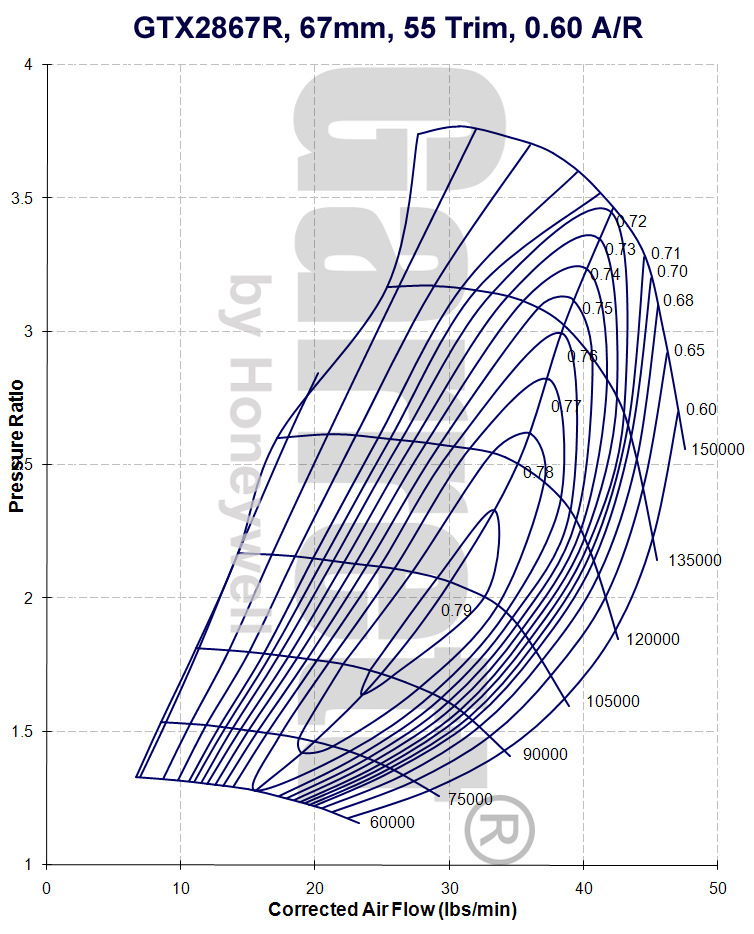
Now, compare these maps to that of a good, modern, turbocharger like the Honeywell-Garrett GTX-2867R, you'll notice that the centrifugal compressor on the turbo (which is an internal compression air pump) is much more tolerant of increases in boost and higher boost levels. Not only does it reach 79% efficiency, you'll cut the maximum efficiency island contour whether you operate it at 1.6 bar or 2.3 bar. This is why generally speaking Turbocharged designs do better in mega boost applications while supercharged designs are best for modest increases in power with the focus being on being lag free and having a linear relationship between your left foot and engine behavior.
The XF is not helped by the fact the it is built on a relatively old and porky platform. The DEW98 platform which underpins the XF also underpinned the S-type and... gasp... the Lincoln LS and (final generation) Ford Thunderbird from the late 90s. The XJ for instance is a bigger, longer, more luxuriously appointed, and yet slightly lighter car than the XF!
Anyway, back to superchargers and trying to make the XFs go faster. The following is are the compressor maps of the Eaton TVS R1320 and TVS R1900 supercharger on the XF 3.0 S/C and 5.0 S/C engines. Note those contours and their numbers. A "65" means that about 65% of the boost is actually useful increases in density while 35% is useless "heat generated. If you draw a line horizontal line across at 1.6 "Pressure Ratio" level you'll see that it'll cut across the most efficient horizontal traverse of the map. This is what your engine will see when you run the blower at 0.6 bar of boost (1.6 bar of absolute pressure is 0.6 bar of boost over atmospheric pressure which is 1.0 bar at sea level). If you draw a line across at running say 2.2 bar (corresponding to 1.2 bar of boost) you'll notice that the supercharger much less efficient -- doing less useful work and making a lot of useless heat.
*Note: 1.0 Bar = 14.7 psi. Hence, 0.6 bar is about 8.8 psi of boost. 1.2 bar on the otherhand corresponds to 17.6 psi of boost.
Now, compare these maps to that of a good, modern, turbocharger like the Honeywell-Garrett GTX-2867R, you'll notice that the centrifugal compressor on the turbo (which is an internal compression air pump) is much more tolerant of increases in boost and higher boost levels. Not only does it reach 79% efficiency, you'll cut the maximum efficiency island contour whether you operate it at 1.6 bar or 2.3 bar. This is why generally speaking Turbocharged designs do better in mega boost applications while supercharged designs are best for modest increases in power with the focus being on being lag free and having a linear relationship between your left foot and engine behavior.
Last edited by dwight looi; Feb 6, 2014 at 01:11 PM.


Trending Topics

Senior Member
Joined: Mar 2010
Posts: 115
Likes: 5
From: Maryland
I'm with you SugarChev, I enjoy reading this stuff, but think your story is more entertaining. I also agree that this forum is full of great knowledge that is easily shared, I actually like the car too.

Thread
Thread Starter
Forum
Replies
Last Post
Malihide
XJ XJ6 / XJR6 ( X300 )
11
Sep 29, 2015 03:21 PM
Currently Active Users Viewing This Thread: 1 (0 members and 1 guests)

