When you click on links to various merchants on this site and make a purchase, this can result in this site earning a commission. Affiliate programs and affiliations include, but are not limited to, the eBay Partner Network.
Guys wanting a Jag front end and this guy has this for sale. Says its an xj6 but am not familiar with the dash arrangement? Seller reckons its an xj6, though not 100 sure?
As the article Larry linked you to will inform you, XJ40 is the Jaguar factory project code for the XJ6 from 1987 to 1994.
Certain details make me suspect the one in your photos is an early '40, circa 1987-1989. Trim level is probably Sovereign. If you need any more info post the last 6 digits of the VIN and we'll see what we can tell you.
ta guys. the car is for sale in town. Looks like it hasn't been doing much for quite a while. Engine gone, etc. I was thinking in terms of borrowing its front end for another project. xj40, as you know, are different to pre 87 xj6's.
Hi Hugh,
Certain details make me suspect the one in your photos is an early '40, circa 1987-1989.
Don
Once again, our guru Don is 100% correct . . . and the giveaway is that */*-$@-* digital dashboard. Even Jaguar themselves, faced with a barrage of weird electrical and instrument problems that beset these units in the very first model release, ditched them asap in favour of the much more common analog layout most XJ40s display. So the example in your pics is of the very earliest year or two.
Also correct is the explanation of the "XJ6" badging. Prior to the XJ40, the XJ6 badge referred to the "car model" which spanned Series 1, 2 and 3. Some folk refer to the XJ40 as a Series 4 XJ6, which is both incorrect and misleading. With the introduction of the XJ40, the boot plinth carried a badge that denoted the car's "trim and options level" . . . "XJ6" being the most basic (and common) while "Sovereign" or "VanDen Plas" denoted more up-market option levels. They are all XJ40s.
Given the condition of the car in your pics, both inside and out, I hope the seller is paying you to take it away. Even here down under, where good cars earn good money, such a car would be scrapped, not sold. Last year, I bought an identical car with great body, later much sought after alloys, towbar (which I wanted desperately, but are so expensive) . . . all for AU$500 with full roadworthy registration. Downside? That digital dash, a host of electrical gremlins and PO "wire-cutting" means the car will probably do little more than run up and down my long driveway . . . all the time flashing out its huge, bright red, lightning bolt messages of impending doom! A real shame.
Thankfully, all this is irrelevant to someone just wanting to transplant XJ40 parts to another XJ40. Two warnings apply though . . . many parts are NOT transferable to/from Series 1-3 XJ6s and XJ40 . . . and watch carefully for mismatch of hubs & wheels, even between two apparently similar XJ40s - there are 2 dissimilar pitch patterns.
Cheers,
Ken
Last edited by cat_as_trophy; Mar 2, 2018 at 05:37 PM.
That looks to be a very early one - 1987 probably, since it has the early door mirrors which were not used long.
Hi db,
What is it about the door mirrors that identifies them as very early? I just assumed they were missing their stainless steel covers. I'd be grateful to know the telltale features. In the U.S. we didn't get the XJ40 until the 1988 model year.
What is it about the door mirrors that identifies them as very early? I just assumed they were missing their stainless steel covers. I'd be grateful to know the telltale features. In the U.S. we didn't get the XJ40 until the 1988 model year.
Cheers,
Don
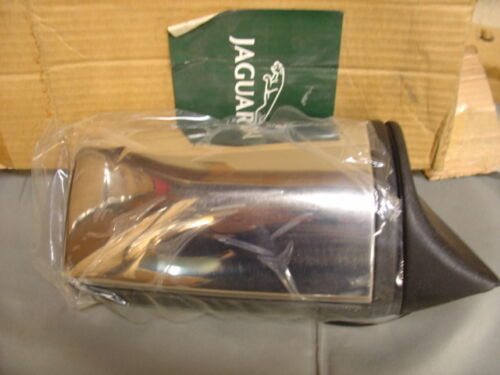
Superfically they look similar, but they are slightly taller than the post 88MY type and the black metal part where the mirror attaches to the body is formed slightly differently. It is less 'sleek' in a way - there is a step in height between the mount and the mirror itself of IIRC a little under an inch.
The other noticable difference is the plenum cover. On the 88MY on, the plastic part fits behind the rear of the bonnet/hood, filling the gap between it and the windscreen - and has grilles on it. On the 86 and 87 cars, the plastic cover follows the shape of the plenum itself, leaving a gap between the rear of the bonnet and the windscreen. It is much neater - indeed, on my father's 1987 3.6 the wiper was set on its splines to disappear into the gap behind the bonnet, out of sight. I don't know why Jaguar changed this - the earlier version was quite a bit more attractive without the wiper marooned on the screen.
There are other visual differences, though these are much less obvious on a photo. Early Daimlers (the ROW equivalent of the USA/Canada Vanden Plas) did not have the matchwood inlays on their veneers, though the Sovereign did. Very early Sovereigns had a leather piece on the armrest pull, changed to Ambla. Early Sovereigns and Daimlers had a black infill panel on the boot/trunk lid, which was also deleted for 1988 - though some do seem to have it. The radio was also different - it was a standard radio unit fitted into a slot on the dash, rather than the later built-in affair. There were two types, both by Clarion. One had six speakers and was standard on the Daimler and Sovereign, the other having four speakers and was fitted to the XJ6. The graphics on the HVAC controls are also different on the early cars - but the unit and layout is the same. The clock is a green LED one like an old calculator.
Edited to add a photo of the early type with step between the mirror and the mounting:
Later type where the shape of the mounting and mirror flow together:
Last edited by Don B; Mar 30, 2018 at 08:00 PM.
Reason: Adding photos!



 folks, is this an xj40?