When you click on links to various merchants on this site and make a purchase, this can result in this site earning a commission. Affiliate programs and affiliations include, but are not limited to, the eBay Partner Network.
Original steering wheel was gross, the leather was sticky and in bad shape, no amount of cleaning would get it reasonable. I splurged on a new wheel and hub adapter, which is about 1" smaller in diameter. Way better. The horn button required a small sub-harness to mate up with the horn button, no biggie. I am on the hunt for a small (1" or so) Growler/Jaguar emblem/badge to put on the wheel, if anyone knows of a reasonable example let me know.
Starting to work on refinement of a couple little items that have been bothering me.
-Get the stock gauges to work, I want to see if Dakota Digital has an interface that will talk to the Terminator X Max and translate RPM and Speed to the stock gauges.
-Work on front end alignment, currently there is a fair amount of toe out which is causing it to be very darty. I plan on trying my hand at a DIY alignment.
-Polish the lips of the wheels
I know this is offtopic from Jaguars, but I'm trying to get more into the Youtube thing. Spent some time making a video about my recent lapping adventures in my M3 this past fall. If you're bored, check it out and consider subscribing. Always open to commentary and suggestions. If there is interest, I would love to make some videos about the XJ6.0
When I bought the car over 2 years ago (man that went quick) the front outer tie rods were shot - lots of play and boots torn. I replaced them during the engine swap and did a very quick eyeball alignment which got me on the road but the car never drove quite right. It was darty, the steering would follow grooves in the road, both characteristics of too much toe out. I decided to try my hand at a DIY alignment and learned some interesting facts along the way.
I drilled some holes in aluminum square stock cut to exactly 24", mounted them to the hubs, and set the toe that way (1/4" toe in).
I then put the wheels back on, set the car on the ground, took it for a spin, and it still drove poorly. After doing some research, I decided to measure the toe difference between loaded and unloaded. Turns out as the suspension compresses, the wheels toe out quite a bit.
I put the car on wooden wheel cribs to be able to access the tie rods, settled the suspension again and zip tied the bars to the wheels.
Measuring the front of the bars compared to the rear, wowza! There was close to 1" toe out. This explains why the car was so darty, and why it would leap all over the place when coming off full throttle. The nose would come down, wheels toe out and the front end would want to pull. After dialing in 1/4" toe in with the suspension compressed, the car drove straight and the darty feeling was gone.
Excellent way to do it at home. I shall copy it!
Just a suggestion, it would be even more accurate with a couple of set screws (of exactly the same length) that went through the ally stock and went against the wheel rims, rather than the bar resting against the tyre.
Last edited by Greg in France; Dec 11, 2023 at 07:49 AM.
Excellent way to do it at home. I shall copy it!
Just a suggestion, it would be even more accurate with a couple of set screws (of exactly the same length) that went through the ally stock and went against the wheel rims, rather than the bar resting against the tyre.
I too did similar setup on my XKE, used cheap Amazon laser lights mounted on the square tubes and shot blue tape targets on wall 10 feet from wheel center. Used the tire and bungees to hold; tried different positions on tire, didn't get much variation. Steering wheel was easily and accurately centered.
Mounted a digital level to the square tube for checking rest of alignment.
This all occurred after thinking (or not) that I needed "uprated torsion bars". Plan on rechecking the torsion bar settings after a couple of weeks of settling.. Three full resets and it was dialed in.
Rgds
David
After putting the kids to bed, I spent Saturday evening tinkering with the tach. I snipped out the resistor and resoldered those leads, returning the tach to OEM spec. Just for testing purposes, I left the tach loosely installed with the signal wire hanging loose.
I fired up the engine and was met with a working tach! After a few minutes comparing the RPM readout on the Holley handheld to the analog tach, I used the Dakota Digital app to apply a correction factor and bring them in line. Success!
The Christmas miracles continue. I enabled the speedo output in the Holley with the default 4000ppm signal, wired it up, and we have a speedo!
I did have to apply a correction factor of 2.0 via the DD app which means that the Jaguar speedo is looking for a 8000ppm signal. Now, I need to figure out what I want to do with the rest of the auxiliary gauges (fuel, temps, etc) and clean up this mess of temporary wiring.
What an awesome feeling seeing the OEM tach and speedo just "work".
First "issue" with the car since the swap was done - original diff gave out. I was coming home one night and started to hear a knocking from the rear end consistent with vehicle speed. Figured it might be a driveshaft issue, but decided to chance it and limp the car home.
The chassis is an '84 with 172K on it, but the rear end assembly has "85 XJ6" written on it in ink marker so I am assuming it was swapped out some time in the last 39 years. No clue on the mileage on it though.
Drained the diff. This gear oil has only a few thousand miles on it.
The rear end comes out as an assembly so 2 hours later I got this.
The folks in Quality Assurance came by to check my work
The culprit is the retaining pin that holds the cross shaft in place, which walked out and allowed the shaft to knock into the pinion.
Pinion took a little beating
It's a shame because I think the 2.88 ratio suits the setup very well, so I am reluctant to regear. The damage is in a non contact area so maybe I'll deburr the pinion teeth and see how it runs.
I hammered out the cross shaft (shouldn't have to do that) and found that it had pretty bad galling on the spider surface. Definitely a lack of oil at some point which caused it to get mega hot.
I actually had to hammer out the cross shaft halfway, cut off the exposed stub, then hammer out the remainder as I obviously wasn't able to pull it out with the carrier flipped.
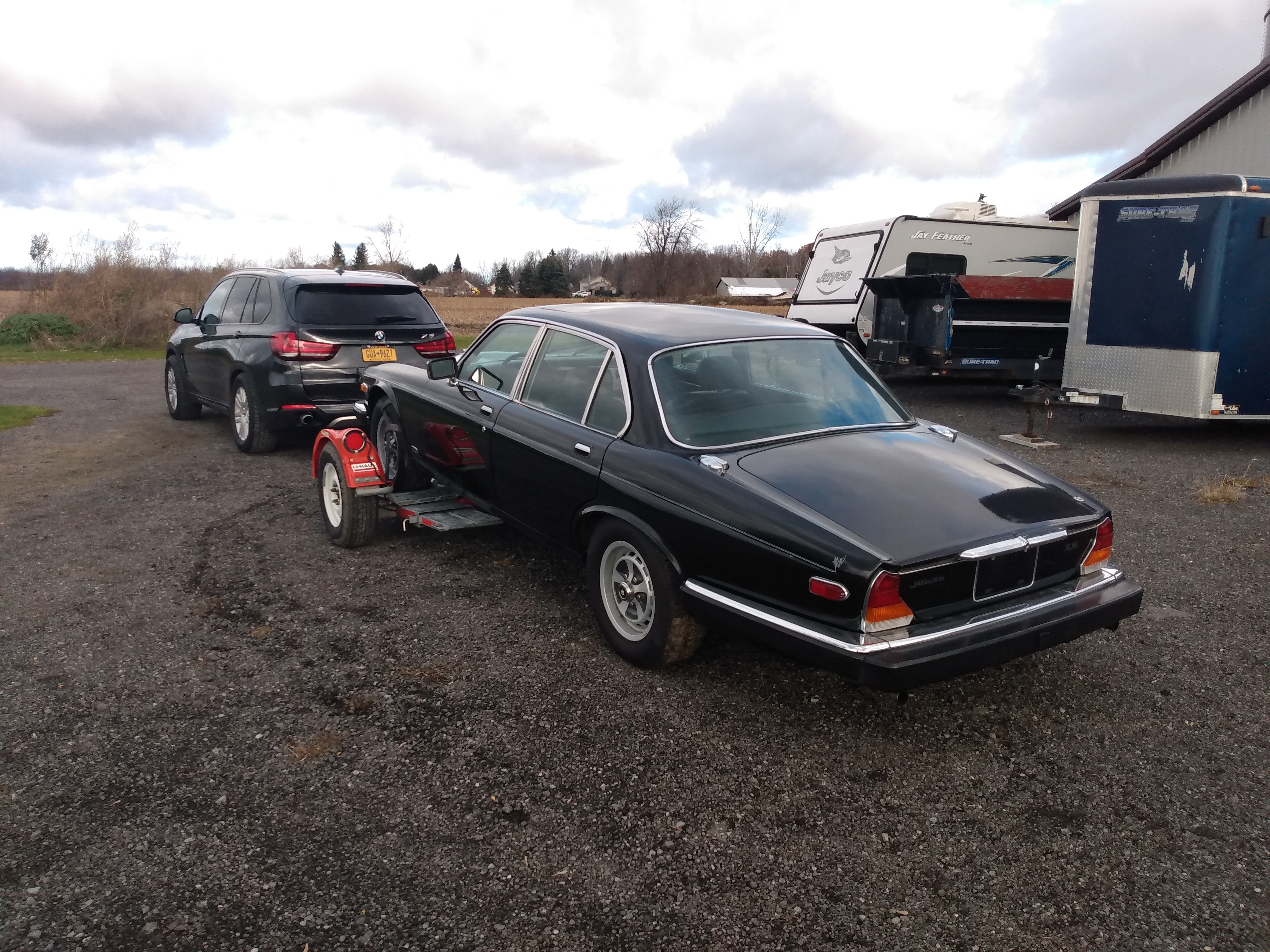
Thinking back, when I dragged the car home it was on the back of a tow dolly since there were no car trailers available due to Covid madness:
Even though the original trans was probably going to be scrapped, I still unbolted the driveshaft from the pinion flange so that it wouldn't cause anything to seize up and lock up on the thruway. Once I got the car home and up on the lift for the first time, I drained the diff and only a few ounces of gear oil came out.
My theory is that it drained out due to a bad leak on the driver's side output shaft while in storage before I bought the car, it got very hot on the way home, and then I continued to beat it to death with new oil for the next 2 years behind the LS.
Game plan - try to salvage the ring and pinion, order an Auburn locker, replace bearings, and put it back together. I'll also check on the condition of the output shaft bearings, hub bearings, and various seals while I'm in there.
Nosgiba
May i respectfuly suggest using an Eaton TrueTrac, rather than an Auburn locke or similar? I put one in my XJS and is is AWESOME. It is a Torsen-type diff and is miles better in raod applications than a normal LSD.
Nosgiba
May i respectfuly suggest using an Eaton TrueTrac, rather than an Auburn locke or similar? I put one in my XJS and is is AWESOME. It is a Torsen-type diff and is miles better in raod applications than a normal LSD.
Greg, always willing to listen to your suggestions based on your experience of already having done this.
Is this the one you used? Maybe I'll call DTS this week.
nsogiba
I would not re-use anything in your differential housing. The metallic slurry along with bits and pieces have done a number on everything including the critical contact surfaces of the R/P themselves. I am in the middle of changing my R/P and carrier to Dana units. I'm using an Auburn locker and Motive gears in 3.07 ratio. I'm like you in that the 2.88 seemed about right for the power of the engine and my driving style. You might look into something like that. I agree with Greg, the Torsen-style carrier is superior, just $200~ more.
Well, I hit a snag as both my research and DTS indicated that there is no Eaton Truetrac available for my 19 spline output shaft application. They only make one for a 30 spline found in DANA diffs like in Greg's car.
So, my options are:
Find a Dana diff locally and get the Eaton Truetrac.
OR
Purchase Auburn 546085 (superseded 5420112) and install into existing housing.
It's near impossible that I would find a Dana diff at a junkyard within a few hundred miles, and would likely cost more than just rebuilding mine with an Auburn. It's a shame Eaton doesn't offer the 30 spline option, I was looking forward to the Torsen technology, but I suppose any limited slip is better than my open diff.
I did also get the carrier/ring gear and pinion gear out - the damage is worse than suspected. There are small bits of material missing on the leading edges of the pinion gear. Normally I would feel comfortable just polishing the burrs and reinstalling, but a failure here could cause the diff to lock up (not the good way) at speed. DTS has a used 2.88 they'll sell me for $100 once I figure out the path I want to take. I'd like to tackle the gear install myself.
I'm not an expert, but I'll pass along what I think I've learned about this swap.
I am going to use the Auburn 546085 carrier you mention above. I will include an email from Auburn and a couple of pictures that caused me to write them. I haven't taken the old bearings off the Jag carrier yet to make that measurement (5.060"), but there's no reason not to believe what they say. That being said, as I mention below, using an aftermarket carrier with Jaguar 2.88 gears might cause an issue. I'll have to keep that in mind when I measure the two carriers.
As I was researching this gear/carrier swap I came across a site (a forum I think) that had a handful of posts concerning the Jag 2.88 gears specifically and putting them on an aftermarket carrier (any brand). From what I remember, the post suggested the 2.88/Jag carrier combination is a rather special animal. I got the idea the off-set of the ring gear flange on the carrier is not in any common Dana position and the 2.88 ring gear is not a common Dana thickness. I think they said this is because Dana does not offer a 2.88 ratio in their standard lineup. I had not thought about this match-up before, but I would scour the inter-web to make sense of this possibility if this was the direction I chose.
Another "what the he**" that might crop up is the way the pinion is preloaded. Some use a crush sleeve like my original 2.88's. Some use shims behind the outer bearing, this is how the new Motive pinion is. I got conflicting opinions as to where the shims would go to adjust the pinion "checking distance", the Jag had them behind the inner bearing race (cup).
Auburn email:
[David,The bearing hub length on the opposite side of the ring gear is .110” shorter than the Dana unit, so that is most of the height difference you are seeing. Bearing shoulder to bearing shoulder on the Auburn unit is exactly the same as a Dana produced unit, which is 5.060”.
We have had many people use this differential in the Jag axle housing over the years without any issues. Just need the correct bearings, which are 25590 & 25523.
That’s the same website that I got my info from, and then part numbers are spot on! I’m using the auburn posi worh 3:73 gears! Nly issue I ran into was the front seal, but that turned out to be a part that was boxed wrong! I did send mine out to be done, as after I took it apart, I decided it was above my pay grade!!!
I like your theory about what cooked the diff. I had a similar experience years ago towing home a '55 Chevy 210 that'd I'd bought on a dolly. During the tow, the rig started to "jerk" like someone was hitting the brake. Me and my dad pulled over and could see the diff was hot and slightly smoking--no oil in it. Oops. So I bought a couple of quarts of motor oil from a gas station and managed to get them in the diff housing and we were back on the road. And even after I'd finished restoring the car and started driving it, the diff held up seemingly okay. Until... When I had confidence in the car's set up and decided to finally try a full throttle launch (mild 350 and 700R4) and a spider gear snapped, sounding like a rifle shot hitting a steel plate.
I just bought my first…1986, same color. What winch did you use? I was planning the same setup to get the car myself but then had to travel so had to pay someone.
I was concerned with manual boat winch i already had pulling 4,000lbs.
Keep us updated!
i am excited to go start working on mine next weekend.