When you click on links to various merchants on this site and make a purchase, this can result in this site earning a commission. Affiliate programs and affiliations include, but are not limited to, the eBay Partner Network.
Take the 86 out for a drive, and the fuel tanks have that familiar "swish"... So we all know what that is, the pressure valve isn't working.. So I pop that out, drill a hole through it, and reinstall it. Still getting the swish, so I take the valve completely off, and take it for a spin.. Still get the swish... So I take the other valve off, that goes to the carbon canister.. Go for a drive, still get the swish opening the tank, with neither of the valves even on the car...
Thinking about that whole system, it seems like the vapour separators in the C post, and the lines are all that's left between the tank and the valves...
So I guess the next steps are going to be trying to blow air through the vent hose, coming out of the tank at the fitting in the boot and seeing if there is a blockage somewhere.. Maybe some junk in the line going into the tank, a bad vapour separator, or crunched line somewhere...
Other thoughts?
Cheers
David
shop.EverydayXJ.com
I am surprised that with your acquired knowledge dismantling these cars, you can't figure it.
Jose .. Fair enough....
Last count, I've dismantled around 50 Series 3 cars... some I saved nearly 100% of them. As I'm typing things, I can picture the way at every single hose is routed, and every little bolt or screw that could possibly be in the way, or a pain in the rear to get to. But here's the thing, I parted my last personal Series 3 driver in 2013. By then we had bought our X300, and it became our "Everyday XJ". When I bought this 86 in July, it was the first time I had ridden in a Series 3 in probably 8 years. And although most aspects of my day circle around these cars, there is a huge disconnect when you're working with them and not enjoying them.
It's true, I could fix the issues with the speedometer transducer, or fuel level senders, or rear brakes locking, or venting issues all by myself..And I could come on the Forum and anyone that asked about a fuel tank whooshing I could say to replace the one way valve, or tell about the time I had to figure out why my tank wouldn't vent... And in a week I could say that some previous owner put a jack under the floor and squished the vent lines running to the front of the car, or the car had sat long enough that the vent lines were clogged due to some nasty rust....
And by that, I suppose neither you, nor I, nor Doug, or Gregory, or Frank, should ever be allowed to ask, only answer..
I know that the archives are full of answers about fuel tanks switching, or rust around windscreens, or windows not working. And we could probably all answer those until we're tired of typing. Or one guy can say to turn the nut clockwise, and another will argue that you need to turn it to the right (same thing, yeah)... But it's the little silly oddball stuff that I like to read about.. And even though I know what steps I'm probably going to have to take to fix something, sometimes it's just fun to chat it out.. if for no other reason than to help the next guy who's reading it.
A big part of what I've missed about having a Series 3 is just getting on the groups and chatting about it.
Welcome back to me?
Cheers
David
shop.EverydayXJ.com
Last edited by davidboger; Nov 3, 2023 at 06:58 PM.
That statement was cold:
Dismantling a car does not teach you how to troubleshoot a system problem. It is like you just asked in your post "how could the vapor lines get clogged" ? Go figure.
I recommend you check the vent pipes that pass through the rear wheelarch area. For some reason they are routed in a sort of S shape on the rear of the wheelarch area. These pipes are steel and can corrode leading to a blockage. That would then prevent the tank on that side from venting properly.
I have often wondered why these pipes take a circuitous route….anyone know?
I am surprised that with your acquired knowledge dismantling these cars, you can't figure it.
Jose .. Fair enough....
Last count, I've dismantled around 50 Series 3 cars... some I saved nearly 100% of them. As I'm typing things, I can picture the way at every single hose is routed, and every little bolt or screw that could possibly be in the way, or a pain in the rear to get to. But here's the thing, I parted my last personal Series 3 driver in 2013. By then we had bought our X300, and it became our "Everyday XJ". When I bought this 86 in July, it was the first time I had ridden in a Series 3 in probably 8 years. And although most aspects of my day circle around these cars, there is a huge disconnect when you're working with them and not enjoying them.
It's true, I could fix the issues with the speedometer transducer, or fuel level senders, or rear brakes locking, or venting issues all by myself..And I could come on the Forum and anyone that asked about a fuel tank whooshing I could say to replace the one way valve, or tell about the time I had to figure out why my tank wouldn't vent... And in a week I could say that some previous owner put a jack under the floor and squished the vent lines running to the front of the car, or the car had sat long enough that the vent lines were clogged due to some nasty rust....
And by that, I suppose neither you, nor I, nor Doug, or Gregory, or Frank, should ever be allowed to ask, only answer..
I know that the archives are full of answers about fuel tanks switching, or rust around windscreens, or windows not working. And we could probably all answer those until we're tired of typing. Or one guy can say to turn the nut clockwise, and another will argue that you need to turn it to the right (same thing, yeah)... But it's the little silly oddball stuff that I like to read about.. And even though I know what steps I'm probably going to have to take to fix something, sometimes it's just fun to chat it out.. if for no other reason than to help the next guy who's reading it.
A big part of what I've missed about having a Series 3 is just getting on the groups and chatting about it.
Welcome back to me?
Cheers
David
shop.EverydayXJ.com
Last edited by davidboger; Nov 3, 2023 at 06:58 PM.
So I guess the next steps are going to be trying to blow air through the vent hose, coming out of the tank at the fitting in the boot and seeing if there is a blockage somewhere.. Maybe some junk in the line going into the tank, a bad vapour separator, or crunched line somewhere... Other thoughts?
That's what I would do.
You mentioned "tanks" so I'm assuming both tanks have the swish....which suggests the obstruction would be downstream, after the point where the left and right vent lines become a single vent line.
Looking for a crunched pipe might actually be the easiest first step.
Thank you Doug...
After the first couple of drives in the car, I noticed both tanks where whooshing... Because I'm not driving it daily yet, and it's always parked in the dry, I'd just pop the fuel caps open prior to driving. A couple of times I forgot to do it, and could hear the dreaded fuel tank popping.. One day I remembered to drill out the one way valve.. And the right side stopped whooshing.. The left still is. Being in project stage, I still just open the filler cap on a drive (it doesn't get to go out on bad weather days).
With the right side stopping the whoosh... I found out my tank has a leak that probably came from the tank popping..So it's self venting if you will..
I haven't had the carpet out of the boot yet, so I'm not sure what condition the piping going into the tank to vent, is in. So I'm going to pull that on the LHS, and put some low pressure air to it..
It's such a different kind of venting problem...
Thanks again,
David
shop.EverydayXJ.com
It was warm in NC today, so I decided to dig into it a little bit.
The vent from the tank is a fitting in the boot, on both sides... In this photo it's facing backwards, but it connects to the hose going towards the front of the car. That hose is the one that directly vents the tank, and goes to the fuel separator.
Blowing air into the tank, I could hear it coming out the filler cap. So I knew the line inside the tank was venting.
Blowing air into the hose going to the fuel separator made it blow out the filler cap. So I knew the fuel separator on that side wasn't clogged.
So, I disconnected the hose that goes from the separator, to the hard vent line... Blowing into the separator showed me that the line was clear from the feed and exit sides of the separator, so I knew the separator wasn't clogged.
So next was blowing air into the line that goes to the carbon canister. That revealed the the line itself is clogged or crushed somewhere...
I did repeat this on the RHS tank, with the same results. So the clogged or crushed line is probably forward of the place where those lines connect... Which would be somewhere in this area: (stock photo)
I did follow the lines from the rear of the car to the front, and nothing felt out of place... It is the smaller of the two lines under the car, on the RHS..
There are some connector hoses, so I could remove those to track it down further. But, not having a lift, and being a little short on time, I went for a temporary fix...
I'm sure this isn't recommended, but to keep me on the road for a little while, and to keep from imploding another tank, this is what I did:
I reconnected the hoses from the separator to the vent hoses towards the front. Then I capped the hose from the tank vent going to the separator. Doing that, the entire vent system is isolated from the tanks.
Finally I just ran a short hose from each of the pipes that vent the tanks, out the underside of the car.
I'm losing the ability to return any of the vaporized gas back to the tank... how much could it possibly be anyway? And I'm also venting directly to the atmosphere. I wouldn't want to do that as a permanent fix for sure.
But honestly, I'm planning to do away with the air pump and air rail on the engine. It just cleans up the engine bay a little... So the function of that brief recirculation of the fumes is something that will inevitably be lost.. And that would mean that I'm just losing the function of the charcoal canister by doing it this way.
This poor ole girl is gonna need a lot.. And the IRS will have to come out eventually.. Which will give me full access to all of those vapour lines..
So this isn't a recommended fix, but a bandaide that will keep it on the road and keep me from imploding another tank, while I knockout some of the other things going on with it...
Cheers,
David
shop.EverydayXJ.com
I had the whoosh problem a couple years ago on both tanks and took the lines and valves apart at the canister in the front wheel well and found that the function of the system depended on the opening and closing of the electrical valve located just below the air cleaner canister. After some time, I traced the trigger to the electric valve to the temperature switch at the end of the water rail along the intake manifold. Checking the temperature switch at various times (varying degrees of cold or hot) it was apparent that the switch never closed resulting in an inability for the carbon canister to ever clear itself and the swooshing continued. However, jumpering the switch to keep the valve open did not improve the issue. Next step, I left the system open as David has done and found no change in the swoosh. Lastly, I applied regulated air pressure at 20 lbs to the vent line at the wheel well with one tank filler cap open and could hear the passage of air. I closed that cap and opened the other tank and applied pressure and found it to pass air as well. Then, putting a vacuum hand pump on the line and alternately opening the filler caps indicated a very slight resistance to the passage of air and I assumed there was likely a restrictor valve in the line that allows the pressure to build in the tank very slightly before opening. Anyway, after this the swooshing has diminished to a very light passage of air occasionally when opening a tank cap but nothing to worry about. My only bother with the fuel system now is that a new tank switching solenoid valve was defective and every morning I find both tanks at the same level.
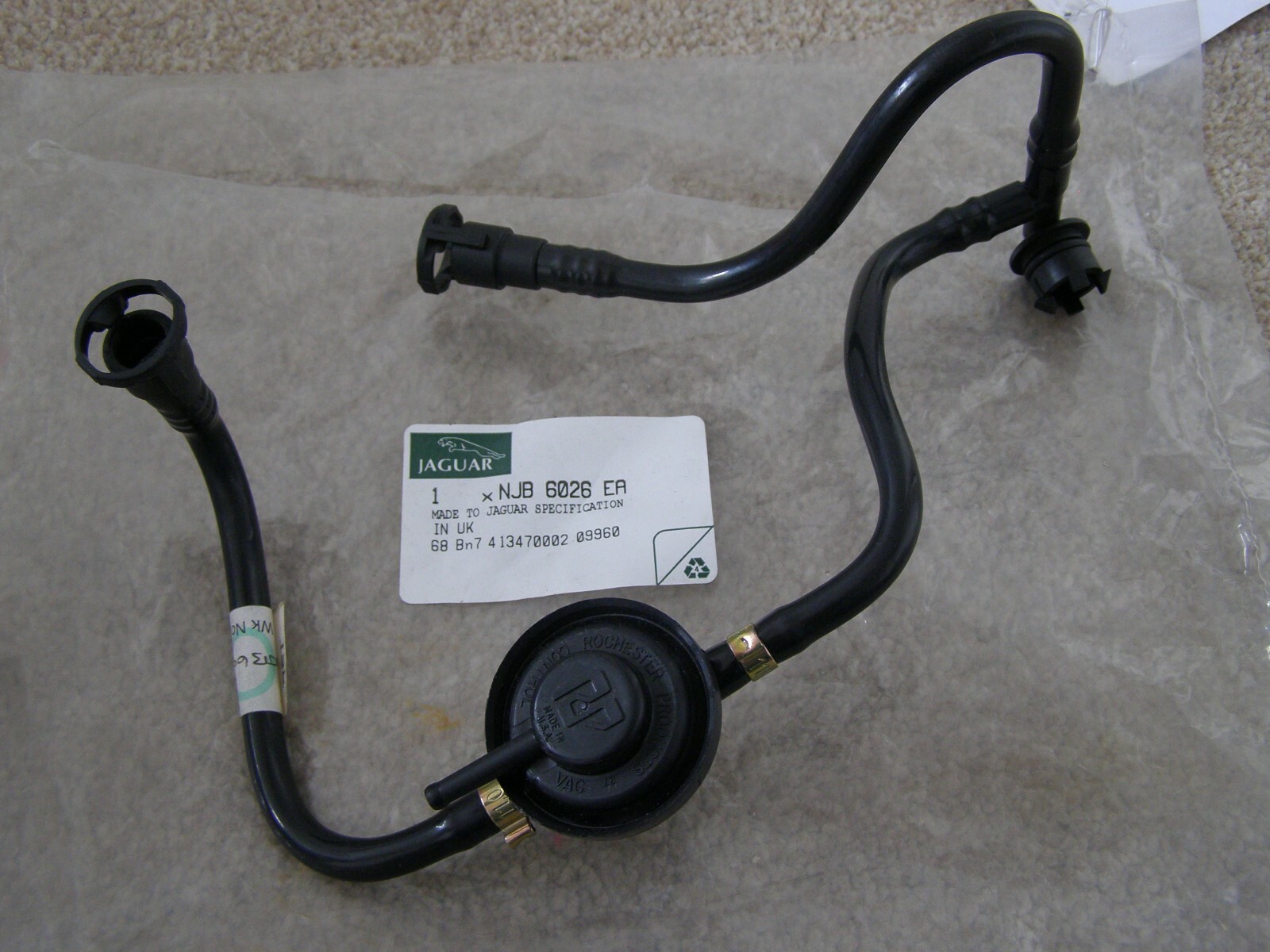
How it works (not necessarily your location though): https://jaguarvp.blogspot.com/2013/0...ief-valve.html
Basically, itallows fumes out once a tiny bit of pressure is in the tank, and when vac is applied (ie engine is running) allows air back into the tank.
Photo
A vac source connects to the spigot, on the XJS a take-off from the ECU vac line.
I am pretty sure there is one near or in the charcoal canister tubing. These two links show two different XJS setups, one more complicated than the other; but for sure yours will be pretty similar, if not identical. In the more complex system, there are all sorts of other valving as well. If you are allowed to, best to get rid of the entire lashup! https://parts.jaguarlandroverclassic.../brand/jaguar/
David, check the return valves and changeover valve for sticking. The changeover can stick partially open (contamination from tanks) and cause feed from both tanks and return to just one. Returns can be compromised at the same time causing lots of running in circles and newly invented profane terms. But don't change any valves until you have very clean tanks or you'll be doing it all again. I suspect you have raw fuel in the charcoal canister too.
Those are Michelin Hydro Edge.... They were on the car when I bought in in July.. Seem to ride pretty well...
Kind of ironic that a car that never sees the rain has rain tires, eh?
Cheers
David
Those are Michelin Hydro Edge.... They were on the car when I bought in in July.. Seem to ride pretty well...
Kind of ironic that a car that never sees the rain has rain tires, eh?
Cheers
David
Thank you so much for those well composed pictures!
Taking a clear photo in a dark, complex space is more difficult than it appears.
Many times undercar or underhood photo's are so distant I cannot discern the intended 'subject'. Others are so close I cannot discern
where the heck we are in the vehicle.
I am not blaming the amateur photographer, modern camera's (& phones) like to operate in full automatic.
So continually attempt to seek a focal point which is
never what we're photographing. Or a flash level too high.
(camera programmers always assume we're photographing a human face)
just browsing the forums for fun and come across this thread.
would anyone be kind enough to explain this "Whoosh" problem to me as from the wording alone it may be an issue that I was unaware of that I have.
I do hear a liquid sloshing around sound occasionally when driving and do get the light smell of gas from inside the car aswell.
is this the aforementioned "Whooshing problem"?



 Another Strange one - Venting issue













 Discontinued in 2011.

 Thanx
Thanx


