When you click on links to various merchants on this site and make a purchase, this can result in this site earning a commission. Affiliate programs and affiliations include, but are not limited to, the eBay Partner Network.
Older cars with the older vertical flow radiators are probably OK with that stuff, but cross flow radiators, the V12 etc style, are not so friendly.
Many I have dealt with, and have been using that stuff as suggested, have been seriously clogged in the lower 25% of the radiator tubes, and a few were not able to be rodded out, the stuff was like concrete, so a new core was needed.
Most of the new generation coolants are not compatible with it that I am aware of.
Thank you for this, Grant!
Bars Leak was a staple when I was growing up. I always thought the stuff remained in solution until it encountered a leak and THEN hardened as fluid escaped, plugging said leak.
The pellets were supposed to dissolve as you have thought.
They did not. The solution they were in, inside the container, was basically soluble oil, used waaaaaay back in radiators when water was the fill. The soluble oil was claimed to lubricate the water pump seal.
Now with coolants being longer life than most engines, and lots of other cooling system advances, alloy radiators being the main thing,
The very fine tubes in modern radiators and heater cores would NOT be compatible with the pellets, or most any claimed radiator sealants in my opinion.
Yes, I recall the halcyon days of Barr's leak. I might even have used it a time or two.
More likely than not in a top and bottom tanked radiator. I think it worked and with no lingering issues.
Today, no, and not for a fairly long spell.
If one is "up against it" and needs a sealer, in lieu of a proper fix, there are better products.
But, in this day of alloy radiators, fixes improbable, I'm not so sure. The things seem
"throw aways". Another example of our wasteful society.
Great advice Grant.
Back in 1980 or thereabouts, always marginal cooling turned into growing overheating problems in our Series1 E-Type. For some years, we had stopped using Barr's Leaks but were growing tired of enduring these problems, especially in our 40+C summers. Out with the w/pump and t/stat (both OK) and our incredibly heavy radiator.
Heavy? Several days later, in the pro rad shop and with end tanks removed as flushing achieved nothing, we learned -
the top 50% of the rad was still open and working . . . sort of;
the mid-height 1" was filled with a whitish sludge paste;
the bottom 50% of the rad had somewhat bulging channels that looked like absolutely solid metal, the rusted crud indistinguishable from surrounding metal, and impossible to "rod" in the traditional manner.
How much of this was from prior use of Barr's Leaks in conjunction with the, by then, widely adopted anti-corrosion fluid used in cooling systems instead of regularly flushed, plain water, I am still unsure many years later.
However, I do recall the rad shop staff delivered same advice that Grant has delivered here . . . in particular, they pointed to the midband of paste as a chemical progression of incompatibility that gradually blocks more and more of a cross-flow, or horizontal pass, rad. Brand new, somewhat thicker, rad core fitted . . . never any Barr's Leaks . . . and never another issue.
Ages ago GM used to recommend sealing pellets as part of routine servicing as well....even when there were no leaks. Never liked the idea.
Over a period of a few years the car, if serviced by the book, would've been treated to multiple doses of a cure for which there was no disease. Each dose added to the build-up of gunk.
I'm with Carl. These products are for use when "you're up against it". (Haven't heard that expression in years!)
In the late 90s Subaru was becoming overwhelmed with head gasket failures. I can't remember the root cause of the failures....just crummy gaskets, I think... but, man-o-man, we had LOTS of upset customers.
Subaru's 'fix' was a bolttle of this...repackaged with a Subaru label.....
Infuriating. At the dealer level we knew, of course, that this was a bodge....and most of the customers did as well. But, Holts was the official cure. Eventually I think Suby did back away from the idea because customers would complain of head gasket leaks and dealers would just throw in another bottle of Holts. Eventually the systems got clogged and engines started to cook. What should have been stepping up to simply replace head gaskets blossomed into having to replace engines.
I can't remember how it all ended. I remember being disappointed at Suby because they were normally more proactive than other manufacturers and a bodge fix wasn't the usual practice.
Before Bar's Leaks and long before Holt's Radweld, the white of an egg was recommended to be added to a leaking radiator when cold. As the temperature rose the egg cooked and magically sealed the leak. It was no less effective than the products mentioned.
This is another one that belongs in the toolbox with the sawdust for fixing a noisy diff and the Lucas Replacement Wiring Harness Smoke Kit.
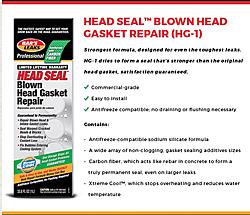
I expanded the Bar add. I was surprised that it listed the ingredients in general terms.
It seems the "active" two are:
A salt. A crystaline compound. Moves about in suspension and then when it comes in contact with a leak, and is exposed to air, crystilizes and thusly becomes a hard seal So far, not too bad. But, what happens to the "uncrytalized"? Remains in suspension, or settles out?
B. Carbon fibers. The salt is the concrete? The carbon is the rebar? OK, so far.
Or is it. Just forms a stronger sediment???
At one time, I recall black pepper as a fix for a leaking radiator. Never tried that one.
I have a vague recollection of a product that the "full service station" where I worked during college, had a little can of "Stop Leak" on the "snake oil" display. Seldom sold.
I opened a can in curiosity. Seemed like aluminum powder???
Back in memory, I recall a ZEREX add. So far back, that the product came in gallon tins! The demonstrator used an "ice pick" to punch a hole in the side. Art first, a stream poured out, but then diminished and finaly stopped???
Doug: I think that phrase relates to "back against the wall".
Grahame:
My V8 will not see any of that stuff.... If it's big four row brass radiator springs a leak and it isn't in the core, I can solder it.
Way back when, my 57 Ford pickup had a bad habit of springing a leak at the upper tank to core joint. Luckily the front one. A propensity of them all at the time. Did the
solder thing a few times. Then, I seem to have found a fix. Not only fill the channel but build up a sheet of solder up the tank about 3".
I too used it many years ago to keep my old everyday driver's going. Bar's leaks and crossed fingers were staple maintenance measures! It never occurred to me that the crossed fingers were doing more good than the Bar's!!
The very fine tubes in modern radiators and heater cores would NOT be compatible with the pellets, or most any claimed radiator sealants in my opinion.
Your spot on Grant, I put bars leak in the Range Rover 18 months ago to buy some time as I New the head gasket was gone..bought me six months and then I had the head gaskets done, however it also cost me a new radiator as the
old one (six months old) was absolutely clogged up.
I was in the local "super' hardware store this AM. looking for, and found a "grabber". A device to allow me to pickup stuff and not bend my ancient joint. Good for low stuff as well as on the top.
As I am a curious guy, I visited the "snake oil" shelves. Yup, Bar's there as well as another "stop leak". Each promised a lo including head gaskets!!!
Good evening gentlemen,
An interesting thread, and some great responses, and advice from the man who knows this stuff and has been a great source of advice to me, Grant Francis. Notwithstanding, my experience is somewhat different as follows:
The Series 1 V12 manual says "add two containers of Bar's Leaks" so I did. All good no problems with clogged radiators or overheating since owning the car in 1988.
Sometime later, 2015, whilst posted to Darwin I thought "It's bloody hot up here, I'll get the radiator cleaned out". Darwin Radiator and Air Conditioning (Nicko) did the job, and we didn't put Bar's Leaks in the coolant for all the reasons stated in the thread. All good car's running fine. Checked the oil one weekend several weeks after the coolant change and discovered a lovely frothy substance at the end of my dipstick! Checked the oil filler cap, same frothy milky substance on it. Water had contaminated my oil! There was no oil in the water.
In a mild panic I drained the oil: twice, and replaced the coolant, and included Bar's Leaks as the manual told me to. The problem went away for several years, but the reason I researched this thread is that it has returned, and I'm due a flush and fluid change with more Bar's Leaks to prevent the oil in water problem.
I also researched the reason Jaguar V12's need an engine block water sealant (not a radiator sealant): they have wet liners. According to my research the Jaguar Engineers were unable to achieve a perfect seal between the block and the cylinder heads water jacket and needed a solution: Bar's Leaks. Now I'm not saying that technology hasn't moved on, and maybe someone can find a better way of sealing the engine, but in an engine of the 1970's vintage it is the solution.
Your thoughts greatly appreciated.
Cheers, Chris
The wet liner V12 relies on the pressure of the head to "seal" the liner bottom to the block. It works, and works well. Seepage was a given, hence the additive.
I used it back in the late 60;s and 70;s in the MK7 and MK10, as rain water was the best we had, and I never had issues that I remember.
The fact they are still in business and appears expanding, they must be acceptable to the masses.
I had issues with the Series 6cyl cars that came with it in the systems, and getting them back to scratch was tough, and coolant etc was readily available so went that path.
My negative of that product was the pellets that simply did not dissolve fully and clogged things.
I've had great results with these in 3 vehicles I tried them on. I just used them with success on a BMW with no observable leak but l had to add coolant once a week. I dropped in three of these tabs and it's been fine for months now. At 244k miles the BMW is on borrowed time but for the price of these tabs was worth a shot..
I'm fond of all things GM so these made sense for me.
Last edited by icsamerica; Dec 11, 2024 at 08:24 AM.
I suspect the advice on Bar's Leaks arose through a need to seal the wet liners of the V12 in an era before the various grades of Loctite became available. My approach with Bar's Leaks is use it once and never again unless there's evidence of milky oil. If used regularly, budget for a new radiator every few years.
Carl, if you have experienced a better product, I would be very keen to hear what it is. I have done some Googling for a different product than Bars Leaks but hesitant to use them as they all appear to be radiator fixes not block/water jacket related, maybe the same thing but as I don't know for sure....Evil Bay has some Nulon product that looks pretty impressive?
Cheers, Chris




 What's up with Bar's leak?