


6.7L V12 build


Junior Member
Joined: Dec 2012
Posts: 3
Likes: 1
From: Auckland nz

Hi sorry to repeat myself - does anyone know of the current owner of the Bradley Smith XJS in the USA. Also does anyone know of any Lister jaguar 7l mk111 supercharged vehicles in Australia or UK - cheers Chris

Veteran Member
Joined: Jul 2010
Posts: 7,362
Likes: 1,241
From: Austin tx and Daytona FL.
SORRY ,have no idea

Senior Member
Joined: May 2013
Posts: 183
Likes: 272
From: UK
Love the flow bench, never had 1 myself, I think they certainly have there place but like many things can lead you down the garden path if you dont take a step back from time to time.
Quick maths - at 3500rpm which is a low usable street car figure; the engine would need to suck just over 17L per second through each cylinder, valve and inlet. This is a lot. Yes the engine might be less efficient but some are more than 100% efficient in their flowing of air. I am struggling to see why there is no drop in flow simply bolting on the inlet manifold. Unless that 17L is being pulled every second you might not be able to see such variations. ? I dont know.
Having said that the increase in flow v valve lift looks interesting and as I would expect. The large bore tube to the head would of course need to be in the correct place and the correct bore to give the correct picture. There is a lot of flow shielding on one side of the valve be it inlet or exhaust.
I like to use published data from the Big Boys, they have had more man hours and more financial input that we could ever hope or dream of.
I bring this up as I am struggling with the following;
If Jaguar got the inlet manifold correct for the XJS (and I believe they did or got very close to optimal design for a production car) then the same inlet manifold on a 6L engine would be 12% undersize all things being equal; maybe they are not, the engine would have more torque and therefore on average be used at lower revs? So maybe the argument for a larger manifold for the 6L is hollow.
However when we are now talking about a 6.7L or larger engines some with manual gearboxes this same problem persists, The larger throttle bodies or twin/ triple on the standard plenum to allow better flow is a myth, there are many calculators about on the web allowing you to work out what you need for your application. The standard TB's are fine for all but larger / high revving monsters.
But a 6.7L unit needs 21% more flow a 7L 25% and a 96mm bore jobby AKA Rob Beeres available option, approaching 30% more flow.
I cannot accept that the standard inlet, designed and build with big money for a 5.3 road car can flow correctly for these larger beasts unless the usable revs are reduced on a pro rata manner, which of course they are not.
So, the Group A inlet, with advantages for a 5.3L above 5000rpm would be good on a 6L from 4,400rpm and on the 6.7L below 4K. Following this logic(?) then the 7.3L would gain above 3500 rpm.
Which by pure co incidence is exactly the point at which I started.
Comments invited.
Quick maths - at 3500rpm which is a low usable street car figure; the engine would need to suck just over 17L per second through each cylinder, valve and inlet. This is a lot. Yes the engine might be less efficient but some are more than 100% efficient in their flowing of air. I am struggling to see why there is no drop in flow simply bolting on the inlet manifold. Unless that 17L is being pulled every second you might not be able to see such variations. ? I dont know.
Having said that the increase in flow v valve lift looks interesting and as I would expect. The large bore tube to the head would of course need to be in the correct place and the correct bore to give the correct picture. There is a lot of flow shielding on one side of the valve be it inlet or exhaust.
I like to use published data from the Big Boys, they have had more man hours and more financial input that we could ever hope or dream of.
I bring this up as I am struggling with the following;
If Jaguar got the inlet manifold correct for the XJS (and I believe they did or got very close to optimal design for a production car) then the same inlet manifold on a 6L engine would be 12% undersize all things being equal; maybe they are not, the engine would have more torque and therefore on average be used at lower revs? So maybe the argument for a larger manifold for the 6L is hollow.
However when we are now talking about a 6.7L or larger engines some with manual gearboxes this same problem persists, The larger throttle bodies or twin/ triple on the standard plenum to allow better flow is a myth, there are many calculators about on the web allowing you to work out what you need for your application. The standard TB's are fine for all but larger / high revving monsters.
But a 6.7L unit needs 21% more flow a 7L 25% and a 96mm bore jobby AKA Rob Beeres available option, approaching 30% more flow.
I cannot accept that the standard inlet, designed and build with big money for a 5.3 road car can flow correctly for these larger beasts unless the usable revs are reduced on a pro rata manner, which of course they are not.
So, the Group A inlet, with advantages for a 5.3L above 5000rpm would be good on a 6L from 4,400rpm and on the 6.7L below 4K. Following this logic(?) then the 7.3L would gain above 3500 rpm.
Which by pure co incidence is exactly the point at which I started.
Comments invited.
Last edited by xjr5006; May 17, 2017 at 06:47 AM.


Veteran Member
Joined: Jul 2010
Posts: 7,362
Likes: 1,241
From: Austin tx and Daytona FL.
xjr5006, interesting theories! only time will tell, and your engines are so much beyond the knowledge of this site,(guys i'm not being facetious,just stating facts)
to add to some of the confusion, i had my factory 1978 5.3L inlet manifolds internal EXTRUDE Honed 1995, they came back with most humps and internal bumps smoothed out(bolt bosses, injector bosses etc, internal surfaces smooth, and a nice visual flow into the runners!
speaking with Swain tech guy he said internal volume was around 10/12% larger than before honing!
of course i port matched to head port by hand , manifold runner at port end measured close to 2mm larger.
opened head port not quite that much , trying to keep the pinch point just before flow enters the bowl/throat area,theory for swirl flow into cylinder bore.
altho i did use Gr44 oversize valves, 3mm inlets,2mm exhaust, 3 angle seat hand blended into throat.
been 22yrs all seems OK, i did increase torque at the tires by using a low rear axle ratio,3.73-1, and a fairly low ratio 1st gear,3-1, so quite a bit of tire torque available on initial start away, overdrive is fine (for street car) 2.60-1.
to add to some of the confusion, i had my factory 1978 5.3L inlet manifolds internal EXTRUDE Honed 1995, they came back with most humps and internal bumps smoothed out(bolt bosses, injector bosses etc, internal surfaces smooth, and a nice visual flow into the runners!
speaking with Swain tech guy he said internal volume was around 10/12% larger than before honing!
of course i port matched to head port by hand , manifold runner at port end measured close to 2mm larger.
opened head port not quite that much , trying to keep the pinch point just before flow enters the bowl/throat area,theory for swirl flow into cylinder bore.
altho i did use Gr44 oversize valves, 3mm inlets,2mm exhaust, 3 angle seat hand blended into throat.
been 22yrs all seems OK, i did increase torque at the tires by using a low rear axle ratio,3.73-1, and a fairly low ratio 1st gear,3-1, so quite a bit of tire torque available on initial start away, overdrive is fine (for street car) 2.60-1.

Veteran Member
Joined: Aug 2014
Posts: 1,858
Likes: 366
From: Pensacola Florida USA


IF you want to see what should have been done for the Jaguar intake manifold...
it is very simple...
go look at the first DB7 manifold... and get the HP #
then look at the HP # for each year DB7 after that and look at each manifold...
at the start the manifold were very similar to our XJS manifolds...
at the end... (with much more HP out put and torque) they had the butterflies on the end and they had a proper taper from front to back.
I have witnessed ricers with good computer software flow modeling intake manifolds and they end up something like what the DB7 end of run and DB9 have. (with only 4 or 6 cylinders though)
Veteran Member
Joined: Jul 2010
Posts: 7,362
Likes: 1,241
From: Austin tx and Daytona FL.
IF you want to see what should have been done for the Jaguar intake manifold...
it is very simple...
go look at the first DB7 manifold... and get the HP #
then look at the HP # for each year DB7 after that and look at each manifold...
at the start the manifold were very similar to our XJS manifolds...
at the end... (with much more HP out put and torque) they had the butterflies on the end and they had a proper taper from front to back.
I have witnessed ricers with good computer software flow modeling intake manifolds and they end up something like what the DB7 end of run and DB9 have. (with only 4 or 6 cylinders though)
so true ,i believe we did a comparision few months back, the one i liked was the this ,large plenum with front mount TB, also i pic of a car i cared for while owner was away! 1993 Skyline straight 6, frt mount TB.
john the Aston engine was 4 valve , and the shape of the inlet mani shows it!
Last edited by ronbros; May 17, 2017 at 01:46 PM.

Veteran Member
Joined: May 2014
Posts: 5,906
Likes: 2,182
From: Bremen, Germany
In theory, you want all intake runners to have the same distance between the TB and the intake valve as well as have a plenum to have sufficient air/vacume reserves. At least for non-pressurized versions aka N/A engines. The closest to a perfect one I have seen used on a standard roadgoing car, equipped in a factory, would have been the manifold from a 1991-1998 Volvo B6304F/S. A straight 6 with a side mounted TB. All runners are within a mm or twonthe same length. The plenum is a sphere. From the middle of the V, every arm/runner is equally far away from the TB.
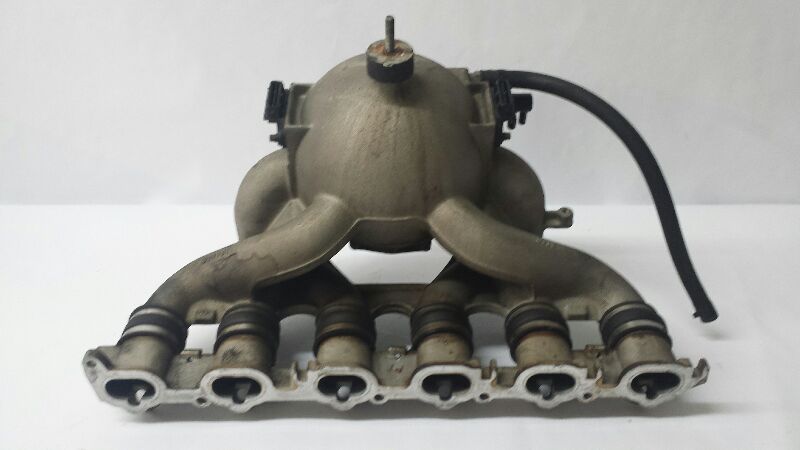
Now, this won't work well for a V12 with a cold V. If though it were to have a hot V, it would be an idea to adapt it all. This manifold design was actually designed by Porsche Engineering (not Porsche cars) in Weissach. Many other brands have tried to copy this design, like Mazda/Ford with the MZR/Duratec HE engines. A ball/sphere with equal length runners. Making it all a better way to work. On the B6304S/F the fuel consumption is down compared to equal aged cars and power is up... For a 24V head, it also has a remarkably high torque figure.
The flaws I see are everytime the same: front mounted TB results in looooong runners formthe rear cylinders with short runners for the fronts...
Now, this won't work well for a V12 with a cold V. If though it were to have a hot V, it would be an idea to adapt it all. This manifold design was actually designed by Porsche Engineering (not Porsche cars) in Weissach. Many other brands have tried to copy this design, like Mazda/Ford with the MZR/Duratec HE engines. A ball/sphere with equal length runners. Making it all a better way to work. On the B6304S/F the fuel consumption is down compared to equal aged cars and power is up... For a 24V head, it also has a remarkably high torque figure.
The flaws I see are everytime the same: front mounted TB results in looooong runners formthe rear cylinders with short runners for the fronts...
Veteran Member
Joined: Jul 2010
Posts: 7,362
Likes: 1,241
From: Austin tx and Daytona FL.
diam , i have personally seen some Toyota 2JZ 6 engines make over 1400hp at the wheels!
using those long tapered inlet manifolds!
that ball is unusual , but theory and reality are two different things.
using those long tapered inlet manifolds!
that ball is unusual , but theory and reality are two different things.
Veteran Member
Joined: May 2014
Posts: 5,906
Likes: 2,182
From: Bremen, Germany

Thread Starter
|
Veteran Member
Joined: May 2010
Posts: 4,638
Likes: 2,583
From: Vic Australia
17L/s is 36cfm not a lot of flow. 36cfm would make about 50HP.
According to V12sales the stock intake manifold flows about 137cfm for each runner
According to V12sales the stock intake manifold flows about 137cfm for each runner
Last edited by warrjon; May 19, 2017 at 02:52 AM.
Senior Member
Joined: May 2013
Posts: 183
Likes: 272
From: UK
Just pulled a Group 44 engine build book (engine 014) unfortunately they have 4750 as the lowest revs a reading is taken from. Even so in early form they dont get 420 at 4750 rpm
'02/14/1986 12.7 CR 6.0L 416.6 @ 4750rpm
and this baby tops out well over 200bhp more than this at higher revs with about 500 at the torque/ hp crossover point. So quite a serious XJR7 engine.
On the other hand what this all proves Im not too sure, LoL
Senior Member
Joined: May 2013
Posts: 183
Likes: 272
From: UK
IF you want to see what should have been done for the Jaguar intake manifold...
it is very simple...
go look at the first DB7 manifold... and get the HP #
then look at the HP # for each year DB7 after that and look at each manifold...
at the start the manifold were very similar to our XJS manifolds...
at the end... (with much more HP out put and torque) they had the butterflies on the end and they had a proper taper from front to back.
I have witnessed ricers with good computer software flow modeling intake manifolds and they end up something like what the DB7 end of run and DB9 have. (with only 4 or 6 cylinders though)[/QUOTE]
Sorry I dont agree. For a road car you want slightly different lengths of inlets to spread the peaks out. Yes you could have a front TB but there is a packaging issue here, were do the filters go! The Jag manifold is not boxy and square like the |Aston manifold shown, the narrow parts of the plenum are at the ends and its deeper in the center by the TB. Someone has worked this out quite carefully. The group A inlet has a larger Plenum, different runners with much larger entry to/ from the plenum. Shoving an ali box on and a TB front, rear or anywhere really doesn't improve the design. A nice tapered sculptured round affair would get the thumbs up from me with TB front or center but that is a custom made jobby and not for the mas produced market especially back 40ish years ago.
Yes I approve of the AJ6 long runner hand made manifolds, But the finish was very poor approaching nasty. They would have great cast up but would have cost ......... 100K ish even back then. AND being handed you need to double this too. Back in the UK that would have bout you about 10 very nice houses in the outskirts of London! Value today about 5M. You need to have the market to justify such expenditure and there has never been that kind of market.
Cant recall exactly what AJ6 charged for their manifolds back in the 80's sure it was 4 figures +. Convert that to a price today and would you be buying them?
Just trying to inflict you with a touch or reality and how things work, but this is just 1 mans view and I accept others will have equally valid differing views which I would also like to hear.
I do believe there is an improvement chopping off the std plenum and tigging on a box with hole to the front or rear (or anywhere really) but the biggest improvement is likely to be to the builders bank account!
it is very simple...
go look at the first DB7 manifold... and get the HP #
then look at the HP # for each year DB7 after that and look at each manifold...
at the start the manifold were very similar to our XJS manifolds...
at the end... (with much more HP out put and torque) they had the butterflies on the end and they had a proper taper from front to back.
I have witnessed ricers with good computer software flow modeling intake manifolds and they end up something like what the DB7 end of run and DB9 have. (with only 4 or 6 cylinders though)[/QUOTE]
Sorry I dont agree. For a road car you want slightly different lengths of inlets to spread the peaks out. Yes you could have a front TB but there is a packaging issue here, were do the filters go! The Jag manifold is not boxy and square like the |Aston manifold shown, the narrow parts of the plenum are at the ends and its deeper in the center by the TB. Someone has worked this out quite carefully. The group A inlet has a larger Plenum, different runners with much larger entry to/ from the plenum. Shoving an ali box on and a TB front, rear or anywhere really doesn't improve the design. A nice tapered sculptured round affair would get the thumbs up from me with TB front or center but that is a custom made jobby and not for the mas produced market especially back 40ish years ago.
Yes I approve of the AJ6 long runner hand made manifolds, But the finish was very poor approaching nasty. They would have great cast up but would have cost ......... 100K ish even back then. AND being handed you need to double this too. Back in the UK that would have bout you about 10 very nice houses in the outskirts of London! Value today about 5M. You need to have the market to justify such expenditure and there has never been that kind of market.
Cant recall exactly what AJ6 charged for their manifolds back in the 80's sure it was 4 figures +. Convert that to a price today and would you be buying them?
Just trying to inflict you with a touch or reality and how things work, but this is just 1 mans view and I accept others will have equally valid differing views which I would also like to hear.
I do believe there is an improvement chopping off the std plenum and tigging on a box with hole to the front or rear (or anywhere really) but the biggest improvement is likely to be to the builders bank account!
Thread Starter
|
Veteran Member
Joined: May 2010
Posts: 4,638
Likes: 2,583
From: Vic Australia
Norm has kindly given me a dyno program and all the engine data, plugging both the stock V12 and XK data the program provides power and torque within 3% of factory numbers. Plugging in my 6.7L data the program spits out.
Torque 520ftlb @ 2300rpm
Power 480hp @ 5500rpm
These figures are with stock manifolds, when I get it finished we'll dyno it and see how we've gone.
New intake & exhaust valves have just arrived so I can get the head machined now.
Torque 520ftlb @ 2300rpm
Power 480hp @ 5500rpm
These figures are with stock manifolds, when I get it finished we'll dyno it and see how we've gone.
New intake & exhaust valves have just arrived so I can get the head machined now.

Thread Starter
|
Veteran Member
Joined: May 2010
Posts: 4,638
Likes: 2,583
From: Vic Australia
This is proven, Norman Lutz has done this a number of times and made over 500hp in a streetable 6.0L engine. He advised me to do this with 4" box section aluminium.

Veteran Member


Joined: Jan 2012
Posts: 14,567
Likes: 10,758
From: France
Do you have this in the plan, Warren?
Thread Starter
|
Veteran Member
Joined: May 2010
Posts: 4,638
Likes: 2,583
From: Vic Australia
No, that is the Dyno chart generated by the Dyno program for my 6.7L engine, using the actual flow data from the flow bench.