When you click on links to various merchants on this site and make a purchase, this can result in this site earning a commission. Affiliate programs and affiliations include, but are not limited to, the eBay Partner Network.
The Lucas ignition amplifier box that sits on top of the intake on an '89 XJS ... I've killed three of them now in about 5 minutes time.
Burned the original factory one, then put a replacement on and burned that one (using the GM part that makes up the innards of the box), then replaced it and burned the third one. Something is shorting it out.
What could cause that? Bad distributor? And can that box be replaced with anything else (like an aftermarket MSD ignition box, etc.)?
The GM ones are the best, so something is taking it down. I'd try replacing the coil, make sure it's the proper low resistance (0.5 ohm primary) type of coil.
When you installed the module did you use the heat conducting paste on the back? That is important, as heat will kill a module. Is it also grounded?
1) Coil is too high resistance. You got 2 coils, and with them paired, as made in Coventry, should have ABOUT 0.7 ish Ohms across the +vw and -ve terminal with ALL other sire NOT connected.
That GM module will tolerate ABOUT 1.0 ohms without issues.
2) The HT lead, all 13 of them, are OLD, and the resistance is way off the scale. About a 5 year life in a V12 engine bay.
3) Spark Plugs are either wrong spec, wrong gap, or OLD.
4) Engine Earth strap is broken, missing, whatever.
5) The carbon brush, up inside the dizzy cap, has fallen out, had a few of them, or worn down, RARE, so the coil CANNOT dump its energy, so the GM thingy gets belted, simple.
6) The actual Earth of that Box to the manifold is not good. I moved all my HE modules out the from of the radiator too many years ago, and never touched them since.
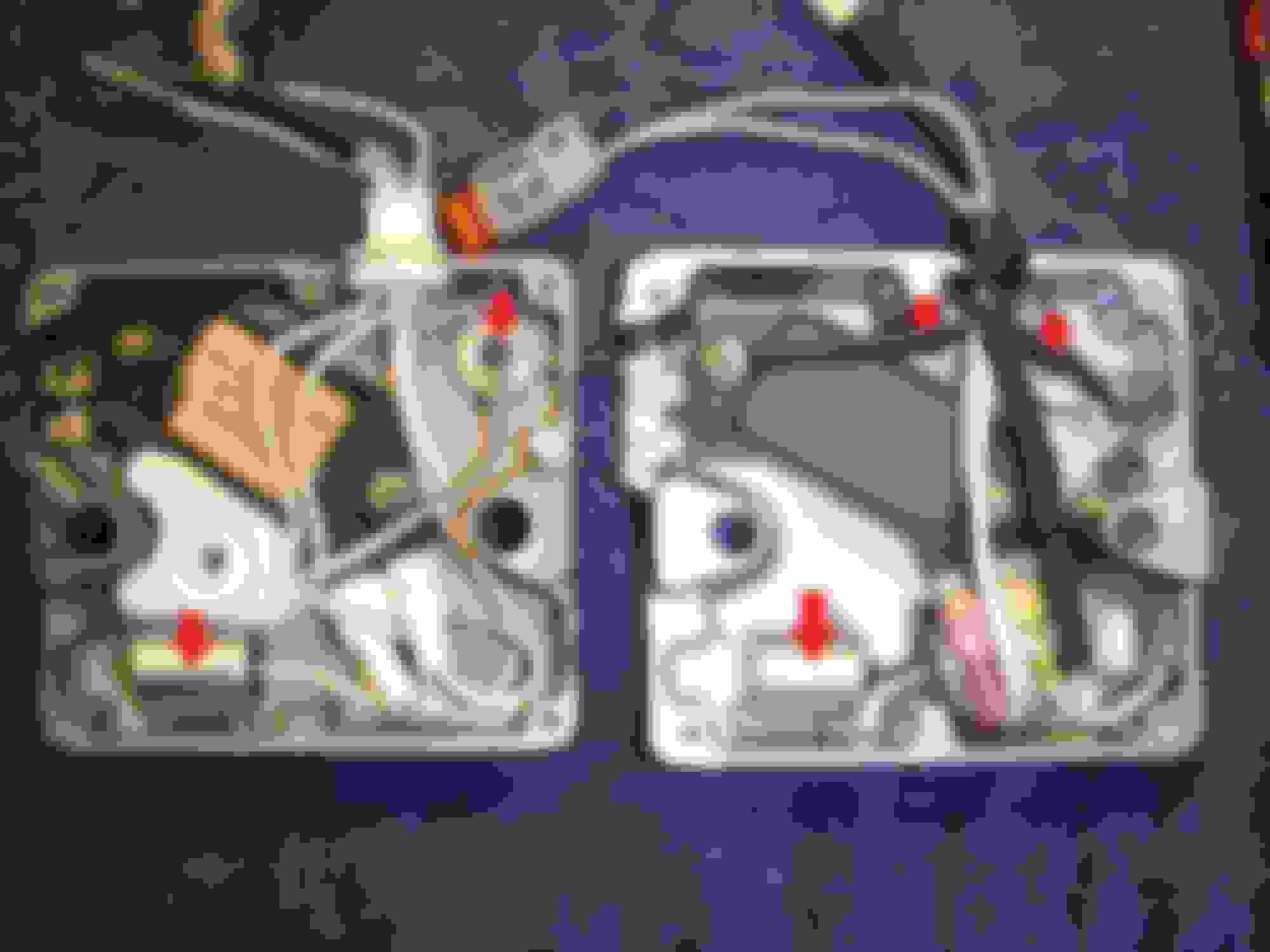
Bringing this back up to the top because we've now killed another unit, and we've also killed a heavy-duty Accel unit. This is after replacing the coil, disconnecting the parts inside the box shown in the picture above, etc.
Are we looking at a distributor issue, or could it be something else? This time it at least made it 10 minutes before dying. But once it died, it could not be restarted.
If you are replacing the HEI unit and the fault persists, then in general I suspect there is another fault in the amp unit. Have you tried another entire unit?
Did you do the things in Grant's list in post 3 above? Is the amp properly grounded and with the paste stuff under the HEI unit?
Are you sure your twin coils are properly connected in paralllel and have a joint resistance of well under 1 ohm?
In my view the item on the top right in this photo (I think it is a zenor diode, though I do not know what that means) should not be disconnected as it protects the amp from spikes, though that is probably not what is killing the amp:
Please post a close up of your installation, particularly the wiring up from the dizzy base to the amp.
The Zeners can short out. I had one do it. Supposedly not necessary with newer replacement HEI modules.
YOu need to make sure you adequate heat transfer compound between the HEI module and the case.That module gets HOT.
YOu need to make sure you adequate heat transfer compound between the HEI module and the case.That module gets HOT.
That's actually why the module is mounted on the intake manifold. It's the coolest spot in the engine bay because it has the intake air that the engine breathes going through it to take away the heat. Consider it an actively cooled heatsink.
First off, this is a Lucas car if I didn't specify before.
Second, this is going to make me sound like an idiot, but ... I can only find one coil on this car. I'm not saying it doesn't have a second one, but if it does, it has created its own gopher hole in the intake manifold somewhere and is hiding. See attached photo.
The shop where it is has slathered on the grounding grease every time it has replaced the module (we're at 4 GM modules and 1 Accel right now, all dead). In the picture, ignore the state of the Lucas box for a second, because I didn't have a tool in my hand to open it, and it was sort of half-open/half-closed. The black tape around the wire was just to mark that wire.
We're going to get another GM box, double-check the resistance off the coil wire, and run a temporary second ground to the box. Remember that this car isn't technically in a no-start/no-run condition; every time we change boxes, it will run for about 5-10 minutes and then fry the module.
But I'd sure like to know where this second coil is allegedly hiding.
The second coil is on the valance just behind the radiator grille. Look though the grille and you will see it on the RHS.
Carefully check the wires running from the secondary coil to the coil by the capstan. make sure they are connected in parallel, ie pos to pos and neg to neg.
I do not like the look of those wires coming up from the dizzy bottom. Have you checked these carefully? Also clean up the earth and run an extra earth from the engine to the chassis frame.
Have you done all the things Grant mentioned in post 3? If any of these are faulty the box will be cooked. Bad engine earthing, as Grant mentioned, is the cause of many failures.
AJ6 Engineering article on V12 IGNITION SYSTEMS Quote …...the constant energy system arrived on the V12 with the introduction of the HE engine. The 12 cylinder spark rate and abnormally high 12.5:1 compression ratio of the original HE demanded an ignition system capable of building up heavy coil primary current exceptionally quickly. The solution arrived at was cleverly practical, a second coil with the HT turret sealed off was connected in parallel with the first, thereby doubling the current flow and halving the time needed to reach the required energy level. When a suitable single coil eventually became available from Ducellier, having 0.5 ohms primary resistance, this was adopted and the second parallel coil was discontinued.
The constant energy module is contained in a heat sink case with a Zener protection diode, a couple of limiting resistors and a capacitor. In some operating regimes, idling in particular, the module has to limit coil current and needs to dissipate quite a lot of heat so it must never be run without being mounted within the heat sink case. Unquote
Distributor: "The trigger input used in all Jaguar applications is the simple inductive pick-up, essentially a magnetically sensitive coil which creates an output voltage when pole pieces move past, these being in the form of individual teeth for each cylinder disposed around a rotor. The winding resistance is likely to be about 3.3K Ohms, but is quoted as being from 2.2K to 4.8K, which seems a bit hazy really.
The waveform produced is a sort of distorted sine wave, rising to a peak positive value then abruptly swinging negative as the pole piece moves through the point of exact alignment (see diagram). Fortuitously this provides a very reliable switching point with which to trigger the ignition event. The drawback is that a sine wave type of signal spends the same amount of time in the negative phase, as in the positive, so even if the switching were to take place at the zero crossing point the maximum on time for the coil could never exceed half of a cycle. To complicate things further if, at low speeds, the coil were turned on for as long as half the cycle either the coil or the module would then have to dissipate a lot of heat. The clever thing about the constant energy module is that it deals with this conundrum rather well by biasing the trigger signal so that it lifts with rising speed. unquote
You must have correct coil, good high tension spark plugs wires, good cap and rotor... all grounds needed to be corrosion free ( including the 2 mounting bolts for Delco HEI module) ... High tension mischief in the distributor could be leaking into the low voltage signal circuit and playing havoc with the unprotected side of the HEI module ( i have not heard of this, but the potential is there... you are dealing with an uncommon anomaly.)
Rgds
David
Last edited by David84XJ6; Sep 27, 2024 at 03:19 PM.
We found the second coil. It was on the left-hand side behind the grille but otherwise just as described in the above post.
One follow-up question: Are the two coils identical parts, with one of them just being capped off? Or is the one behind the grille a different part#?
Greg, to answer your question about steps outlined in post #3 -- yes, we have either done those things or are in the process of now going back and cleaning up grounds, etc. The one thing that we're not going to do at this time is take out all the plugs because this car had a tune-up about 6 months before the problem with the box started and it was running fine during that period. So unless we've had a catastrophic plug failure, we're going to save that particular fix for last and handle the more obvious stuff up top.
We found the second coil. It was on the left-hand side behind the grille but otherwise just as described in the above post.
One follow-up question: Are the two coils identical parts, with one of them just being capped off? Or is the one behind the grille a different part#?
Primary coil resistance way to high, then when the 2ndary is wired in, still above 1.0 Ohms.
EACH coil as rated at 1.2 Ohms each, and when joined by that Mini Loom, gave 0.6ish Ohms, well suited to that Module.
ALL Ohms readings are done with ALL wires disconnected, except the Mini Loom when doing the joined readings, so tag them before removing.
That Mini loom between the 2 caused a few issues on 2 of mine. High resistance in the wires themselves.
2nd coil dead, or high resistance was common enough to annoy.
I looked at that Duceliar back in the day, and $450AU was not going to happen.
Found a Fuelmiser CC215, Universal Electronic Ignition Coil for $50, that had a resistance of 0.75, and has lasted 20 years, and the Module (Echlin Brand) is still doing as designed.
BUT,
My Amp is out the front, on the RH side of that valance, mounted on sleeves to allow airflow all round, sealed with RTV, wires extended to suit, eliminating that Shielded wire nonsense until the bulkhead connector behind the RHF wheel.
Dedicated earth wire, Amp to Car, using 6mm wire.
Just wanted to give you guys the (hopefully final) update to this story ...
We believe the problem was in the second coil, the one mounted behind the grille. We removed that one, bought a modern coil to replace both the factory coils, added an upgraded ignition amplifier internal module, freshened up the wiring situation going to the module, and added a secondary ground there as well.
The car has been driving smoothly for a few weeks now. Or, as smoothly as this old girl can still drive, anyway. She's far from perfect but she is, at least, back on the road. Thanks to everyone for your help.






 '89 XJS eating ignition amplifier boxes ...