When you click on links to various merchants on this site and make a purchase, this can result in this site earning a commission. Affiliate programs and affiliations include, but are not limited to, the eBay Partner Network.
Sealing caps shouldn't have springs - why Jaguar did that I don't know - a radiator cap isn't a cap because it has a spring either, some are designed to let air back in, some are not but most think a cap is a cap is a cap ... it isn't ... just like thermostats.
Think about this in engineering terms, this is not all about system pressure, although part of it is. In an expansion situation you need the expansion tank cap to lift before the filler cap - this pushes into the recovery bottle. When the system cools and pulls vacuum the cap on the filler neck must NOT allow anything back in - aka air - it is desireable for the expansion tank to pull excess coolant back from the recovery tank.
Ben
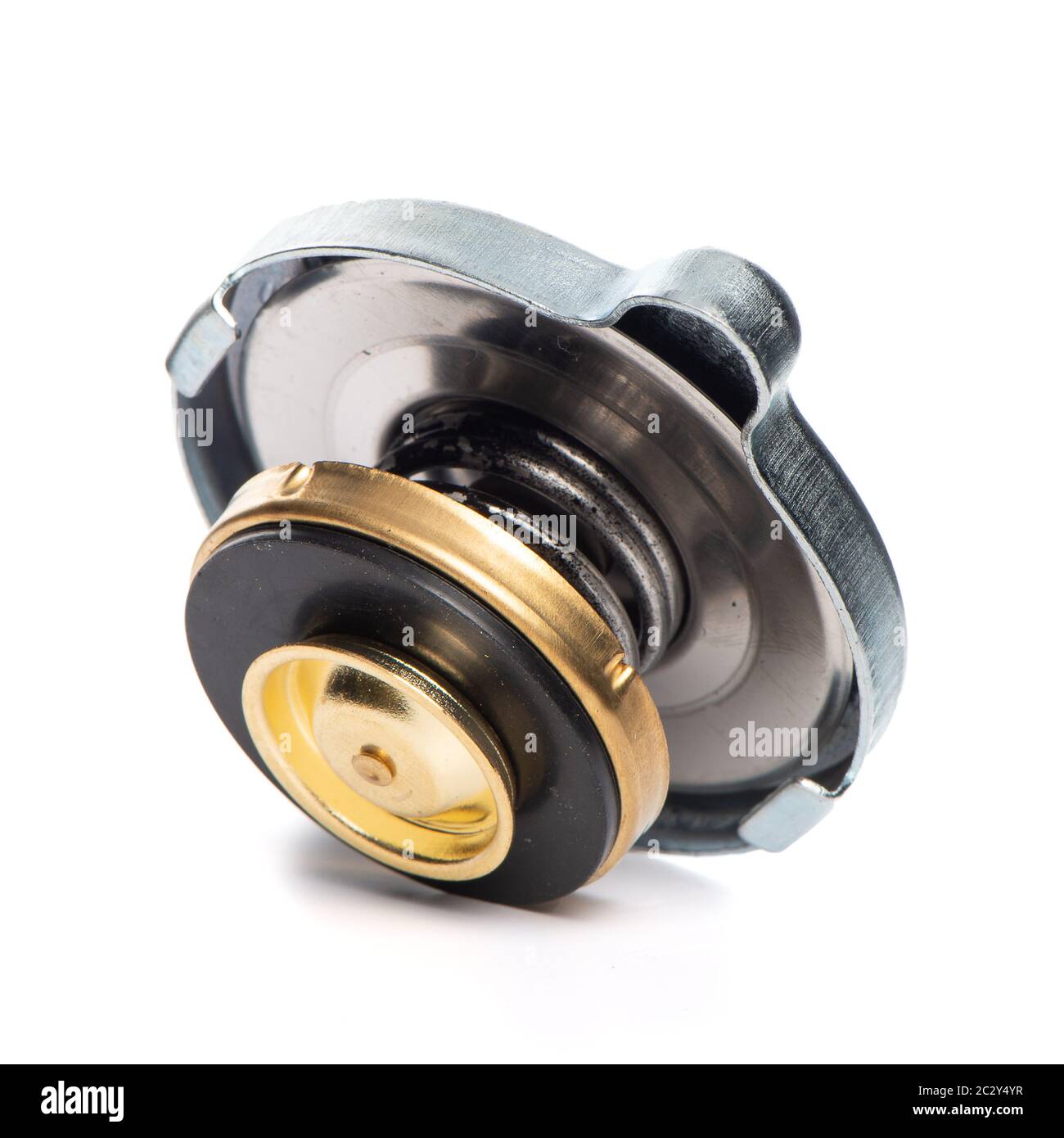
We need to clear up terms here. Do you agre that the filler spout only needs a blanking cap on the top and does NOT need a sprung "pressure release cap" of this sort (ie with an inner, lower, pressure release part and a 100% sealing top outer part):
If so, then it is clear that the central filler spout if fitted with a pressure relief cap, the blow off rating is irrelevant. If you do not agree, why not? What is the pressure relief cap doing when it lifts, other than allowing a dribble of coolant to enter the radiator purge system, which is itself at radiator pressure?
I take it you agree that the wing header tank cap DOES control system pressure? If not, why not? Now I am quite willing to be proved wrong - frequently happens - but what part of the above makes you contend that the centre spout pressure relief rating affects anything at all in the cooling system?
Of course, a leaking-to-outside cap, whether on the spout or on the header will affect the system; but you are not, as far as I can tell, positing this? The question is, what difference does the pressure rating of a properly working pressure relief cap on the central filler spout make to the Jaguar V12 cooling system? My answer is zero; as is the Great Palm's.
Last edited by Greg in France; Oct 17, 2021 at 06:05 AM.
Absolutely - the filler cap must be non vented and if pressure rated at all must lift off later than the expansion tank - to ensure the expansion tank manages the expansion and not the filler, the expansion cap must be vented or the recovery bottle becomes irrelevant. It is the expansion tank that sets the system pressure and therefore the boiling point.
Absolutely - the filler cap must be non vented and if pressure rated at all must lift off later than the expansion tank - to ensure the expansion tank manages the expansion and not the filler, the expansion cap must be vented or the recovery bottle becomes irrelevant. It is the expansion tank that sets the system pressure and therefore the boiling point.
Ben
We are close! But why do you think the pressure rating on the spout inner release matters at all? The spout cap inner cannot release pressure outside of the system as it connects to the purge system. Remember, we are not talking about leaking outers, just the pressure release activation. Between the spout pressure release and the spout outer top, is the pipe to the radiator purge system. As long at the spout outer is a proper seal, the pressure blow off on the spout inner does not matter and cannot affect system pressure, as it vents to the purge system, not to outside. After all, if the spout is OK with a blank cap only on the top, ie with no inner, then what difference can the pressure rating of the spout inner make?
Of course, if you mean that the spout cap top outer, seal must be a decent seal, and well above the 15 psi the header tank blow off, I completely agree; but as far as I know, all caps have FAR higher sealing on this part than any system is ever run at.
Why the pressure cap on the filler spout, no oidea.
BL had thousands of teh Blank Caps, used on Mini's, 1100's etc etc.
Jaguar used a Balcnk cap on teh S1 2 3 filler spout, and the pressure cap on the Header Tank.
My only take is:
Originally the filler cap had a chain, to prevent mixing caps. NOW, whether this cap was a BL (Unipart) Blank Cap or a spring cap, dont remember, its that simple.
Mechanics being what they are, mixing a blank cap on the header and a spring on the filler, NOT good whatever way its looked at.
Higher pressure on the filler, dunno why, although the spring seal does not touch the seat, is more fool proof. Mix the caps, a 16 at the filler, and a ?? at the header, no harm of a fatal nature can occur.
The important part is the upper seal, and that is the weakest part of these systems, 6 or 12.
The PreHE had no filler spout, and the header tank had a spigot out the bottom that "T" joined the heater return pipe, thus filling was via the bottom hose, pushing air out as it went, simpler and caused no real issues ever. Total MONGREL to fill, due to radiator and filler neck heights being within 2mm of each other.
NO overflow bottle either, very different system that gave very little trouble.
Bleeding the HE is the most important procedure. Get it wrong, and coolant will purge for no apparent reason, and air pockets, becoming steam very quickly, will destroy that engine.
Ensuring both caps have a 100% top seal to the outside world is a given in V12 land.
If the 2 above are followed to the letter, they DO NOT run hot, never did, its lousy caretaking that causes that, and I have seen some horrid examples of the 7 V12's I have owned, and others I have sorted for frustrated owners.
The ideal on the filler cap would be not to release at all - tight shut off - aka non vented in either direction. This is why the caps cannot be the same because the recovery bottle mandates vented, lose the recovery bottle and you can use non vented on the expansion tank too but I don't know why the engineering decision was made to incorporate - perhaps it is down to the system capacity and the potential vacuum problems as a result. The important thing isn't the pressure per se but the vented / non vented, you absolutely cannot put a vented on the filler because then it will allow air into the system not draw fluid back - air is easier to draw than fluid - path of least resistance and all that. In this scenario more and more air will be introduced because air is compressible. Consider though that the use of a vented cap on the expansion tank makes it easier for the system to purge air - air in the system is the enemy.
If you put two identical caps - say both the listed Jaguar parts are non vented then it doesn't matter - if they are vented it matters - but non vented caps on both renders the expansion bottle redundant since nothing can ever be drawn back from it when a non vented cap is used - may as well just dump it on the road.
Thanks for your help everyone. I am planning on draining and refilling the cooling system, including the header tank and recovery bottle. Then I will pressure test the system to see if either of the caps I have are sealing properly and/or holding the right pressure. From there we can figure out what to do next.
Ben
You wrote: "The important thing isn't the pressure per se but the vented / non vented, you absolutely cannot put a vented on the filler because then it will allow air into the system not draw fluid back - air is easier to draw than fluid - path of least resistance and all that."
In what sense do you mean a vented cap?
in the sense of two levels of seal, a blow off lower and a permanent outer (as in the photo in my post above) or
in the sense that a single outer that can blow off?
Jaguar themseles fitted a vented cap, in sense 1, to the spout. Because there is a chamber in the spout that vents to the radiator top purge system, the vented cap, in sense 1, can blow off with no effect at all on system pressure, as is shown in the attached factory system diagram.
Two kinds of cap with springs - one allows things back in on cool down (vented) and one does not, the ideal fitting for the filler would be a tight shut off with NO spring whatsoever, which is the principle followed by many later vehicles with expansion tanks, these generally did not have recovery tanks and the filler was on the top of the radiator - and was a totally different cap. The Jaguar system creates a high spot in that filler and the only thing that will purge it is human intervention unless circulation can be induced in the 'vent' to the radiator, this requires a sealing cap with no close off spring or there will be no circulation.
I guess opinions will need to differ on this topic.
The atmosphere - a vented cap is designed to seal against outgoing on pressurisation unless pressure exceeds a set amount but to permit air back in when things cool, a non vented cap results in a vacuum being maintained, if the expansion tank is 'vented' and the end of that vent is immersed in coolant aka the recovery bottle when a vacuum is created by cooling down coolant is 'recovered' from the bottle - if you allow the system to vent elsewhere this does not happen.
The bleed tube on the filler assembly is below the level of the 'rubber' seal but you don't want that cap allowing air in on cool down - you need to force coolant to be drawn in from the recovery bottle.
The principles are indentified also here although they're identified as 'recovery' and 'non-recovery' >> Radiator Caps
Last edited by BenKenobi; Oct 17, 2021 at 09:31 AM.
Reason: Added Link
Ben
The spout cap top seal does not let air in, it is a seal. While fluid can be drawn into the spout from the radiator top purge pipes, on cooling, or, obviously, up the spout!
But....help me understand here....the cooling system isn't really exposed to atmosphere, is it? There's the 'atmospheric' tank in the fender which is open to atmosphere but, unless empty of fluid, won't be a source of atmospheric air.
Assuming normal operation of a properly bled system, coolant expands and, when 16 PSI is reached, is pushed into the atmospheric tank, via the cap on the expansion tank . On cool down coolant (not air) is drawn from the atmospheric tank back into the cooling system, via the small vent on the underside of the expansion tank cap.
Meanwhile, the cap on the filler neck is exposed to...what? As I see it, it is exposed only to coolant and the venting/steam relief system, not atmosphere.
But....help me understand here....the cooling system isn't really exposed to atmosphere, is it? There's the 'atmospheric' tank in the fender which is open to atmosphere but, unless empty of fluid, won't be a source of atmospheric air.
Assuming normal operation of a properly bled system, coolant expands and, when 16 PSI is reached, is pushed into the atmospheric tank
Yes - that's how it needs to be kept.
Meanwhile, the cap on the filler neck is exposed to...what?
Technically nothing since the air purge is below the primary seal, the rubber on the spring part, the secondary seal is only going to prevent ingress or egress if it is in very good condition and if the neck is in good condition which is why a hard seal here would be much better - i.e. no pressure rated cap at all, I don't have a whole lot of faith in the purge line to purge - there is presumably a venting jet aka some form of venturi fed from B bank thermostat housing but not sure where that's supposed to be or how effective it is.
since the air purge is below the primary seal, the rubber on the spring part, the secondary seal is only going to prevent ingress or egress if it is in very good condition and if the neck is in good condition
If I am understanding you correctly, I agree.
It seems to me, then, that the take-away from all this is that the cap on the filler neck must effectively seal against outside air. This requires us to occasionally check that the seal on the underside of the cap, and the corresponding mating surface on the filler neck, are kept in good condition.
That's easy enough to do....and IMO makes a lot of this discussion academic.
which is why a hard seal here would be much better - i.e. no pressure rated cap at all,
To assuage any concerns it should be easy enough to source a blanking cap.
I don't have a whole lot of faith in the purge line to purge - there is presumably a venting jet aka some form of venturi fed from B bank thermostat housing but not sure where that's supposed to be or how effective it is.
The vent/steam purge/whatever we call it system has been a bit of a mystery to me. I can't fully wrap my head around it. But if we keep all the pipes clean it'll do what it is supposed to do, I reckon, and doesn't require me to fully understand how or why
If you have time for a real brain tease look up the discussion from a few years ago regarding the jiggle pin in the filler neck nipple
Cheers
DD
Last edited by Doug; Oct 17, 2021 at 01:30 PM.
Reason: replace nonsensical word :)
Pretty much spot on - just got to make sure the system is compelled to draw in from the recovery tank with no other options, air locks can prevent this since air is compressible, it is also easier to pull in air than coolant.
discussion from a few agree regarding the jiggle pin in the filler neck nipple
It is here The radiator purge pipe The venturi part in close up
Also attached is a clearish diagram of the entire system. The pressure input for the venturi is not on the crosspipe, but from the top of the B bank thermostat casting.