When you click on links to various merchants on this site and make a purchase, this can result in this site earning a commission. Affiliate programs and affiliations include, but are not limited to, the eBay Partner Network.
well, technically there are 2 cats in the downpipe primary pipes(each side). Plus the 2 more per side.
4 per side, 8 total.
Well, technically, that simply isn't true at all :-)
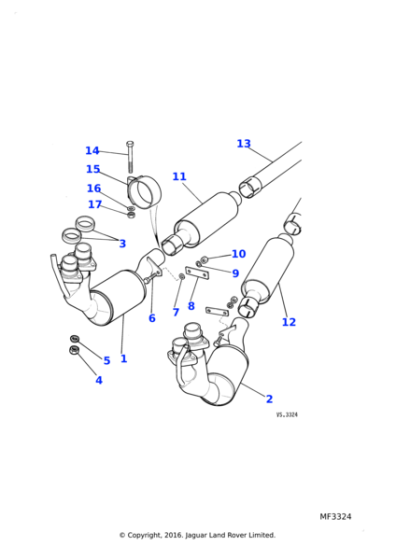
The first pic, from Jaguar, shows cat converter system used on the USA cars, including California.
As you can see each bank has (1) downpipe catalytic converter and (1) downstream catalytic converter. That equals to two per bank. Four per car.
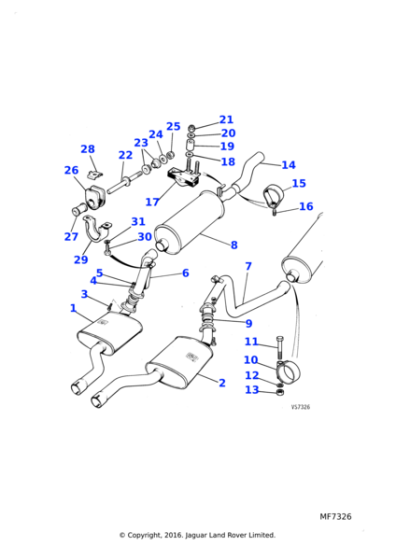
The second pic shows downstream of the cat converters, which is the standard exhaust system with two silencers per bank. Four per car. This is the same across all markets
So, there are 4 converters per car and 4 silencers per car. That indeed equals 8 'things' in the exhaust system. But, although all catalytic converters are things not all things are catalytic converters :-)
which always seems odd when the US cars with air pump, 2 additional cats spec the same output.
it seems like the additional compression is the only factor contributing to increased HP(11.5:1 vs 12.5:1), air pump and cats have no impact on output.
Pretty much.
The air injection pump would draw just a tiny amount of power. I'll toss out a number: 2 horsepower.
Converters? Well, over the years many have removed or gutted their converters and reported no seat-of-the-pants difference in power. Or very minimal increases.
Of course, if the converters are clogging-up that's a different kettle of fish. Quite a difference might be felt.
Well its not so much that I consider them individual, it’s that they are individual, there are 3 of them.
there is definitely a difference in throttle response using euro set up with no cats at all, but in my experience the minimal gain is not worth the stink (i found driving in town un-enjoyable with windows down and no cats)
which always seems odd when the US cars with air pump, 2 additional cats spec the same output.
I believe the air pump only runs for 45sec after startup. It's purpose is to get the cat converters hot and burn off the extra fuel after start and in the warm up phase. After that the air pump isn't needed and it freewheels. The one on my 94 is clutched like an AC compressor, so when it isn't running it draws no power.
I believe the air pump only runs for 45sec after startup. It's purpose is to get the cat converters hot and burn off the extra fuel after start and in the warm up phase. After that the air pump isn't needed and it freewheels. The one on my 94 is clutched like an AC compressor, so when it isn't running it draws no power.
Earlier models, like Bonn's '86, were on a more rudimentary system where the belt driven pump is driven at all times. When the output air is no longer needed a diverter valve dumps it into the RH air cleaner. The switching parameters, and devices that trigger opening of the diverter valve, escape my memory at the moment. I think it was a thermal vacuum valve.
My XJR had an electric air injection pump. It was a problematic designed lifted from GM...who only used it for a couple years before giving it up. It made a distinct "zing" noise when engaged. Until, that is, it stopped working !
Thanks everyone, for the good information.
One last mystery:
What was the physical difference between the 12.5:1 and 11.5:1 HEs? Heads? Gasket thickness? Piston profile?
Have done some reading that the 11.5 will always perform as well as the 12.5, don't interchange the ECUs, etc etc.
In Australia, the 12.5 was in the 'Leaded' era, transitioning to the 11.5, as we got Unleaded fuel.
Did they have different heads and/or pistons?
Have done some reading that the 11.5 will always perform as well as the 12.5, don't interchange the ECUs, etc etc.
Perform as well in what respect? Power/acceleration?
Road tests from the 80s consistently report significantly faster acceleration from the hi-comp ROW version versus the low-comp USA versions. Which would be expected considering difference in advertised horsepower.
Thats what I heard as well. What was the output of the UK Marelli cars vs the North American versions? Wonder if there was still a difference.
As far as I know Jaguar never changed the advertised horsepower. "Advertised" being the key word, as the marketing department guys have as much say as the engineering guys as far as that goes.
The USA HE 5.3s were always advertised at 262 horsepower. Canadian cars as well, I think.
Most spec sheets have the ROW engines 299 horsepower, some a little less, for both Lucas and Marelli engines.
You'd think that a full one point reduction in compression would have to make a significant difference but Bywater had said otherwise, attributing most of the difference to ignition timing differences
Some say the loss was in the catalytic converters but I disagree. I've run my Canadian-spec low compression V12 both with and without converters and I can positively say there is NOT a 37 horsepower difference. That amount would be quite noticeable. I'll guess 10 horsepower.
The fumes were the deal
breaker for me. The throttle response was definitely noticeably faster with euro downpipes. I never really did any seat of the pants testing as I couldnt get over the stink(i drive summer only usually with the windows down), put the factory downpipes back(slightly freed up)