


No wouldn't start: Engine cranked, then started after 6 attempts w/white exhaust


Thread Starter
|
Senior Member
Joined: Jan 2011
Posts: 379
Likes: 6
From: San Francisco
 No wouldn't start: Engine cranked, then started after 6 attempts w/white exhaust
My hypothesis is that some of the spark plugs are bathing in oil, since when I changed them a couple of months ago, the old ones were doing exactly that:
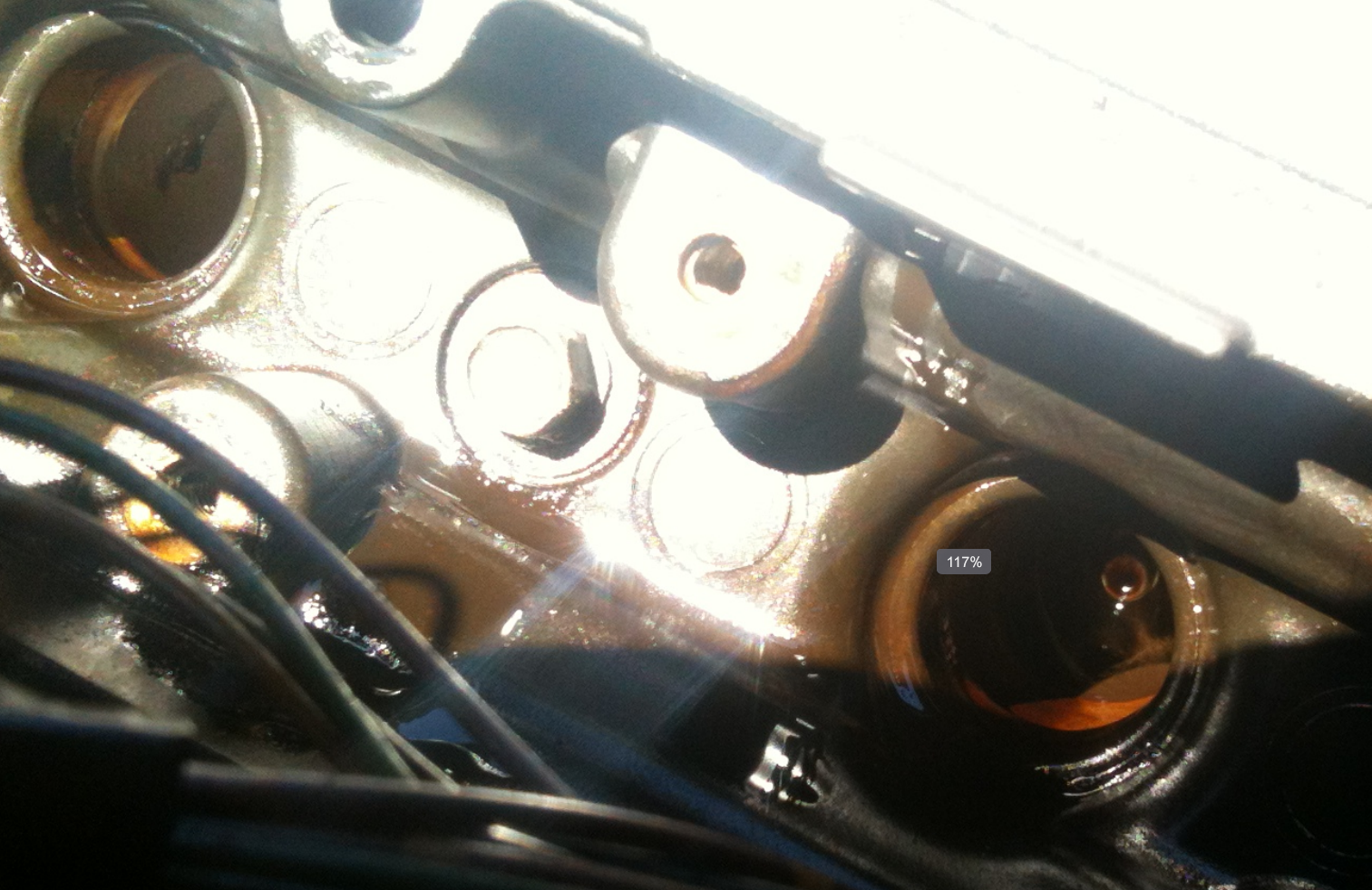

And after changing them, the engine started fine, but I saw similar amounts of white exhaust smoke..
I also have a slow coolant leak.
Can anyone deduce what spark plug seals I need to replace from the photo? And could something else be causative?
And after changing them, the engine started fine, but I saw similar amounts of white exhaust smoke..
I also have a slow coolant leak.
Can anyone deduce what spark plug seals I need to replace from the photo? And could something else be causative?




Joined: Dec 2011
Posts: 120,439
Likes: 17,015
From: Durham, UK

1. the Spark Plug Boss Seals need replacing:
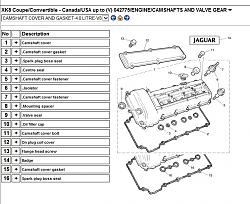
(click on the image to enlarge it)
There's two designs. All-in-one (item 16) or separate (items 3 and 4). Either can be used. Also the rubber Camshaft Cover Gaskets should be replaced as re-using them is rarely successful.
2. even more important on a V8 - NEVER ignore coolant leaks.
Graham

(click on the image to enlarge it)
There's two designs. All-in-one (item 16) or separate (items 3 and 4). Either can be used. Also the rubber Camshaft Cover Gaskets should be replaced as re-using them is rarely successful.
2. even more important on a V8 - NEVER ignore coolant leaks.
Graham

Veteran Member
Joined: Mar 2008
Posts: 5,390
Likes: 1,116
From: Ellijay
Danger! . . . Danger! . . . Will Robinson!
White smoke is coolant and about the only way for it to get into the cylinders is via a head gasket problem.
A thorough investigation of the situation beyond the plugs is called for.
White smoke is coolant and about the only way for it to get into the cylinders is via a head gasket problem.
A thorough investigation of the situation beyond the plugs is called for.
Veteran Member
Joined: Jun 2008
Posts: 1,714
Likes: 326
From: Chesapeake Bay area, Virginia
Oil in the plug wells will not cause a misfire, oil is not conductive. The white smoke and coolant loss is possibly a blown headgasket. One thing that could be happening is that when you pulled the plugs, the oil went in the cylinders and burned off. This will produce some smoke although it will be more grey than white. A compression test would be a good start. If you run the engine with the header tank cap off do you see any bubbles? Does it make white smoke all the time or just after you pulled the plugs?
Thread Starter
|
Senior Member
Joined: Jan 2011
Posts: 379
Likes: 6
From: San Francisco
No bubbles in tank. Car started fine now as it usually does.
I noticed some old coolant by the right, passenger side bank:
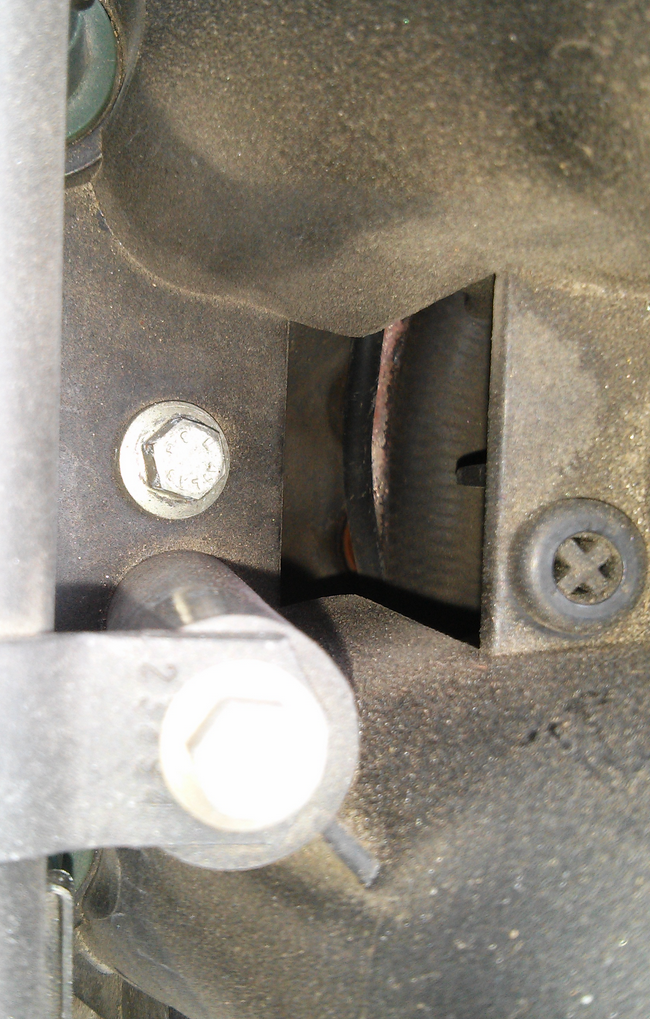
I by mistake managed to pull the coolant return? hose off, as you can see I've attached a different clamp.. Also there is some old coolant on the top..thingie:
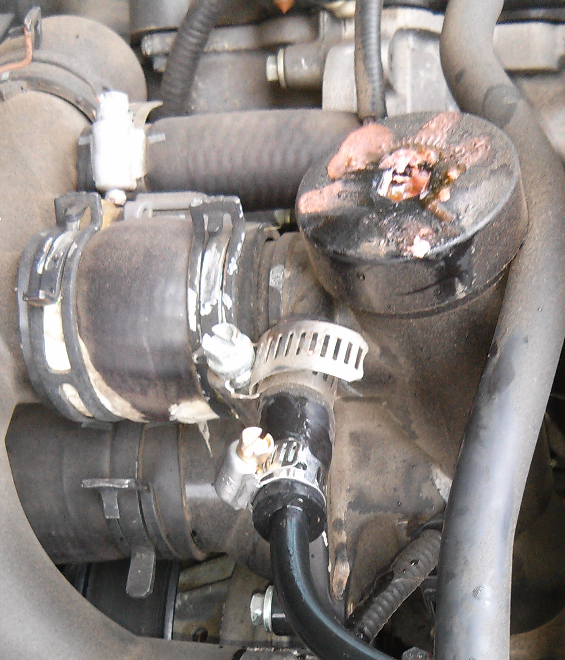
So it could be the right gasket only?
I also managed to pull out
I noticed some old coolant by the right, passenger side bank:
I by mistake managed to pull the coolant return? hose off, as you can see I've attached a different clamp.. Also there is some old coolant on the top..thingie:
So it could be the right gasket only?
I also managed to pull out
Joined: Dec 2011
Posts: 120,439
Likes: 17,015
From: Durham, UK
Graham
Trending Topics

Veteran Member
Joined: Jun 2008
Posts: 1,714
Likes: 326
From: Chesapeake Bay area, Virginia
If it were me, I would do a compression check, replace the valve cover gasket, and chase down the coolant leak. The coolant on top of the cap shown, how would it get there?
Thread Starter
|
Senior Member
Joined: Jan 2011
Posts: 379
Likes: 6
From: San Francisco
So, what's the best way to do a compression test? As far as I've gathered:
1. Let engine run for 20 minutes or equivalent to get it warm, then wait 1 hour.
2. Remove all the spark plugs and disconnect the coils.
3. Screw gauge into first bank by hand (to avoid over tightening).
4. Floor the gas pedal, and turn "on" the engine letting it crank 5 times.
5. Read pressure - repeat for the other cylinders.
If you get a low reading on a cylinder more than 10% under the other ones - pour 1 teaspoon of engine oil into the plug hole and retest. If the reading jumps, the piston rings are worn. If not, think valve problems.
Anything missing?
1. Let engine run for 20 minutes or equivalent to get it warm, then wait 1 hour.
2. Remove all the spark plugs and disconnect the coils.
3. Screw gauge into first bank by hand (to avoid over tightening).
4. Floor the gas pedal, and turn "on" the engine letting it crank 5 times.
5. Read pressure - repeat for the other cylinders.
If you get a low reading on a cylinder more than 10% under the other ones - pour 1 teaspoon of engine oil into the plug hole and retest. If the reading jumps, the piston rings are worn. If not, think valve problems.
Anything missing?

Senior Member
Joined: Dec 2012
Posts: 402
Likes: 99
From: Swansea, Wales
So, what's the best way to do a compression test? As far as I've gathered:
1. Let engine run for 20 minutes or equivalent to get it warm, then wait 1 hour.
2. Remove all the spark plugs and disconnect the coils.
3. Screw gauge into first bank by hand (to avoid over tightening).
4. Floor the gas pedal, and turn "on" the engine letting it crank 5 times.
5. Read pressure - repeat for the other cylinders.
If you get a low reading on a cylinder more than 10% under the other ones - pour 1 teaspoon of engine oil into the plug hole and retest. If the reading jumps, the piston rings are worn. If not, think valve problems.
Anything missing?
1. Let engine run for 20 minutes or equivalent to get it warm, then wait 1 hour.
2. Remove all the spark plugs and disconnect the coils.
3. Screw gauge into first bank by hand (to avoid over tightening).
4. Floor the gas pedal, and turn "on" the engine letting it crank 5 times.
5. Read pressure - repeat for the other cylinders.
If you get a low reading on a cylinder more than 10% under the other ones - pour 1 teaspoon of engine oil into the plug hole and retest. If the reading jumps, the piston rings are worn. If not, think valve problems.
Anything missing?

Senior Member
Joined: Dec 2012
Posts: 402
Likes: 99
From: Swansea, Wales
As long as the throttle is wide open you should be fine.
You need to let as much air into the cylinder as possible in order to maximise the compression.
You need to let as much air into the cylinder as possible in order to maximise the compression.

Thread
Thread Starter
Forum
Replies
Last Post
BrentGardner
XJ XJ6 / XJ8 / XJR ( X350 & X358 )
29
Dec 16, 2024 12:13 AM
msdg137
XK8 / XKR ( X100 )
7
Sep 16, 2015 06:24 AM
1964Daimler
MKI / MKII S type 240 340 & Daimler
2
Sep 2, 2015 11:41 PM

Currently Active Users Viewing This Thread: 1 (0 members and 1 guests)