When you click on links to various merchants on this site and make a purchase, this can result in this site earning a commission. Affiliate programs and affiliations include, but are not limited to, the eBay Partner Network.
This is one of the videos I've watched in which they specifically state that the 55 mph for 5 minutes and then coast to 20 is what clears the CAT monitor: https://www.youtube.com/watch?v=UERN4wA8ZJ0&t=306s They also go into detail about the other monitors including the misfire detection one. Are you saying that is incorrect?
They specifically state the cars it's about, and don't include any Jaguars, so treat with caution (at best).
Many of the Jaguar docs appropriate to the year & model of the Jaguar specify Jaguar's drive cycle and I trust that far more.
You don't need to follow any drive cycle stuff but the point of doing what the car maker says is to speed up monitors setting (to "Ready" in the video). The video _might_ be the same as the Jaguar stuff for your car but it may not be. It definitely doesn't match some of the Jaguars as you can see by reading the DTC etc files on www.jagrepair.com. It's probably fairly close.
A warm up basically means engine going from cold to hot. (The car monitors such as IAT & ETC sensors.)
Thanks for the info Jag. I have that JagRepair document and according to it the "drive cycle" for the Catalyst Efficiency Monitor is to simply "Start engine and bring to normal operating temperature > 82 °C (180 °F)." then
"Drive the vehicle in a steady state condition between 1300 – 3000 rpm without stops or starts for a minimum of 5 minutes." I'm guessing "a steady state condition" means on the freeway without stopping. I did this several times before changing out the downstream O2 sensors with no success. I'll give it another try later this morning. Traffic should be somewhat light on Saturday so I may be able to hold that speed long enough to meet the drive cycle.
Thanks for the info Jag. I have that JagRepair document and according to it the "drive cycle" for the Catalyst Efficiency Monitor is to simply "Start engine and bring to normal operating temperature > 82 °C (180 °F)." then
"Drive the vehicle in a steady state condition between 1300 – 3000 rpm without stops or starts for a minimum of 5 minutes." I'm guessing "a steady state condition" means on the freeway without stopping. I did this several times before changing out the downstream O2 sensors with no success. I'll give it another try later this morning. Traffic should be somewhat light on Saturday so I may be able to hold that speed long enough to meet the drive cycle.
I'm rooting for you. I gave up on mine and am going to list it for sale. It would be a good candidate for a LS swap.
I found this document posted by another member on another thread. It indicates that the proper "drive cycle" to clear the CAT monitor is to drive 35-45 mph for 30 seconds. It also states that the cycle may have to be driven more than once to actually clear the monitor. This is obviously different from the 55 mph for 5 minutes shown in other posts regarding resetting the CAT monitor. Anyone heard of this cycle? And I keep forgetting to ask if a cycle needs to be driven more than once do you have to shut the car off, let it cool down, then start all over or can you just coast to a stop and then drive it again?
Well, back from another round of unsuccessful "Drive Cycle" driving. Tired the 55 mph, slow to 20 . . . and the drive 35 mph for 30 seconds .. . same result, nothing. I'm thoroughly convinced that there is no one out there who actually knows of a way to clear the INC reading from these monitors and that why I have is about 3,000 pounds of scrap metal, pretty scrap metal, but scrap metal none the less. I'm thinking part of the problem is the 450 miles of wire that runs through the car in order to connect the myriad of sensors, monitors, diagnostic switches and computers, all of which were designed to do nothing but NOT allow you to drive the vehicle.
Hey, Y2K, if you find someone who wants to buy yours tell them I can make them a deal on a 2fer. Maybe someone buys these things by the pound? Driving anything built after 1975 in this state is asking for headaches should a wire become broken or contaminated.
It was a fun car to drive and it sure looks nice but at 77 I just don't have enough time left to keep trying to figure out what the f**k is wrong with this POS.
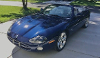
For Sale one British Racing Green 2001 XK8 with Cashmere leather interior.
I'm guessing (sorry) that the CARB "Clean Truck Check" doesn't apply to a car like a Jaguar, as I suspect the key word is Truck.
A pity, as it looks like jags would pass!
I don't know CARB's current rules but they used to allow some small number of unset (aka "INC") monitors (so long as no current DTCs). Maybe still the case?
I think they also allowed a pass if some non-trivial money had been spent on attempted repairs - still the case?
(I think the underlying idea was to allow a smallish number of oldish cars to be on the roads, where proper efforts had been made to keep them clean, but not big numbers of dirty ones.)
Hey, Joe, how much are you looking for? I live in South Carolina so driving 55,65,75 all day long isn't a problem, we're also in a free state so we don't have vehicle inspections or front license plates. I used to live in the Socialist Republic of New Jersey so I feel your pain trying to take care of a simple issue. All kidding aside getting it to the east coast would be a costly endeavor but, doable for the right price.Do you have any pictures and service history you can share? Thanks
I found this document posted by another member on another thread. It indicates that the proper "drive cycle" to clear the CAT monitor is to drive 35-45 mph for 30 seconds. It also states that the cycle may have to be driven more than once to actually clear the monitor. This is obviously different from the 55 mph for 5 minutes shown in other posts regarding resetting the CAT monitor. Anyone heard of this cycle? And I keep forgetting to ask if a cycle needs to be driven more than once do you have to shut the car off, let it cool down, then start all over or can you just coast to a stop and then drive it again?
Well, back from another round of unsuccessful "Drive Cycle" driving. Tired the 55 mph, slow to 20 . . . and the drive 35 mph for 30 seconds .. . same result, nothing. I'm thoroughly convinced that there is no one out there who actually knows of a way to clear the INC reading from these monitors and that why I have is about 3,000 pounds of scrap metal, pretty scrap metal, but scrap metal none the less. I'm thinking part of the problem is the 450 miles of wire that runs through the car in order to connect the myriad of sensors, monitors, diagnostic switches and computers, all of which were designed to do nothing but NOT allow you to drive the vehicle.
Hey, Y2K, if you find someone who wants to buy yours tell them I can make them a deal on a 2fer. Maybe someone buys these things by the pound? Driving anything built after 1975 in this state is asking for headaches should a wire become broken or contaminated.
It was a fun car to drive and it sure looks nice but at 77 I just don't have enough time left to keep trying to figure out what the f**k is wrong with this POS.
For Sale one British Racing Green 2001 XK8 with Cashmere leather interior.
Joe
It's a bad cat. The question is whether or not you want to dump another $1K+ into it. CARB-legal universal cats run north of $400, plus whatever the muffler shop charges to cut and weld your old flanges to the new cats. In my case I really can't justify another $1K. With the mileage at 155K, the value is probably barely over $2K with functional cats. I put mine on non-op last week and when the weather clears up I'll take some better pix and post it. I really hate to see it go to the scrapyard.
So after a "hard reset" (disconnect battery cables and hold them together for 10-15 seconds) I plugged in the OBD2 and got the following information:
Tomorrow I'm going to try to find time to get under the car and see if I can locate the plug from the TCM to the transmission and see if it's contaminated and clean it up. I'll check out the drain area on the windshield wiper cover to make sure there's no water build up there. With any luck that should correct those 2 faults. I have no idea what that new fault is about the instrument pack. The first fault code again has to do with the "vehicle theft detected - engine disabled" which of course is not correct.
I did a "clear codes" and got those screen last few screens. I have no idea what they mean.
I read a thread on here indicating that the TCM was located in the port side engine compartment under the cover up against the firewall. I'm not sure exactly where.
I read a thread on here indicating that the TCM was located in the port side engine compartment under the cover up against the firewall. I'm not sure exactly where.
The TCM is on the RH side in the box containing the ECU. It's top right in the picture/
Your TCM is mounted vertically in front of the ECM. Both of these are in a sealed enclosure underneath the passenger side bulkhead cover.
There are four 'tamper-proof' bolts that you'll need to extract in order to access the modules.
Your TCM is mounted vertically in front of the ECM. Both of these are in a sealed enclosure underneath the passenger side bulkhead cover.
There are four 'tamper-proof' bolts that you'll need to extract in order to access the modules.
Thank you Michael. I think I clicked on the wrong image. This looks like the correct one.
I'll try and get out there again today and take a look. It doesn't seem this location is susceptible to water damage but who knows.
This is what I have as the wiring diagram for the TCM.
Would the "Instrument Pack" error code I just got after the hard reset be related to the TCM/ECM faults?
Could any of the fault codes I'm getting related to this issue be causing the CAT and Component monitor not to reset?
Thank you for any help on this. I'm pretty much out of ideas as to how to get these monitors to reset so I can get this thing through a smog check, which, in The People's Republic of California, is strictly based on having OK readings on those monitors, NOT what is coming out of the exhaust.
Here's what was inside the cover in that compartment.
I noticed that there seems to be a slot at the front of the compartment that the TCM should slide into but it was not in the slot, just sort of sitting there. Then there are the hand written notations on the back of the unit with the year and vin of the car. I'm guessing this was a replacement unit. I removed the cable plug and everything looks clean with no contamination. Is there any way to test this to make sure it is functioning properly?
I've been reading some other threads related to TCM fault codes. One thread mentions "TCM Tokens" without any other information. Can anyone tell me what these refer to?
I put everything back into the box, with the TCM in the slot at the front, but I didn't put the bolts back in yet. I almost dropped one when removing them and didn't want to chance dropping one trying to get them back in unless I wasn't going to have to open it again. I'm not going to be able to get under it today, grandson's baseball playoff game. Hopefully tomorrow morning I'll get it back up on the jack stands and crawl under to see if I can get to the plug, which is either on the right side or left side of the transmission depending on which post I've read.
Here's what was inside the cover in that compartment.
I noticed that there seems to be a slot at the front of the compartment that the TCM should slide into but it was not in the slot, just sort of sitting there. Then there are the hand written notations on the back of the unit with the year and vin of the car. I'm guessing this was a replacement unit. I removed the cable plug and everything looks clean with no contamination. Is there any way to test this to make sure it is functioning properly?
Joe
Somebody's been Mickey Mousing around in there. Probably the same hack who used bolts instead of studs on your exhaust. It's mounted vertically in that position, IIRC in some slots. It should fit against the side of the box. I just now checked my pix. I could find nobody who repaired them or who could check for correct operation when replacing mine. My scanner was giving checksum errors when communicating with it. NOMA had a good replacement and the checksum errors went away.
Regardless, this has nothing to do with your CAT monitor.
Last edited by Y2KJag; May 7, 2025 at 03:22 PM.
Reason: Typos
It was in the compartment horizontally, with the plug at the top, but it just wasn't in the slot that is built into the compartment.
I've been finding some posts on here and the jagforum.com site that have information regarding some tests that can be done on the TCM.
I'm seeing some threads saying that ANY fault code will stop the monitors from resetting. Of course I'm also seeing other threads saying that the TCM fault codes shouldn't stop the monitors from resetting. This seems to be my biggest issue. There does not seem to be any real answer. It's just like the "drive cycles" that are supposed to clear the monitors. One source says drive 55 mph for 5 minutes then take your foot off the gas and coast to 20, another says to drive 35 mph for 30 seconds. I'm beginning to think it's all BULLSH*T and it amounts to built in obsolescence on all these newer cars. I mean when I call the Jaguar dealer and their service depart tells me that they do not work on cars this old I'm thinking Jaguar doesn't give a crap about keeping their cars on the road, just buying new ones, which, I would never do. As a certified "Old Fart" I do not understand how a company can build a car that can not be repaired. In my opinion a "monitor" is supposed to tell you something is wrong. If it can't be reset then it's of no use. There is nothing telling me I have a bad O2 sensor, or a bad CAT. At this point if someone offered me a gold plated Jaguar I'd tell them to keep it. I've been on these forums for 6 months trying to find a solution and no one knows how to fix this. I'm either too old, too stupid or too computer illiterate to drive anything with more wire than steel.