


Daimler V8 /68


Thread Starter
|
Member
Joined: Sep 2012
Posts: 76
Likes: 0
From: Canada
 Daimler V8 /68
Hello, Went to start up, started no probs, went to apply brakes, right to floor!
All brake fluid leaked out over the winter.
It's presently at the shop to have the air removed from lines, etc.
Do I need a new master cylinder? (it's never been touched) If so where?
All brake fluid leaked out over the winter.
It's presently at the shop to have the air removed from lines, etc.
Do I need a new master cylinder? (it's never been touched) If so where?

Veteran Member


Joined: Feb 2011
Posts: 3,918
Likes: 2,524
From: Victoria, Canada
Yes you do, for safety and I have had exactly the same experience with my 1966 Mk 2 while going downhill...the fact that I can write about this is almost a miracle. In my case a new aftermarket seal kit had been put in the master cylinder and it failed. We put in a brand new master cylinder and booster unit from XKs Unlimited and all has been well. The brakes are up to modern standards with good pedal feel and stopping distance ( but it remains a single rather than dual line system).

Veteran Member

Joined: Aug 2013
Posts: 1,827
Likes: 805
From: Lake Cowichan BC Canada
I'm betting the fluid filled the vacuum chamber cylinder inside the booster.
I'm surprised it didn't all get sucked up in the vacuum line into the intake manifold. (lots of white smoke when this happens)
It's probably filled the vacuum tank in the fender well.
Time to overhaul the braking system...
New master cylinder and booster for sure.
Best check the calipers as well, the bores are probably rusted and pitted.
Don't forget your flexible lines too _ just replace them.
I'm surprised it didn't all get sucked up in the vacuum line into the intake manifold. (lots of white smoke when this happens)
It's probably filled the vacuum tank in the fender well.
Time to overhaul the braking system...
New master cylinder and booster for sure.
Best check the calipers as well, the bores are probably rusted and pitted.
Don't forget your flexible lines too _ just replace them.
Last edited by JeffR1; Mar 15, 2016 at 08:25 PM.
Thread Starter
|
Member
Joined: Sep 2012
Posts: 76
Likes: 0
From: Canada
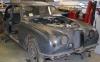
Daimler V8 Brakes
The car is back, brakes work perfect, they found no leaks on the system, so yes were did the fluid go?
If it went into the booster, wouldnt that cause some tell-tale symptoms?
If it went into the booster, wouldnt that cause some tell-tale symptoms?
Veteran Member
Joined: Aug 2013
Posts: 1,827
Likes: 805
From: Lake Cowichan BC Canada
The booster holds quite a bit of fluid, but when it does reach a breaking point, the brakes will continue to work normally, but the excess brake fluid will get sucked into the intake manifold and be burned.
If the seals are marginal inside the booster allowing the fluid to escape into the main vacuum cylinder, then I suppose the brakes could fail.
Not trying to scare you, but it should be looked into.
And if they found no leaks, that is where the fluid went _ inside the booster.
If the seals are marginal inside the booster allowing the fluid to escape into the main vacuum cylinder, then I suppose the brakes could fail.
Not trying to scare you, but it should be looked into.
And if they found no leaks, that is where the fluid went _ inside the booster.
Trending Topics

Veteran Member
Joined: Dec 2009
Posts: 9,547
Likes: 2,546
From: Crewe, England
Agree, it's time for a booster rebuild. However we mustn't forget the Reservac tank that sits between the booster and the manifold. If any fluid has been sucked out of the booster, some will have ended up there, I think. Apart from the non-return valve these have no moving parts so it's just a matter of draining it off.
The slave cylinder in these boosters, (UK=Servo), is cast iron, and I can remember rebuilding mine in the 80s, and carefully cleaning the working passage where the piston with its seals operates. With the age of these things, a light hone to remove marks might be beneficial as it's obvious the surface where the seals sit may be corroded thus the seal doesn't seal and fluid leaks past into the vacuum chamber. If the unit is to be rebuilt, a depth gauge is needed to set the piston rod length.
The slave cylinder in these boosters, (UK=Servo), is cast iron, and I can remember rebuilding mine in the 80s, and carefully cleaning the working passage where the piston with its seals operates. With the age of these things, a light hone to remove marks might be beneficial as it's obvious the surface where the seals sit may be corroded thus the seal doesn't seal and fluid leaks past into the vacuum chamber. If the unit is to be rebuilt, a depth gauge is needed to set the piston rod length.

Thread Starter
|
Member
Joined: Sep 2012
Posts: 76
Likes: 0
From: Canada
Daimler V8 1968 / oil filter
Hello, This is a simple one? What oil filter fits, I have a Bosch 72121, but can't quite remember if this is correct, too many autos.
Or a Hastings LF115, the Wix no. 51515.
The Bosch looks right?
Or a Hastings LF115, the Wix no. 51515.
The Bosch looks right?

Thread
Thread Starter
Forum
Replies
Last Post
David - Jaguar Daimler V8compressor
UK & Eire
0
Dec 22, 2015 04:21 AM
1964Daimler
MKI / MKII S type 240 340 & Daimler
3
Oct 11, 2015 10:43 AM
Currently Active Users Viewing This Thread: 1 (0 members and 1 guests)

