


Broken Rod


Veteran Member
Joined: Oct 2008
Posts: 2,475
Likes: 129
From: Pittsburgh, PA

I always thought that was good for it. I usually start up the car to get the inside temp to a comfortable level while I take the dog out, then just hop in and go. So it usually gets about a 5 minute warm up before I leave anywhere. If thats not good I'll have to stop doing it. Now that I have a garage it isnt a big deal like it was before.
Since you are ordering filters online anyway, maybe give the K&N oil filters a try. I like the welded nut on the end for ease of removal. Run about $13 each. I use them on everything.
Anyway, sorry for the OT - eager to hear what the second mechanic says about this "broken rod" that nobody belives is really a broken rod...including me....

Veteran Member


Joined: May 2009
Posts: 27,518
Likes: 4,910
From: Yorkshire, England
ROFL - yep, me too!

Veteran Member
Joined: Nov 2009
Posts: 5,084
Likes: 432
From: NY
The STR's positive displacement M112's (112 cubic inches) forces a formidable 13 lbs. of O2 dense air and fuel down the shoot. One can think of a blown engine as two engines or two air pumps under the hood. The small 4.2 becomes 6+ litres but with more power and torque lower in the power band.

Veteran Member
Joined: Dec 2006
Posts: 2,964
Likes: 507
From: Hamilton, NJ
The STR's positive displacement M112's (112 cubic inches) forces a formidable 13 lbs. of O2 dense air and fuel down the shoot. One can think of a blown engine as two engines or two air pumps under the hood. The small 4.2 becomes 6+ litres but with more power and torque lower in the power band.

STR from the factory is decent as a setup, but near the upper limit of it's performance capabilities, on the other hand a twin screw at 20psi would put it at another level (Think tuned Mercedes AMG Power). BUT you might have to go to forged internals and copper head gaskets if you expect it to last

Take care,
George
George

Veteran Member


Joined: May 2009
Posts: 12,078
Likes: 3,361
From: home
George;
Do you know if any internal engine parts are forged or not? I have never found out if there is any difference compared to the standard non-supercharged 4.2L. The only difference so far is the reduced compression ratio to 9.8 from 11.5. This is done with different pistons so I think the rods and crank are the same?? Brutal has verified that the heads are the same and the exhaust manifolds.
The VVT was not added to the STR until the 2006 and up model years. There is also a mention of a pulley change around 2007 to increase the power to 410 HP. I have not been able to pin this down any better??
We almost have the largest Eaton at 112 cubic inches. There were also different generations of the M112. The STR has the best and latest Generation V(5) of the M112. The generations vary in compressor maps and bearing packages. The Eaton is favored by car manufacturers because of it's very long life and lack of problems. Even though there are more efficient units out there. The new XFR now has a variation of the twin screw as does the massive LS9 in the 638 HP Corvette.
The STR does not have the largest Eaton blower. There is a M122 which of course is 122 cubic inches. This unit is only used on the 2007 and up Ford Shelby GT500 Mustang with the 5.4 L that makes 500 HP ,480 Ft-LB. The Mustang guys regularly replace this with a nice TS kit that is available for that application. Lucky guys!!! This M122 was made with some special castings on the intake side to match the Mustang and I don't think we could adapt it to our cars.
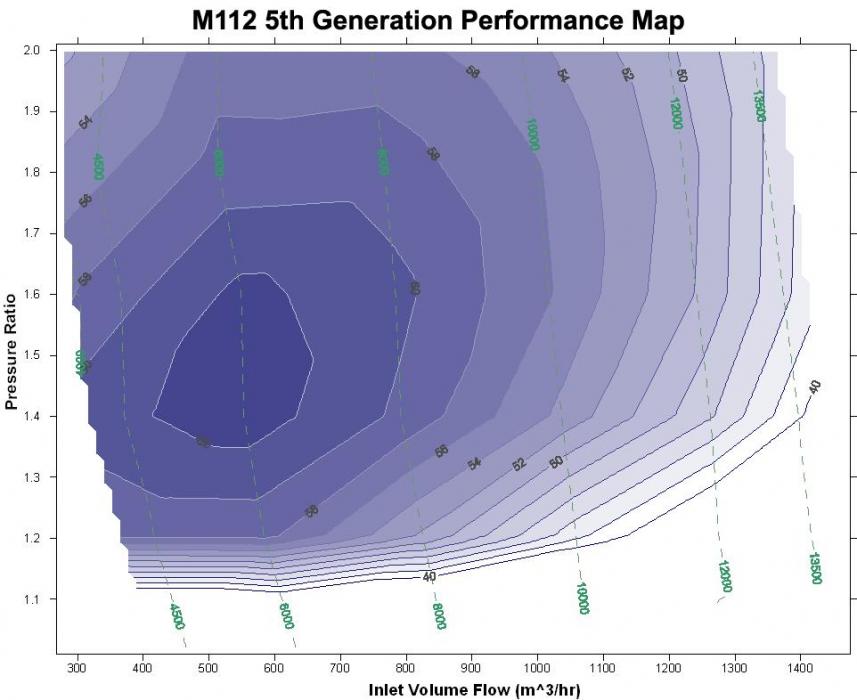
Here is the compressor map for our Gen V Eaton. You can see why spinning this thing faster will only give so much extra power before that is overwhelmed by the additional heat of compression.
.
.
.
Do you know if any internal engine parts are forged or not? I have never found out if there is any difference compared to the standard non-supercharged 4.2L. The only difference so far is the reduced compression ratio to 9.8 from 11.5. This is done with different pistons so I think the rods and crank are the same?? Brutal has verified that the heads are the same and the exhaust manifolds.
The VVT was not added to the STR until the 2006 and up model years. There is also a mention of a pulley change around 2007 to increase the power to 410 HP. I have not been able to pin this down any better??
We almost have the largest Eaton at 112 cubic inches. There were also different generations of the M112. The STR has the best and latest Generation V(5) of the M112. The generations vary in compressor maps and bearing packages. The Eaton is favored by car manufacturers because of it's very long life and lack of problems. Even though there are more efficient units out there. The new XFR now has a variation of the twin screw as does the massive LS9 in the 638 HP Corvette.
The STR does not have the largest Eaton blower. There is a M122 which of course is 122 cubic inches. This unit is only used on the 2007 and up Ford Shelby GT500 Mustang with the 5.4 L that makes 500 HP ,480 Ft-LB. The Mustang guys regularly replace this with a nice TS kit that is available for that application. Lucky guys!!! This M122 was made with some special castings on the intake side to match the Mustang and I don't think we could adapt it to our cars.
Here is the compressor map for our Gen V Eaton. You can see why spinning this thing faster will only give so much extra power before that is overwhelmed by the additional heat of compression.
.
.
.
Last edited by clubairth1; Feb 2, 2011 at 09:27 AM. Reason: spelling error

Veteran Member
Joined: Feb 2010
Posts: 1,080
Likes: 43
From: Carrollton TX
Now don't forget porting and reshaping of "special areas" will change the compressor map. An eaton specialist is eager to help us get more out of our stock blowers. But I need to bring one in for him to put on the flow bench and find the tweaks for our casting since it is different from the ford casting. That was one of steigmeirs mistakes, According to someone with over 25+ years of eaton experience said they casted differently internally and cannot be treated as a ford blower. Porting it wrong and rehearing it wrong will actually cause you to lose power as the rotors become unphased.
When they are out of phase (time) the air collides within the blower. Causing more heat and extra power consumed to turn the blower so you end up with a power robbing noisy monster.
When they are out of phase (time) the air collides within the blower. Causing more heat and extra power consumed to turn the blower so you end up with a power robbing noisy monster.
Veteran Member
Joined: Feb 2010
Posts: 1,080
Likes: 43
From: Carrollton TX
Now don't forget porting and reshaping of "special areas" will change the compressor map. An eaton specialist is eager to help us get more out of our stock blowers. But I need to bring one in for him to put on the flow bench and find the tweaks for our casting since it is different from the ford casting. That was one of steigmeirs mistakes, According to someone with over 25+ years of eaton experience said they casted differently internally and cannot be treated as a ford blower. Porting it wrong and rehearing it wrong will actually cause you to lose power as the rotors become unphased.
When they are out of phase (time) the air collides within the blower. Causing more heat and extra power consumed to turn the blower so you end up with a power robbing noisy monster.
When they are out of phase (time) the air collides within the blower. Causing more heat and extra power consumed to turn the blower so you end up with a power robbing noisy monster.
Veteran Member
Joined: Dec 2006
Posts: 2,964
Likes: 507
From: Hamilton, NJ
Then the fuel injector sprays the fuel, spark plug goes off and boom, explosion. Piston is pushed down etc.
NOW, since you have more air, the injector size, and injector pulse has to be adjusted to compensate and provide more fuel, for the increased amount of air. (To maintain an acceptable air / fuel ratio) This is NOT done by the S/C but rather by the car's fueling system.
You are trying to keep the mixture as close to 13.7:1 as you can. Too much fuel, and some of it remains unspent, too little fuel and the engine detonates prematurely, (leans out). Leaner is great for power, but oxygen burns hotter than gasoline, hence why it will blow up your motor.
This is why tuning is so important and why half the guys with homemade turbo kits blow their cars up by leaning them out.
In the end you end up with more fuel, and more air in the same size cylinder than you would with a naturally aspirated engine, hence why they make more power.
Take care,
George
Veteran Member
Joined: Nov 2009
Posts: 5,084
Likes: 432
From: NY
Hi George. thank you for the info. on forced induction. I recently read up on modern forced air induction. We know that modern blown motors ECU's monitor boost, temps., etc. and subsequently increase/decrease fuel or advance or retard spark. Into the combustion chamber of a "non direct injected fuel system management" goes a denser and richer charge of air and fuel. On the other hand the 2010 5 litre Jaguars have direct injection. In this application fuel and air aren't mixed prior to burn. Can anyone confirm this right or wrong?
Veteran Member
Joined: May 2009
Posts: 27,518
Likes: 4,910
From: Yorkshire, England
Maybe bfs was just using a rather short message but meant that.
More air in should be seen by the MAF and that should mean the PCM adds more fuel. Strictly the SC didn't add it but it's the indirect cause of it being added.
More air in should be seen by the MAF and that should mean the PCM adds more fuel. Strictly the SC didn't add it but it's the indirect cause of it being added.
Veteran Member
Joined: May 2009
Posts: 27,518
Likes: 4,910
From: Yorkshire, England
The 5.0 is indeed GDI (gas direct inj) but the air & fuel still need to mix to an appropriate degree.
It's quite complicated as I think at small power they use stratified fuel / air.
It's quite complicated as I think at small power they use stratified fuel / air.
Veteran Member
Joined: Dec 2006
Posts: 2,964
Likes: 507
From: Hamilton, NJ
Hi George. thank you for the info. on forced induction. I recently read up on modern forced air induction. We know that modern blown motors ECU's monitor boost, temps., etc. and subsequently increase/decrease fuel or advance or retard spark. Into the combustion chamber of a "non direct injected fuel system management" goes a denser and richer charge of air and fuel. On the other hand the 2010 5 litre Jaguars have direct injection. In this application fuel and air aren't mixed prior to burn. Can anyone confirm this right or wrong?
The difference is when the air and fuel mix. In an STR or other multi port fuel injection system, the injector is basically spraying right into the intake valve, and the air and fuel are mixed in the head as they enter the cylinder via the intake valves.
In a Direct Injection engine fuel is sprayed right into the cylinder, and only air passes through the intake valves. And the two mix in the combustion chamber itself.
The actual statement for a direct injection application is that air and fuel aren't mixed prior to entering the combustion chamber.
Either way the two have to mix before burning (ignition - basically the spark plug firing), otherwise you wouldn't have combustion.
Your statement of a denser and richer charge of air and fuel going into the combustion chamber is correct in either scenario, but that's relative to a naturally aspirated engine, that doesn't have forced induction, so it's limited to air at atmospheric pressure.
Take care,
George
Veteran Member
Joined: Dec 2006
Posts: 2,964
Likes: 507
From: Hamilton, NJ
Personally I blame my father and my Engineering Background. My girlfriend seems to think otherwise though
Take care,
George

Senior Member
Joined: May 2010
Posts: 125
Likes: 9
From: Missouri
I enjoyed the read as well. Even though it's not new info for me, it's interesting to see this thread stay alive while we wait for the OP to come back and tell us what's really wrong.
Myself? I blame rusty carburetor bearings.
Myself? I blame rusty carburetor bearings.

