When you click on links to various merchants on this site and make a purchase, this can result in this site earning a commission. Affiliate programs and affiliations include, but are not limited to, the eBay Partner Network.
It took me quite some time to realise what you meant by keeping my own fluids up, and "JD through a straw" - Jack Daniels, I assume...?
Loads of rags it is, then. Open air is no problem. Nothing but open air. Too much open air... And if the barbs look wonky, carefully, carefully smooth them (the goal being to make a neat circle, or the goal being to get a crisp edge to grab the hose with--or both, I assume), and then if the connection is dodgy, get some proper EFI clamps as the current ones look generic.
My first priority, I think, will need to be the aircon coolant leak. The fogging is getting ridiculous, though today, being cold and wet, was a day designed for fogging anyway. But the defroster struggled. I think it gets worse when I use anti-fogging stuff, actually. Only on the left hand side, however. It might be just the o-rings for the heater core pipes. I shall do some research....
If the barbs are suspect, take a thin strip off the emery, and form a circle with your thumb and forefinger, place the emery inside that circle, then the spigot (barbed section), inside that emery circle, close the gap, and rotate the spigot in that circle, thus "smoothing" the sharp edges to a dull edge (which will not damage the hose) when clamped.
I did ALL mine, takes the guess work out of the whole exercise.
Some of mine had serious DEEP cuts across the barbs, Gorilla Rocket Scientist before my ownership, so I use a very fine, very small file to get them out. My wife came to that rescue with a nail file, worked a treat, women, gotta luv their thinking, sometimes.
It is surprisingly easy to damage those sharp barbs, and equally easy to smooth them down to accept clamps.
You are probably on the money with those o/rings, very common.
Thanks for the tips. The idea is to remove anything that might tear the hose, I gather. And remove anything that might let fuel leak out, like a gouge. I think there might be some nail files around. My wife won't let me use hers, that's for sure....
I'll do some research on how best to get a look at the o-rings -there's quite a bit of info out there, and I just need to collate and sort it so I know what I'm doing. From memory, the pipes are on the left, so access from the passenger side should be relatively easy.
Some day, Some day, you are in Japan? Have a look and ask around about the fuel injection used on fairladys. I'm not sure the year but I'm almost certain some vintage of datsun z uses the same barbed bosch injectors, may make getting the parts you want easier/cheaper.
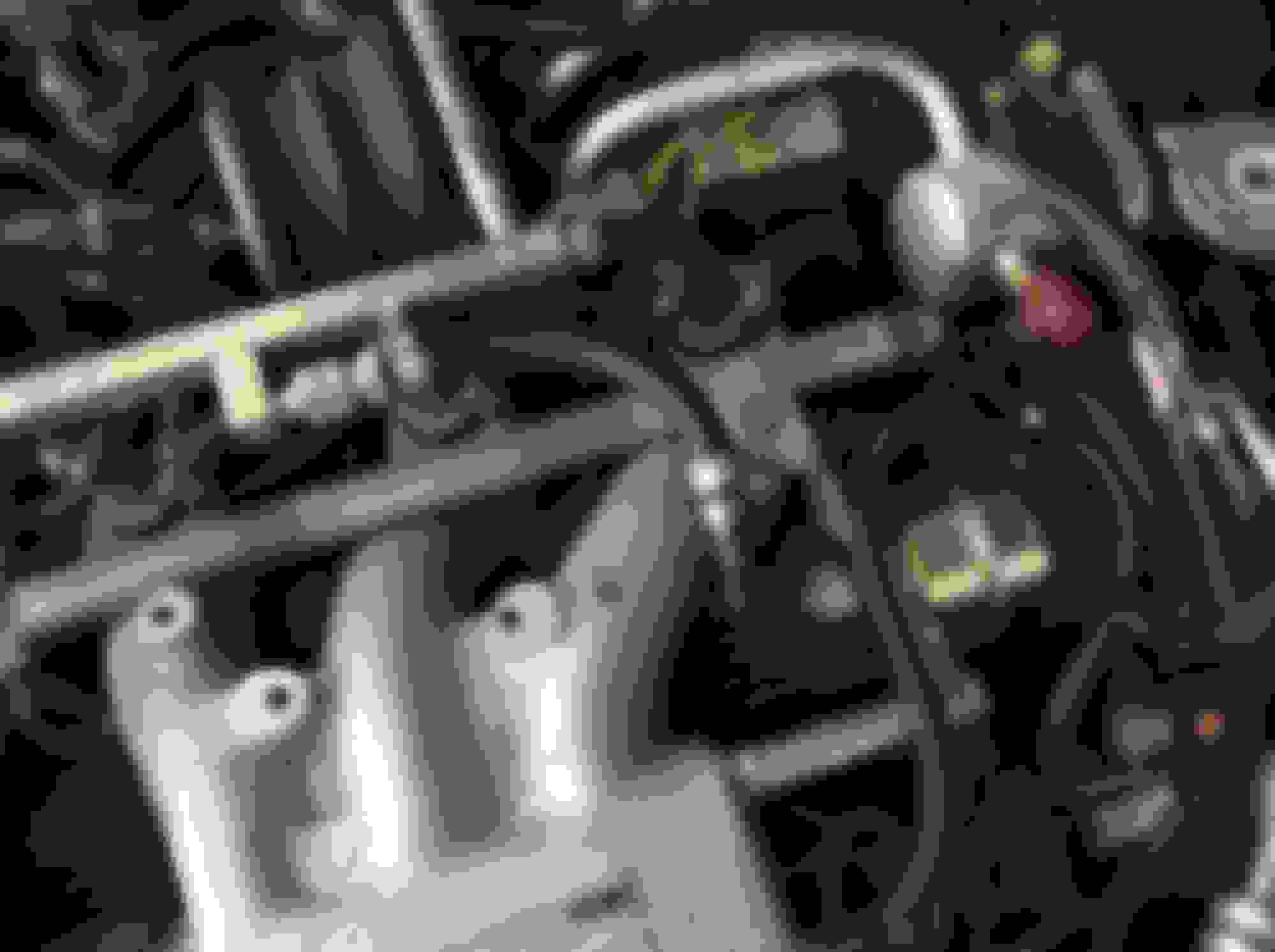
None of my 1989/1990 XJS's have those Rubber Hoses as shown in your photo
which seems to be the worst possible place to have a Petrol leak
No Rubber Hoses as in your Photo with or without Clamps
(except for the two curved ones at the front)
I have a question on your photo and this topic of fuel hose clamps, my 91 XJS appears to have had new hoses installed and you can see in my photo the use of screw clamps on this section between the right rail and what I think is a fuel pressure switch. I get a leak on this section upon initial startup o& the engine and the leak stops after the engine warms up and the pressure switch apparently opens and reduces the line pressure at this hose section. My question is can one buy these factory OEM hose sections of is replacement with or without clamps the only answer. I have checked these tightness of the metal threaded connections of this section and they appear to be tight, indicating the leak may be from the hose where the clamp is locatated. Thanks in advance for your response or that of others.
I have no idea if you can buy these Fuel Hoses or not but I certainly would not want to be driving around in an XJS with a Fuel Pipe that only leaks even when its cold, as one day it might start leaking when its hot
At which point it could start a Fire that may not be too easy to put out
So I think you might be better off going to your local hydraulic shop and then ask them to make some up for you out of top quality fuel hose
Last edited by orangeblossom; Jun 19, 2019 at 05:48 PM.
That's not my hose. In LastChance's case, I think it should be fairly easy to get a short section of standard fuel hose and replace that section, but I agree it would be a good to get input from others with a pre-facelift V12 about whether clamps are used on that section.
. My question is can one buy these factory OEM hose sections of is replacement with or without clamps the only answer.
That is the fuel feed from the pressure regulator to the fuel rail. Originally, it was a single piece, with the hose crimped to the metal ends. Part number is EAC9987, but unfortunately showing NLA at Jaguar. It should be a barbed fitting that the hose pushes onto, without the need of clamps. When many people take off the old hose they use a knife to cut off the old hose and put nicks on the barbs, which leak. Also, when the screw clamps are tightened onto the barbs they can cut the hose and cause leaks.
I have a question on your photo and this topic of fuel hose clamps, my 91 XJS appears to have had new hoses installed and you can see in my photo the use of screw clamps on this section between the right rail and what I think is a fuel pressure switch. I get a leak on this section upon initial startup o& the engine and the leak stops after the engine warms up and the pressure switch apparently opens and reduces the line pressure at this hose section. My question is can one buy these factory OEM hose sections of is replacement with or without clamps the only answer. I have checked these tightness of the metal threaded connections of this section and they appear to be tight, indicating the leak may be from the hose where the clamp is locatated. Thanks in advance for your response or that of others.
The barbs on the hard line in my pic at top are what reside beneath that hose, you don't want to be tightening down on those sharp edges with a clamp. It can simply be pushed on along with a suitable ferrule.