When you click on links to various merchants on this site and make a purchase, this can result in this site earning a commission. Affiliate programs and affiliations include, but are not limited to, the eBay Partner Network.
How are the late front wheel seal supposed to work?
I understand how to install them, on spindle/wheel carrier/stub axle and that the taper is toward the car.
What I don't understand is how they are supposed to work?
Long story short, did a set of wheel bearings on the 90 the other week, saw the stub axles were worn, ordered them
and put it together with new seals and bearings in the meantime. Drove it maybe 300 miles in-between.
Have it apart doing the new stub shafts and new bearings and seals and I observe that the seal has been
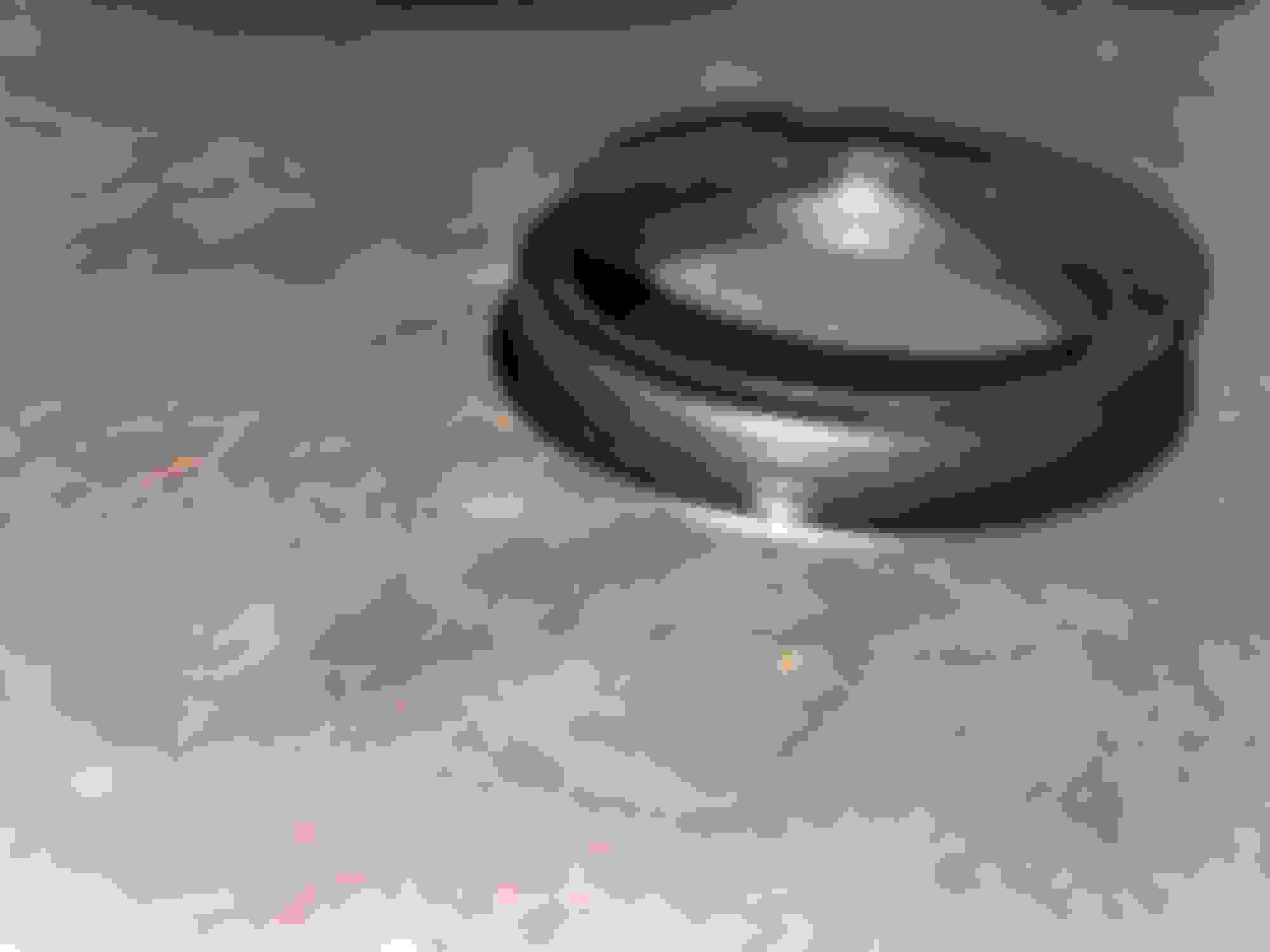
stationary on the spindle and the contact surface where the hub touches it and rotates, it's worn all of the lips
off of the seal already. You can see the grease in that immediate area is black with ground up rubber.
Is this normal?
On this second time with the new stub shafts, I can rotate the wheel and see the seals turning on both the spindle and the hub,
I greased it all lightly when installing them. Should the spindle side be dry? Is it normal or ok for them to just rotate
wherever they decide to? None of the surfaces are rough, it has to rotate on one or the other, I'm puzzled how it
can not-wear quite a lot?
I may have worded it badly, but they are correct, the outer ribs on the seal slide into the hub.
I am still not sure we are communicating! I am saying that the flat side of the seal should be outermost on the hub, is that what you mean yous is like? So when the hub is pushed onto the stub axle, the flat side of the seal is against the inside of the stub.
Yes, the flat side is inside the hub.
And the rotation of the hub appears to rub the ribs off the seal in short order. This seems an odd arrangement. This seal was in use for several hundred miles and was well greased.
Ff the seal is rotating against the hub, and the lip of the seal that is against the stub is staying fixed to the stub instead of rotating against it, then you have the wrong size of seal.
Ff the seal is rotating against the hub, and the lip of the seal that is against the stub is staying fixed to the stub instead of rotating against it, then you have the wrong size of seal.
So the seal should be fixed to the hub and rotate on the stub axle? The seal are the correct part number, I can't say if the are manufactured correctly. They install on the stub tightly but by hand. The previous one that had many miles on it was nearly destroyed and was firmly stuck to the stub, the hub rotating on it.
So the seal should be fixed to the hub and rotate on the stub axle?
Yes, it should. All oil seals work like this. The seal should be quite hard to fix into the hub, needing a number of firm taps round the rim with a mallet or similar. It should be an almost effortless push onto the stub axle once fixed into the hub.
Yes, it should. All oil seals work like this. The seal should be quite hard to fix into the hub, needing a number of firm taps round the rim with a mallet or similar. It should be an almost effortless push onto the stub axle once fixed into the hub.
These were quite the opposite, they did not go onto the stub axle easily, but they were installable by hand with some grease. Installing the hub and rotor onto the stub and seal seemed to take considerably more effort. This has been the case three times now.
If I'd known this I may have tried to install it to the stub axle dry or with some light adhesive. I couldn't find any specifics in the service manual.
One would also never know which it was rotating on unless like me they had occasion to go back in there shortly after the job was done.
What a mechanically odd setup.
Last edited by wolf_walker; Jul 25, 2022 at 08:47 AM.
These were quite the opposite, they did not go onto the stub axle easily, but they were installable by hand with some grease. Installing the hub and rotor onto the stub and seal seemed to take considerably more effort. This has been the case three times now.
If I'd known this I may have tried to install it to the stub axle dry or with some light adhesive. I couldn't find any specifics in the service manual.
One would also never know which it was rotating on unless like me they had occasion to go back in there shortly after the job was done.
What a mechanically odd setup.
I notice in Kirbys book on page 363 it's alluded to that the hub does rotate on the seal which is fixed to the stub axle/wheel carrier.
"The post-ABS grease seal works the other way round, it sits on the hub carrier and its lip touches the hub proper which rotates relative
to it. The hub’s inside surface in that area is nothing like as smooth as the stub axle’s surface, so I’d expect that grease
seal to fail much earlier.”
and
"If you have an ABS-equipped car, perhaps while you have the hub off for an overhaul it’d be a good idea to polish up
the contact surface on the hub to help seal life."
Not that I'm arguing but I figured what's in his collection is fairly well vetted information at this point?
If you have an ABS equiped car, it may well be different. What date of manufacture is it, and what model?
Members with experience of ABS cars might chime in.
I think that this link shows a photo of an ABS seal (I might be wrong) but if it does, your seal pic posted above looks a bit different. This one looks like it does ride on the hub. ie exterior lip seal. Did yours look like this when new? https://www.ebay.com.au/itm/200914336500
and https://parts.jaguarlandroverclassic...-oil-seal.html
Last edited by Greg in France; Jul 25, 2022 at 11:31 AM.
It's a 90 with ABS. The earlier non-ABS models are a bog standard drive-in-the-hub type seal like every other cone wheel bearing setup.
This version started in 90 on the XJS and is similar if not identical to what was used on a number of later models, XJ40 and the one after it I believe.
Did your seal look like those in my links when it was new? I have just edited the last post.
Yes they do, that photo I posted is after a couple hundred miles of use, albeit with more play than desirable with the original worn stub axle.
You can see the outer face of the seal, where it fits into the hub, has worn away the ridges or flaps since the hub was spinning
on it. The inner face has similar ridges or flaps, and they would not be riding on the finely machined stub axle either, they would be on the
much rougher wheel carrier/spindle raised lip itself. All of those surfaces I cleaned up with fine sandpaper, but they are just not precision smooth machined surfaces
so I don't see how one or the other surface of that seal isn't going to wear regardless of where it's spinning at.
Nor how you would control where it spins at without using adhesive. The ROM makes no mention of any of this, they just
say to install the seal on the wheel carrier/spindle first, then install the wheel hub on it.
In case it helps, here's the assembly instructions from the Jaguar service manual for ABS-cars, and here's the parts pic of the seal in relation to hub and stub axle:
Thanks, I do have the manual and read through it, afraid it wasn't a ton of help as far as the seal goes other than saying
to install it lol...
I guess if one wanted to be very specific, it says to fit the new seal on the stub axle, and THEN says to lube it, which would
possibly, maybe, indicate that the hub should rotate on the seal and not the seal on the stub axle? That seems to be kind
of reaching with what information they present though.
I remember fighting these seals on my XJR, as the X300 Jags use the same part number. I ruined a few in the process. A real pain.
I ended up very carefully shaving the ID of the seal to increase the ID just barely. Then slide the seal onto the stub axle. Then install the hub and bearings, crank the adjustment down pretty tight to 'install' the seal into the hub, then back off the adjustment as needed.
Search "CBC2858" and I think you'll find a number of threads discussing problems. I'm pretty sure at least one of us ended up getting Jaguar-packed seals which worked as intended, suggesting the aftermarket seals are not correct and/or not accurately manufactured
I remember fighting these seals on my XJR, as the X300 Jags use the same part number. I ruined a few in the process. A real pain.
I ended up very carefully shaving the ID of the seal to increase the ID just barely. Then slide the seal onto the stub axle. Then install the hub and bearings, crank the adjustment down pretty tight to 'install' the seal into the hub, then back off the adjustment as needed.
Search "CBC2858" and I think you'll find a number of threads discussing problems. I'm pretty sure at least one of us ended up getting Jaguar-packed seals which worked as intended, suggesting the aftermarket seals are not correct and/or not accurately manufactured
Cheers
DD
That's pretty well how I installed them, minus the shaving down since they pressed on the spindle fine. They installed okay, all things considered.
Maybe I'll spring for a set of factory Jag ones next time.
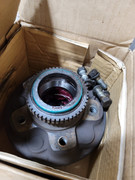
What I'd really like to know is where to get another hub that has an ABS ring AND takes the regular pre-abs press in seal like this one.
It also has a grease fitting for whatever that's worth. The ID of the seal bore differs between the two types.



 How are the late front wheel seal supposed to work?