


AGM battery


Veteran Member
Joined: Mar 2015
Posts: 7,420
Likes: 2,396
From: Hastings

Any car will do an excellent job of charging an AGM, it charges faster than standard battery. The argument posed by some is that if you frequently drive very long periods of time and are not using anything in the car that is consuming power- you might shorten the battery life, as the AGM requires lower voltage to maintain it after its fully charged (thus the need for special outboard ctek chargers- original point of post). However, the more realistic odds in a car like the XK is that you are only making short trips and or using a few things that consume power.

Senior Member


Joined: Sep 2012
Posts: 581
Likes: 224
From: Tucson, AZ
If a flooded battery is used in a charging system designed for an AGM it will NOT be fully charged because the float voltage is set lower for the AGM. From a practical standpoint this is probably not an issue.

Veteran Member
Joined: Mar 2015
Posts: 7,420
Likes: 2,396
From: Hastings
Here are a couple of things to keep in mind when maintaining your Absorbent Glass Mat (AGM) battery, including an OPTIMA® battery.
Many newer battery chargers, like the OPTIMA Chargers Digital 1200 12V Performance Battery Charger and Maintainer, have microprocessors that collect information from the battery and adjust the current and voltage accordingly. Some have different settings for charging flooded, gel and AGM batteries.
All lead-acid batteries can experience sulfation—the formation of lead sulfate crystals upon discharge. Look for a charger with a desulfation mode to help condition your battery and keep it performing at its best.
Low and slow is best. A low amp charger (one to 12 amps) is generally the best choice for charging any lead-acid battery. It's quicker to charge at higher amperage, but it also can generate a lot of heat, which reduces the life of a battery, just like the heat of summer.
Alternators are NOT chargers. Don't rely on your alternator to do the work of a charger. If your battery is discharged to the point where it cannot start your vehicle, use a charger as soon as possible to make sure your battery gets fully charged.
An alternator is meant to maintain a battery, not charge it.
Batteries eventually die. Batteries are a consumable product. No battery will last forever. The goal is to consistently maintain your battery to get the most life out of it.
Different chargers. Different capabilities. Under normal conditions most 12-volt automatic battery chargers will work on an AGM battery. Many newer battery chargers have settings specifically for AGM batteries; some even have separate settings for OPTIMA REDTOP and YELLOWTOP batteries, like the OPTIMA Chargers Digital 1200 12V Performance Battery Charger and Maintainer.
AGM and gel technology differ. Remember that the technology of an AGM battery is not the same as a gel battery, which has its own charging requirements. If your charger offers different modes, select the correct one for your battery. If you use the gel setting to charge an AGM battery, it won't fully charge and, over time, it could actually damage your AGM battery.
Under normal starting conditions, an OPTIMA battery should never experience at rest voltages below 12. Most 12-volt chargers and alternators have no problem recharging an OPTIMA if it has an at rest voltage of 10.5 or greater.
The magic threshold – 10.5 volts. The charging scenario for a deeply discharged AGM battery, one that's dipped below 10.5 volts, may be slightly different. The OPTIMA Digital 1200 can recover batteries that have been discharged as low as 1.25 volts. For other charger tips for recovering a deeply discharged AGM battery can be found in OPTIMA's tech tip, How to Resuscitate a Deeply Discharged AGM Battery.
Veteran Member
Joined: Mar 2015
Posts: 7,420
Likes: 2,396
From: Hastings
That sentence is priceless in understanding these battery debates and chargers and if you want to use one or not.
Naturally, many, most folks can go the lifetime of a car and not use a external charger, the alternator is ample to maintain it.
So there are no absolutes and everybody is right. However, the manufacturer has a brilliant point, how does your car know when to bulk charge, absorb charge and trickle? when does it know to desulfate.
I can add just one thing to the pie, I make Lifepo4 battery modules, its near impossible to reliably tell the state of charge. (where the battery is in relationship to charge requirements)
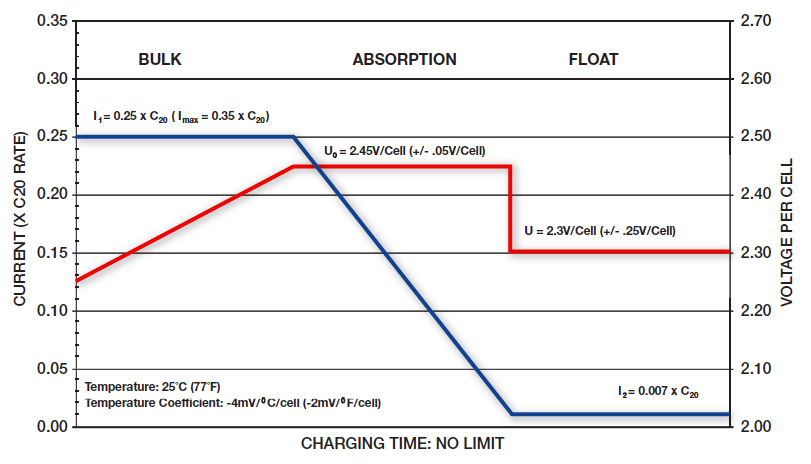
Here is a chart of how non-linear charging is on AGM.
Naturally, many, most folks can go the lifetime of a car and not use a external charger, the alternator is ample to maintain it.
So there are no absolutes and everybody is right. However, the manufacturer has a brilliant point, how does your car know when to bulk charge, absorb charge and trickle? when does it know to desulfate.
I can add just one thing to the pie, I make Lifepo4 battery modules, its near impossible to reliably tell the state of charge. (where the battery is in relationship to charge requirements)
Here is a chart of how non-linear charging is on AGM.

Veteran Member

Joined: May 2009
Posts: 27,546
Likes: 4,924
From: Yorkshire, England
Thanks both!
Though the posting was about whether an alternator - intended for a traditional type lead acid, and not intended for an AGM battery - would keep an AGM adequately full on an on-going basis. It wasn't about a charger as such or about a rather flat battery (unless such a traditional alternator would cause a fairly flat AGM).
Sorry for the questions/confusion, anyway!
Though the posting was about whether an alternator - intended for a traditional type lead acid, and not intended for an AGM battery - would keep an AGM adequately full on an on-going basis. It wasn't about a charger as such or about a rather flat battery (unless such a traditional alternator would cause a fairly flat AGM).
Sorry for the questions/confusion, anyway!
Last edited by JagV8; Sep 4, 2017 at 01:31 AM.

Veteran Member
Joined: Jan 2010
Posts: 2,941
Likes: 1,511
From: New Zealand
I am confused then because, unless I am miss-reading it, the manual for my CTEK says that the charge rate for the AGM battery setting is 14.7V and 14.4V for normal batteries.
Veteran Member
Joined: Mar 2015
Posts: 7,420
Likes: 2,396
From: Hastings
It requires and can take higher current in the CHARGE mode
In TRICKLE mode it needs lower- but rarely if ever your car is going to be in trickle mode
In all reality, if we are not academic about the whole thing, SLA and AGM are perfectly interchangeable, as demonstrated by folks who have used them for 3 years
Thread Starter
|
Senior Member
Joined: Aug 2017
Posts: 988
Likes: 380
From: Södra Sandby, Sweden
You are Correct.
It requires and can take higher current in the CHARGE mode
In TRICKLE mode it needs lower- but rarely if ever your car is going to be in trickle mode
In all reality, if we are not academic about the whole thing, SLA and AGM are perfectly interchangeable, as demonstrated by folks who have used them for 3 years
It requires and can take higher current in the CHARGE mode
In TRICKLE mode it needs lower- but rarely if ever your car is going to be in trickle mode
In all reality, if we are not academic about the whole thing, SLA and AGM are perfectly interchangeable, as demonstrated by folks who have used them for 3 years
Veteran Member
Joined: May 2009
Posts: 27,546
Likes: 4,924
From: Yorkshire, England
Aha. The (USA 2003-on) S-Type mostly provides more like 13 (13.4 or whatever) and only a higher voltage for a short time (a few mins). So judging by the above it isn't going to charge a flattish AGM.
(I wasn't going to fit one.)
(I wasn't going to fit one.)


Veteran Member
Joined: Sep 2013
Posts: 5,209
Likes: 1,847
From: NY
The dealer does this for the 5.0 cars. It is not required for the 4.2 cars. There is a different charging system .

Senior Member
Joined: Mar 2023
Posts: 158
Likes: 51
From: OC, Calif.
Clarifying...
I see some confusion I'd like to clear up:
Whether you call it a tickle charger or, correctly, a trickle charger, you need to confirm with the device's manufacturer that it's either a "smart" charger, "float" charger or battery "maintainer" that has an automatic overcharge-prevention chip (so you can leave your car charging for unlimited periods without risks). Also necessary to confirm that the charger is AGM battery-compatible and rated to maintain a battery having your battery's amp-hour rating.
In the case of my 2020 F-Type, its Absorbed Glass Mat (AGM) battery is 95ah, so I confirmed that the 120v-AC Heagstat 12-volt, 2-amp "fully automatic smart trickle charger and maintainer" I bought was rated to maintain a 95ah battery. It was. And it was only about $20 on Amazon.
If the charger's packaging or user manual is not explicit as to specs confirmation, contact the manufacturer; it's doubtful that Jaguar Forums is the right place to confirm.
I don't drive every day so I connect my Heagstat unit routinely when I pull into my garage. By connecting to the under-bonnet terminals (consult your owner's manual) I automatically charge both the F-Type's batteries simultaneously, and I avoid having to wire an aftermarket quick-connect harness in the boot. Yeah, it's a small hassle to have to connect/disconnect to drive, but I've learned the expensive battery's lifespan is prolonged considerably and I no longer have to worry about "low battery" alarms or malfunctions.
Note: There's a little recessed opening at the upper edge of the bonnet, near the side, to permit the charger's connection cable to exit the fully closed bonnet without being crimped. (I think the bonnet must be fully latched during charging to permit locking of the car.)
Whether you call it a tickle charger or, correctly, a trickle charger, you need to confirm with the device's manufacturer that it's either a "smart" charger, "float" charger or battery "maintainer" that has an automatic overcharge-prevention chip (so you can leave your car charging for unlimited periods without risks). Also necessary to confirm that the charger is AGM battery-compatible and rated to maintain a battery having your battery's amp-hour rating.
In the case of my 2020 F-Type, its Absorbed Glass Mat (AGM) battery is 95ah, so I confirmed that the 120v-AC Heagstat 12-volt, 2-amp "fully automatic smart trickle charger and maintainer" I bought was rated to maintain a 95ah battery. It was. And it was only about $20 on Amazon.
If the charger's packaging or user manual is not explicit as to specs confirmation, contact the manufacturer; it's doubtful that Jaguar Forums is the right place to confirm.
I don't drive every day so I connect my Heagstat unit routinely when I pull into my garage. By connecting to the under-bonnet terminals (consult your owner's manual) I automatically charge both the F-Type's batteries simultaneously, and I avoid having to wire an aftermarket quick-connect harness in the boot. Yeah, it's a small hassle to have to connect/disconnect to drive, but I've learned the expensive battery's lifespan is prolonged considerably and I no longer have to worry about "low battery" alarms or malfunctions.
Note: There's a little recessed opening at the upper edge of the bonnet, near the side, to permit the charger's connection cable to exit the fully closed bonnet without being crimped. (I think the bonnet must be fully latched during charging to permit locking of the car.)
Last edited by Ramart; Nov 11, 2024 at 12:19 AM.

Senior Member
Joined: Jun 2023
Posts: 497
Likes: 164
From: Montreal, Canada
I have a question looking for a narrow reply. During my first week of ownership of 4.2L XK I had to change the larger Group 49H8 battery.
So I went with the same size in AGM. Later on, I noticed the parts listings as have an alternative alternator to the 140 amp model. The alternative pumps out 220 amps. Since I am running a larger than OE battery should I match it to this larger alternator? One reason not to, is that my charging system is set up for wet batteries, not AGM. The difference of 80 amps seems to be a lot!
So I went with the same size in AGM. Later on, I noticed the parts listings as have an alternative alternator to the 140 amp model. The alternative pumps out 220 amps. Since I am running a larger than OE battery should I match it to this larger alternator? One reason not to, is that my charging system is set up for wet batteries, not AGM. The difference of 80 amps seems to be a lot!

Veteran Member
Joined: Mar 2015
Posts: 1,340
Likes: 805
From: Evesham, Worcs, UK
I have a question looking for a narrow reply. During my first week of ownership of 4.2L XK I had to change the larger Group 49H8 battery.
So I went with the same size in AGM. Later on, I noticed the parts listings as have an alternative alternator to the 140 amp model. The alternative pumps out 220 amps. Since I am running a larger than OE battery should I match it to this larger alternator? One reason not to, is that my charging system is set up for wet batteries, not AGM. The difference of 80 amps seems to be a lot!
So I went with the same size in AGM. Later on, I noticed the parts listings as have an alternative alternator to the 140 amp model. The alternative pumps out 220 amps. Since I am running a larger than OE battery should I match it to this larger alternator? One reason not to, is that my charging system is set up for wet batteries, not AGM. The difference of 80 amps seems to be a lot!
Richard
Senior Member
Joined: Jun 2023
Posts: 497
Likes: 164
From: Montreal, Canada
Well what do you know. My alternator packed it in. Three garages later and and he loves Bosch, so I have Rockauto send sending him the Bosch 220 amp. Don't the garages normally send the alternator out for rebuild? Yes, but he doesn't want to tie up the lift because the motor mount has to be removed. Its winter tire, change over season here, and they are fitting me in. Will let everyone know, if the deal goes south. So far, everyone is winning. 

Veteran Member
Joined: Apr 2008
Posts: 3,702
Likes: 1,696
From: Ottawa, Ontario, Canada
@sony2000 , been there, done that.
FWIW, the replacement Bosch generator and regulator lasted about 2 years. (incidentally I learned there are different models from Bosch, at varying quality levels)… The original Denso lasted 15 years.
This summer, I replaced the failed Bosch with the OEM (yes, from Jaguar ) Denso version as I consider a 2 year serviceable period, rediculous.
Best of luck.
FWIW, the replacement Bosch generator and regulator lasted about 2 years. (incidentally I learned there are different models from Bosch, at varying quality levels)… The original Denso lasted 15 years.
This summer, I replaced the failed Bosch with the OEM (yes, from Jaguar ) Denso version as I consider a 2 year serviceable period, rediculous.
Best of luck.
Last edited by guy; Nov 14, 2024 at 06:37 AM.

Thread
Thread Starter
Forum
Replies
Last Post
Currently Active Users Viewing This Thread: 1 (0 members and 1 guests)