


"XJR 550" project

Veteran Member


Joined: Feb 2010
Posts: 1,558
Likes: 592
From: Kalispell, Montana

Here is some information on 2013 Mustang Trinity 5.8L supercharged Cylinder Heads.
Note their pentroof chamber configuration is basically the same layout as Jaguar used.
(No VVT on this engine, 15 lbs boost, with and Eaton M122)
Heads Aluminum, four-valve per cylinder, inter exhaust seat cooling
CAM Covers Cast aluminum (5.4 co)
Compression ratio 9.0:1
Valves 37x32mm (1.454x1.257-in), four per cylinder; intake (5.4 co), exhaust Nimonic w/Stellite face insert
Camshafts DOHC, four camshafts (carried over from Ford GT)
Camshaft Timing Fixed (5.4 co)
Duration 242 degrees intake, 247 degrees exhaust
Lift 11.18mm (0.439-in) intake, 11.48mm (0.451-in) exhaust
Valve Followers Roller finger follower (5.4 co)
Lash Adjusters Hydraulic (5.4 co)
Note their pentroof chamber configuration is basically the same layout as Jaguar used.
(No VVT on this engine, 15 lbs boost, with and Eaton M122)
Heads Aluminum, four-valve per cylinder, inter exhaust seat cooling
CAM Covers Cast aluminum (5.4 co)
Compression ratio 9.0:1
Valves 37x32mm (1.454x1.257-in), four per cylinder; intake (5.4 co), exhaust Nimonic w/Stellite face insert
Camshafts DOHC, four camshafts (carried over from Ford GT)
Camshaft Timing Fixed (5.4 co)
Duration 242 degrees intake, 247 degrees exhaust
Lift 11.18mm (0.439-in) intake, 11.48mm (0.451-in) exhaust
Valve Followers Roller finger follower (5.4 co)
Lash Adjusters Hydraulic (5.4 co)

Thread Starter
|
Senior Member
Joined: Mar 2011
Posts: 662
Likes: 297
From: 'Out West', USA
First and foremost in conjunction with the piston you intend to use- you should ensure the compression ratio is correct.
If you leave the chamber size the same- you will basically have more squish than standard not a bad thing if its in the right place.
If that's going to be ok, I would enlargen the chamber beside the bores only- so in the axis of the cam chain and flywheel/flexplate (not the ports).
This will minimise the potential occurance of 'Omega Tumble'.
I would releave the frown - by a lead in to deshorud the valves further as much as possible. I will infact be abandoning the 'frown' squish and going for straight edge squish like the GT3 heads- because this has been proven time and time again on Porsches and BMWs.
Last edited by Count Iblis; Oct 2, 2015 at 09:59 PM.
Thread Starter
|
Senior Member
Joined: Mar 2011
Posts: 662
Likes: 297
From: 'Out West', USA
Squish doesn't cool the valves during combustion.Taken from earlier post
The chamber size along with the piston crown (along with other crevices) were designed to meet the target compression ratio- in the case of the AJ33- 9:1
Don't compare a GDi chamber with a PFI chamber- there are very different criteria involved and compromises


So i've been looking into the idea of a Jag / Aston hybrid, basically to utilise the Aston heads/cams on the Jag bottom end.
One issue has popped up, piston to valve clearance...
If we look at the Aston pistons they are fly-cut to allow valve clearance, I guess because of the larger diameter valves and increased lift.
Can see in Pavel's picture here, stock AM on left, his design on right:
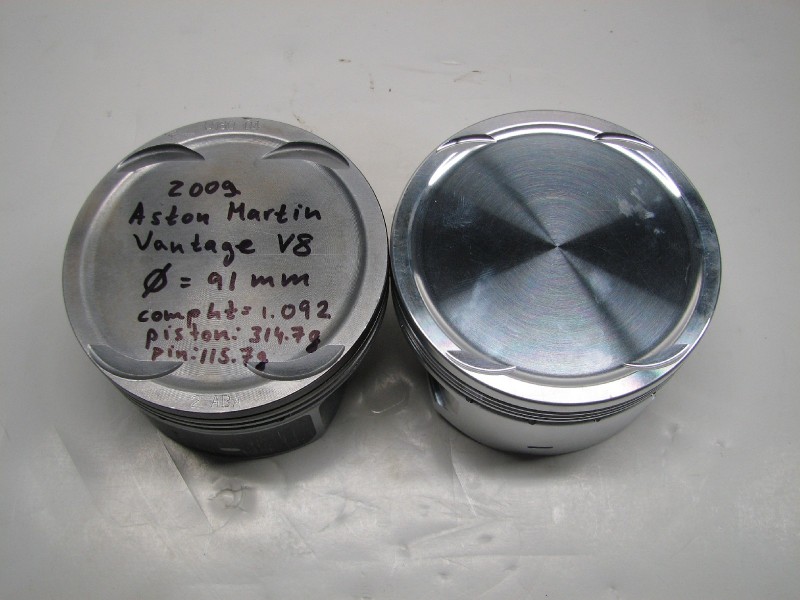
There is also "Badcat" in the UK who is offering a built engine with "reprofiled high lift Cams for more efficient induction....bespoke designed Pistons made by Mahle USA to accommodate higher lifting valves."

From what i've seen in the tech guides and pictures of stripped engines, the standard Jag pistons probably won't work with any higher valve lift than stock?
AJ26 = flat top, no valve recess
AJ26S = dished with outer edge same as AJ26, no valve recess
AJ28 = flat top, very slight valve recess
AJ33 = ??? (anyone got pics?)
AJ33S = dished with raised center (at spark plug), raised edge and squish points, very slight valve recess
None of the stock pistons seem to be capable of handling an increased lift?
One issue has popped up, piston to valve clearance...
If we look at the Aston pistons they are fly-cut to allow valve clearance, I guess because of the larger diameter valves and increased lift.
Can see in Pavel's picture here, stock AM on left, his design on right:
There is also "Badcat" in the UK who is offering a built engine with "reprofiled high lift Cams for more efficient induction....bespoke designed Pistons made by Mahle USA to accommodate higher lifting valves."
From what i've seen in the tech guides and pictures of stripped engines, the standard Jag pistons probably won't work with any higher valve lift than stock?
AJ26 = flat top, no valve recess
AJ26S = dished with outer edge same as AJ26, no valve recess
AJ28 = flat top, very slight valve recess
AJ33 = ??? (anyone got pics?)
AJ33S = dished with raised center (at spark plug), raised edge and squish points, very slight valve recess
None of the stock pistons seem to be capable of handling an increased lift?
Last edited by Cambo; Oct 13, 2015 at 12:13 AM.
Senior Member

Joined: Nov 2011
Posts: 878
Likes: 324
From: Europe
There are a few forum members who run higher lift cams with stock 4.2SC pistons - with 4.2 and 4.0 heads. The cam lifts are a bit under 1mm more than stock 4.2SC cams If you want to run high lift cams , you need deeper pockets or full piston redesign - like Badcat cam profiles or even more aggressive ones. Then you also need stiffer valve springs etc.
The idea was to simply bolt the Aston heads/cams onto an AJ33/34 bottom end.
So that would be taking the lift from 8.5/9.0mm to 11.1mm, so it's like 2.1-2.6 mm more lift in practise...
So that would be taking the lift from 8.5/9.0mm to 11.1mm, so it's like 2.1-2.6 mm more lift in practise...
Last edited by Cambo; Oct 13, 2015 at 08:24 AM. Reason: numbers...

Senior Member
Joined: Oct 2012
Posts: 256
Likes: 99
From: Michigan
Knife edging the crankshaft lightens it (it reduces its rotational inertia) and reduces windage in the sump ( it reduces parasitic drag).
On a V8 engine inparticular you have to make sure you have dynamic balance when you do this or else you can ruin your engine.
I would also be careful on an inline 4 too.
On a V8 engine inparticular you have to make sure you have dynamic balance when you do this or else you can ruin your engine.
I would also be careful on an inline 4 too.
I'd love to have that rev reaction in a Jag though. Would sending them the pistons and rods be the safer way to proceed in I wanted to knife edge my supercharged 4.0?

Veteran Member
Joined: Jun 2009
Posts: 2,838
Likes: 66
From: USA
Why not go the other way round and put the supercharger assembly on the AM-V8 long-block? Get the best of both worlds.
1. Comp is too high on the stock AM motor to just chuck a blower on
2. The AM bottom end has major differences (dry sump, mounting brackets, etc) it's not a straight swap
3. A good runner AM 4.3 is $10k+ if you can find one.
And actually in this case I was thinking of a naturally aspirated setup. What to do with a N/A 4.2L for more power without opening up the bottom end. But the idea of the AM top end on the stock Jag 4.2 bottom end falls over if there is no enough valve-to-piston clearance.
BUT
In saying all that, I can imagine an Aston/Jag supercharged hybrid to run in a Jag chassis.
Jag AJ33S 4.2L block, with the piston oil squirters, etc...
AM forged crank
Custom rods & pistons aka from PRE
AM heads & cams
Kenne Bell from Avos
Jag charge coolers
etc...
Now that would be the best of ALL worlds...
Veteran Member
Joined: Jun 2009
Posts: 2,838
Likes: 66
From: USA
I had realized that the comp ratio was too high, but if a Vantage motor was rebuilt with lower comp pistons and steel con rods, I think it should still work. Just gotta match the stock comp ratio. Ends up being like the Arden stroker kit, but with more displacement and better flowing heads. Dry-sump oiling's not a bad thing, I think...
Last edited by Panthro; Oct 14, 2015 at 03:33 PM. Reason: Forgot something
Senior Member
Joined: Nov 2011
Posts: 878
Likes: 324
From: Europe
Look what I picked up out west  :
:
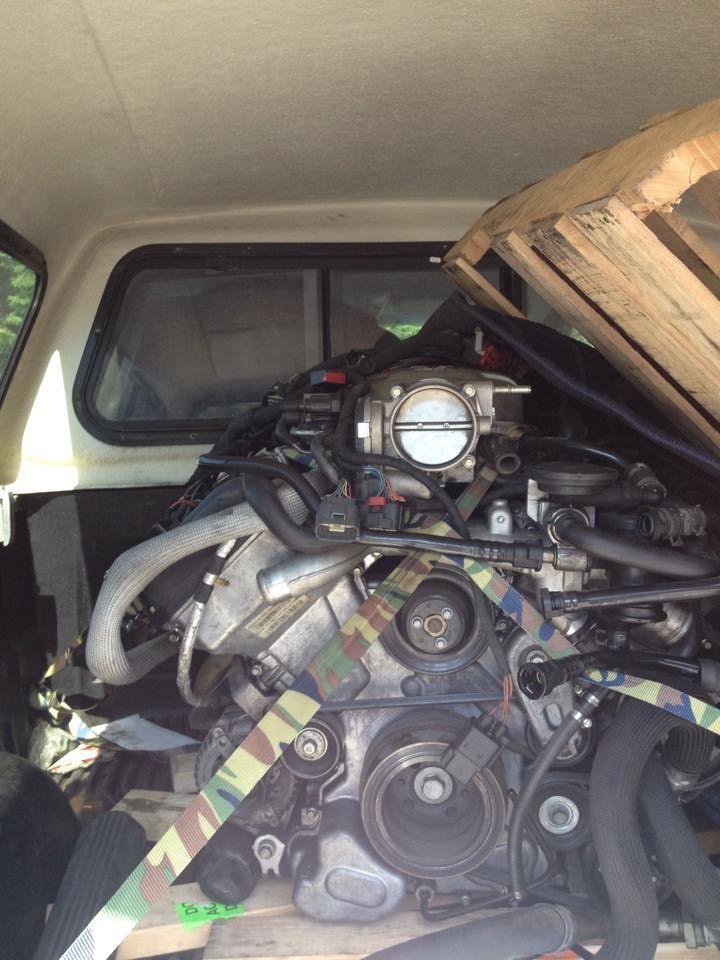
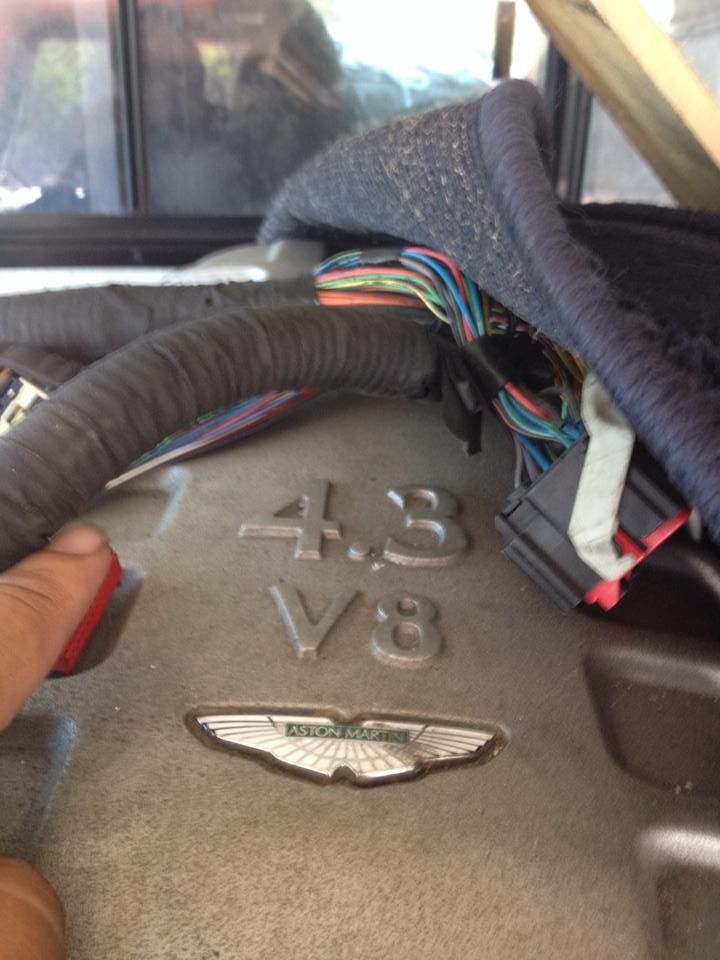
The ports of the AJ37 are better than both the AJ27 and AJ33 heads, they have more motion AND better flow.
It has a fully 8 counter weighted forged steel crankshaft (stock Jag is cast iron with 6 CW). May help mitigating the first mode on SC cars- if we were able to raise the rev limit.
The cams are 256 period duration with 11.1 mm lift. The lift was limited by the valve covers. Will provide a good base for further modification
:

The ports of the AJ37 are better than both the AJ27 and AJ33 heads, they have more motion AND better flow.
It has a fully 8 counter weighted forged steel crankshaft (stock Jag is cast iron with 6 CW). May help mitigating the first mode on SC cars- if we were able to raise the rev limit.
The cams are 256 period duration with 11.1 mm lift. The lift was limited by the valve covers. Will provide a good base for further modification
Intake and exhaust cams are both 256/11.1mm - LSA??? Since the AM V8 is CR 10.5 N/A engine, how well the cam profiles meet the CR 9.0 supercharged engine requirements?
Veteran Member
Joined: Feb 2010
Posts: 1,558
Likes: 592
From: Kalispell, Montana
There is no quick solution to generating more HP out of the 4.2 Jaguar engines. The more power you want, the more you will have to modify the motor. Perhaps for a NA engine, the AM cams will work. But for a heavily modified supercharged Jaguar engine, higher lift cams and duration changes will be required, along with chamber shaping and porting of the heads.
Higher lift than what exactly Joe? Longer duration than what exactly?  These are not questions with simple answers...
But apparently it's fine to have exact same cam specs for n/a and s/c, well that's how the 4.2's left the factory...
Question for Count Iblis: any chance you can take measurements of the 4.3L throttle body, is it bigger than the 4.2L Jag version?
These are not questions with simple answers...But apparently it's fine to have exact same cam specs for n/a and s/c, well that's how the 4.2's left the factory...
Question for Count Iblis: any chance you can take measurements of the 4.3L throttle body, is it bigger than the 4.2L Jag version?
Senior Member
Joined: Nov 2011
Posts: 878
Likes: 324
From: Europe
SC vs N/A cam profiles:
Supercharged Chevy Small Block - Super Chevy Magazine
PS. to be honest, the thread name should be upgraded to "XJR 750 or 850"
Supercharged Chevy Small Block - Super Chevy Magazine
PS. to be honest, the thread name should be upgraded to "XJR 750 or 850"
Last edited by XJR-99; Oct 16, 2015 at 10:29 AM.
Veteran Member
Joined: Feb 2010
Posts: 1,558
Likes: 592
From: Kalispell, Montana
If the forum had 5 to 10 engine builds documented with dyno results, it would make decision making mush easier.
Veteran Member
Joined: Feb 2010
Posts: 1,558
Likes: 592
From: Kalispell, Montana
Regarding the article, one of the things I am trying to balance out is the STR stock engine uses a bypass valve for idle and gentle acceleration up to perhaps 3000 rpm. As the bypass closes the supercharger boost kicks in and power builds quickly. The test engine in the article didn't have a bypass valve and I am pretty sure they didn't care much about emissions at idle. In a more aggressive cam for our engines, if you want to keep the engine emission legal you may not be able to have too much overlap.
If anyone knows the relationships between the cam duration, idle, bypass valve operation and how all of this interacts with the supercharger, please chime in.
If anyone knows the relationships between the cam duration, idle, bypass valve operation and how all of this interacts with the supercharger, please chime in.

Veteran Member
Joined: Jul 2010
Posts: 7,362
Likes: 1,241
From: Austin tx and Daytona FL.
this may not be relative to this engine, but the Chevy article is about mechanical S/C VS N/A!
a turbocharged engine takes a completly different effective cam timing than an N/A.
also Duration and lift of any cam has little use without a proper profile shape.
you can have two cams with exactly the same Duration and Lift, but respond differently, the most important numbers would be related to the Area under the curve,
and Lobe separation angle,(LSA).
area under the curve is best measured with the valve off the seat around .200 thousandsth, and thats were most power potential would show how aggressive the profile shape is!
Jaguar must like the 256* cam period, my Jag V12 factory(pre-HE) uses 256* period, and that was back in late 60s.
also one mans cam is another mans opinion.
a turbocharged engine takes a completly different effective cam timing than an N/A.
also Duration and lift of any cam has little use without a proper profile shape.
you can have two cams with exactly the same Duration and Lift, but respond differently, the most important numbers would be related to the Area under the curve,
and Lobe separation angle,(LSA).
area under the curve is best measured with the valve off the seat around .200 thousandsth, and thats were most power potential would show how aggressive the profile shape is!
Jaguar must like the 256* cam period, my Jag V12 factory(pre-HE) uses 256* period, and that was back in late 60s.
also one mans cam is another mans opinion.
Veteran Member
Joined: Feb 2010
Posts: 1,558
Likes: 592
From: Kalispell, Montana
Interesting. The AJ-V8 series engines has either 230 or 240 inlet duration and either, 220, 230 or 240 exhaust duration.
Veteran Member
Joined: Jan 2012
Posts: 2,953
Likes: 1,120
From: Phoenix, AZ USA
I assume that it was only on the intake side as is true with the earlier N/A versions but I could not find documentation to confirm this.
What is more interesting, is that the parts catalog lists different intake and exhaust cam part numbers for N/A and S versions of the AJ33, but for the AJ34, all the part numbers are the same.
So along with the addition of VVT, the AJ34S adopted the N/A cam profiles, which did not change through the entire run of the 4.2L. The head part numbers are the same, so the change can't be due to some improvement in the ports.
Are the N/A cams actually the better choice? Is that only true when pared with VVT? Or was this a cost compromise to reduce the number of line items?