When you click on links to various merchants on this site and make a purchase, this can result in this site earning a commission. Affiliate programs and affiliations include, but are not limited to, the eBay Partner Network.
Dear distinguished forum members,
This is my first post, and i believe it will not be the last.
I thank you in advance for your help in bringing back, this wonderful car, to what it should be.
I've purchased the car recently, and it was missing care as owned by a person who neglected her during 10 years.
I did already a basic maintenance : replacement of engine, gearbox and rear axle oil + filters + spark plugs (coils are recent).
My issue is that I have the feeling to drive with the choke inserted ( RPM are stable at idle : around 900 rpm): When I release the throttle pedal and press the clutch to change gear (up or down), the rev keep increasing by 200 to 500 rpm.
On flat road, if I release the throttle pedal, the car keeps its speed (cruise control is off ;-) ).
In addition, it miss power aswell compaired to my Volvo C70 (1.75 T and 150 hp)
Despite having no error codes on my OBDII reader, neither messages on the dash, I was suspecting an air leak. So I did the following :
- uper and lower intake gaskets replacement,
- injection nozzles cleaning (ultrasound) + o'rings replacement,
- 2x VVT solenoid check, cleaning + cam cover gasket replacement
- 2x Cam cover gaskets
- IMT check + gasket replacement
- check positive cranck-case breather pipe & elbows : I've replaced the pipe as it was a little bit cracked
- 2 o'rings of the full load ventilation
- Mass air flow sensor + air temp sensor cleaning and control
- head temp sensor control
- Break assistance vacuum hose and connection control
Everything looks good, but I steel have the revs increasing every time I'm switching gears.
Any Idea?
Thanking you all for your support
Marc
To test for a leak use the fuel trims. 900 sounds high.
Dear JagV8,
Thank you for the advise.
I borrowed an Icaresoft OBD reader to a friend of mine and here are the fuel trim readings:
At Idle (870-900 RPM):
Long Term 1 : approx 0.8%. Short Term 1 : from 0 to 4.7%
Long Term 2 : approx 0.8%. Short Term 2 : approx -1.6%
At 2000 RPM
Long Term 1 :approx 3.9%. Short Term 1 : approx -1.6%
Long Term 2 : approx 2.3%. Short Term 2 : approx -3.9%
At idle:
B1.S1 : approx 6%. B1.S2 : 99.2%
B2.S1 : approx 4%. B2.S2 : 99.2%
Similar values at 2000 RPM
Dear JagV8,
Thank you for the advise.
I borrowed an Icaresoft OBD reader to a friend of mine and here are the fuel trim readings:
At Idle (870-900 RPM):
Long Term 1 : approx 0.8%. Short Term 1 : from 0 to 4.7%
Long Term 2 : approx 0.8%. Short Term 2 : approx -1.6%
At 2000 RPM
Long Term 1 :approx 3.9%. Short Term 1 : approx -1.6%
Long Term 2 : approx 2.3%. Short Term 2 : approx -3.9%
At idle:
B1.S1 : approx 6%. B1.S2 : 99.2%
B2.S1 : approx 4%. B2.S2 : 99.2%
Similar values at 2000 RPM
Your opinion?
Thank you all for your time
Forget to mention that the fuel pressure is at 278 KPa (2.78 bar) ...maybe a bit low?
Dear NBCat,
Thank you for the interest and the table.
My fuel pressure is way too low
Yes, I've replaced the fuel filter last month.
I will check the filters attached to the fuel pump and transfer pump ...If I can find a tool to remove the retaining rings.
Cheers
Marc
I would just check the rear brakes are not binding, (sticking on) rear wheel(s) hot after a run?, or jack up and see if free to turn, with hand brake off.
Check range of the throttle, or reset it by, ignition on, (engine off) and accelerator peddle down to the floor, and back up.
simples checks, and removes this area of possable error.
some help!
Make a plastic tool from drainage pipe, or use a wooden button to knock the collar off/on.
I would just check the rear brakes are not binding, (sticking on) rear wheel(s) hot after a run?, or jack up and see if free to turn, with hand brake off.
Check range of the throttle, or reset it by, ignition on, (engine off) and accelerator peddle down to the floor, and back up.
simples checks, and removes this area of possable error.
some help!
Make a plastic tool from drainage pipe, or use a wooden button to knock the collar off/on.
Dear Bydand,
Thank you for the tips.
The brakes are ok and no heat after a run.
I've already did the throttle calibration with no effect.
I've just checked the fuel pump filters, they were very dirty.
After cleaning and reassembling, I 've started the engine, let it warmup and the fuel pressure is still at 270-275 Kpa.
I will try to clean the fuel pressure sensor contacts, never knows.
Will keep you posted
Marc
Last edited by DeepSound80; Jul 17, 2024 at 06:51 AM.
someone else with the same fuel pressure. see above.
Just checked mine just now 270/278 kPa. at tick over. Which is 738/758rpm. MY 2000 ,on 58K miles and the fuel filter was changed by me.
Just had all the air inlet off and fuel rail to change VVT solenoid No.1 and the Crank breather pipes. Runs fine.
MMmmm..
Just a thought.
You have cleaned the throttle butterfly, and it is free to move and not sticking?
someone else with the same fuel pressure. see above.
Just checked mine just now 270/278 kPa. at tick over. Which is 738/758rpm. MY 2000 ,on 58K miles and the fuel filter was changed by me.
Just had all the air inlet off and fuel rail to change VVT solenoid No.1 and the Crank breather pipes. Runs fine.
MMmmm..
Just a thought.
You have cleaned the throttle butterfly, and it is free to move and not sticking?
Good to know that the fuel pressure is ok, but still have a idle a bit high :-(
I've cleaned & controlled the VVT valve and they are working fine.
The crank vent elbow is almost new and I've replaced the rigid pipe going to the throttle body.
I have to look at the butterfly as you've suggested
Hello,
I've managed to remove the throttle body for cleaning and replacing the gasket.
It was not so dirty, and not sticky. Anyhow its done
Results ... Not that much, her idle has droped down to 840rpm only.
I still have to investigate.
You suggestions are more than welcomed
Cheers
Marc
So idle dropped 60 rev, by taking the inlet pipe off and on and cleaning the throttle butterfly.
Question. Was the trim data taken with the car stationary on the various engine revs, i.e Not under load driving at 2000 revs?
I would go around all the vacuum lines again with soapy water spray bottle, with the car at a warm idle, and watch if the revs drop at one vacuum connection or another.
The soapy water, is just to clog up the pipe seals temporarily.
Oil dip stick O ring in good condition, not broken or hard?
The breather pipe, split or leaking is the usual suspect, but you have replaced that. When I did mine, I changed the pipe out for re-enforce silicon pipe. Dia. 15mm and 10mm and replaced the rubber reducer, with a brass one. The pipe set up was, 90 deg elbow, from crankcase breather, to 90 deg steel pipe, 15mm to 10mm rubber reducer which was showing signs of cracking. 10mm plastic straight connector, to 10 rubber pipe connecting to plastic pipe. Sound failure?
I kept the steel pipe and replaced all with silicon pipe and a brass reducer. Cheaper than the Jaguar parts. Items 7,6,8 & 9
So idle dropped 60 rev, by taking the inlet pipe off and on and cleaning the throttle butterfly.
Question. Was the trim data taken with the car stationary on the various engine revs, i.e Not under load driving at 2000 revs?
I would go around all the vacuum lines again with soapy water spray bottle, with the car at a warm idle, and watch if the revs drop at one vacuum connection or another.
The soapy water, is just to clog up the pipe seals temporarily.
Oil dip stick O ring in good condition, not broken or hard?
The breather pipe, split or leaking is the usual suspect, but you have replaced that. When I did mine, I changed the pipe out for re-enforce silicon pipe. Dia. 15mm and 10mm and replaced the rubber reducer, with a brass one. The pipe set up was, 90 deg elbow, from crankcase breather, to 90 deg steel pipe, 15mm to 10mm rubber reducer which was showing signs of cracking. 10mm plastic straight connector, to 10 rubber pipe connecting to plastic pipe. Sound failure?
I kept the steel pipe and replaced all with silicon pipe and a brass reducer. Cheaper than the Jaguar parts. Items 7,6,8 & 9
Hi,
Yes, the trim were taken with a stationary car at idle and at 2000rpm.
As recommended, I've warmed the car , connect the OBD reader and then spray soapy water on vacuum pipe connections (one by one) and check the rev. They remain steady between 830 and 850rpm.
The oil stick o ring was worned so I've replace it, but no consequences on the revs.
I thank you for sharing your crankcase breather car setup, because mine is a bit different : After the oil separator, I have the breather elbow, the metallic tube, the rubber reducer, another rubber elbow and the rigid pipe. I don't have the rubber adaptor (6), the PCV valve (8) and the connector (9).
Can it be the source of my issue?
The last measurement I did at idle (840rpm) are similar to the previous ones.
As a complement :
- Ignition timing advance for #1 cylinder : 9.5°
- Air flow rate from Mass air flow sensor : 4.5 g/s
- Absolute throttle position : 13.7%
Ah, To get the full benefit of the fuel trim readings it is better to do this while the engine is running under some engine load. (driving in gear)
With the car stationary there is very little difference in load between idle and 2000rev, apart from slight windage and mechanical resistance.
With load there is more air flow,/heat and distortion of the pipes and fittings, etc. Which gives greater force, (+/-) pressure to act on the various pipes and fittings.
We are back to a slight air leak(s), which is what you are telling me, and would show up on the fuel trims if taken under a greater engine load while driving etc,
But not enough to throw a code apparently. Irritating none the less.
The usual suspect are the crank breather lines, or the main air inlet manifold cracked / spilt, OR anyother of the air/vacuum lines, old or new, cracked, or damages while fitting/installing parts / manifolds etc.
All you have to do is find it/ them!
The reading look OK, ....Is the ambient air temperature reading, reading normal?
The soapy water trick was for the easily accessible pipes/fittings check.
Looks like you will have to go deeper, and check, recheck each air/vacuum line and fitting old and new.
I take it all the M6 bolts and studs, for the manifold were and are good none loose fitting, stripped threads etc, which would cause a small leak at idle, and more so while running.
I thank you for sharing your crankcase breather car setup, because mine is a bit different : After the oil separator, I have the breather elbow, the metallic tube, the rubber reducer, another rubber elbow and the rigid pipe. I don't have the rubber adaptor (6), the PCV valve (8) and the connector (9). Can it be the source of my issue?
Well no, only if the pipes leak! The connections are for drawing oil mist out the crankcase and maintaining slight negative pressure, and tied into the brake booster.




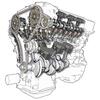
 3.0 V6 S-Type - Feel to drive with choke inserted