


to improve weight distribution


Thread Starter
|
Senior Member
Joined: Mar 2010
Posts: 210
Likes: 10
From: Tucson AZ
 to improve weight distribution
Hi: Search of the forum fails to turn up any references to moving the battery to the trunk where my ancient XJ-S kept its giant lead box. How hard would it be to help the X-type overcome its huge disadvantage in overhanging gross mass? Just twenty feet of heavy wire? Or are there hidden pitfalls? Thank you. --Tom in Tucson

Veteran member


Joined: May 2008
Posts: 14,803
Likes: 4,102
From: Great Mills, MD
Thomas, as long as you are using some heavy gauge wire (4-6 gauge), then you will be just fine. The big issue that I could forsee is when starting the car, the longer lead between the battery and the starter can lead to a higher voltage drop (assuming not using a properly sized wire), which can lead to slower cranks of the engine and easier conditions to be met to have failure of the starter (pulling more current, leading to the starter getting overheated). But, like I said, as long as you use the proper gauge wiring, should not be an issue.

Senior Member
Joined: Jan 2011
Posts: 298
Likes: 31
From: Monmouth Co. NJ
The battery would have to be vented to the outside. My XK8 has the battery in the trunk and there is a rubber hose which vents under the car. Only special batteries have this vent hose. Jack
Thread Starter
|
Senior Member
Joined: Mar 2010
Posts: 210
Likes: 10
From: Tucson AZ
There is a vent tube affixed to the battery already in place up front and I would just be relocating that same battery aft. I would find or make a small hole to the bottom of the boot area via spare tire I guess to route that little hose. I don't want hydrogen building up in my luggage area!
On your XK8, is the earth cable grounded to the chassis right at the battery in its rear location? In other words, only one heavy positive cable is needed to run forward to the engine and starter connections I hope?
Only other problem I can see is building a secure isolated connection block up front where my new cable will meet the old post. Thank you.
On your XK8, is the earth cable grounded to the chassis right at the battery in its rear location? In other words, only one heavy positive cable is needed to run forward to the engine and starter connections I hope?
Only other problem I can see is building a secure isolated connection block up front where my new cable will meet the old post. Thank you.
Veteran member
Joined: May 2008
Posts: 14,803
Likes: 4,102
From: Great Mills, MD
THomas, yes, cars with the battery in the rear have the battery grounding to the body of the car. I would recommend finding a nice solid piece of metal back there and then using a grinder with a sanding pad, clean off a nice spot to ground the ground wire to.
As for where the power wire will attach up front, I would restore the power wire to where it is connected now. Remove the 4 foot wire that is there now and then run the new wire to the spot where the old wire was connected to the electrical system. This will minimize problems in the future.
As for where the power wire will attach up front, I would restore the power wire to where it is connected now. Remove the 4 foot wire that is there now and then run the new wire to the spot where the old wire was connected to the electrical system. This will minimize problems in the future.




Joined: Dec 2009
Posts: 13,741
Likes: 9,686
From: Wise County,TX
When I went to Jaguar Training (NP02) New Product 2002 for the X-Type intro and I asked why the battery is in the front, I was told "because that is where the battery is on the MONDEO".
I thought they should have placed it in the boot also.
bob gauff
I thought they should have placed it in the boot also.
bob gauff
Thread Starter
|
Senior Member
Joined: Mar 2010
Posts: 210
Likes: 10
From: Tucson AZ
One thing concerns me though: on a XK8 with battery in rear, is the trunk release purely electric or is there a mechanical override? On the X-type, the only manual release is the kid-danger one pulled from inside. If there were a total complete failure of the battery in my trunk, I would have to release the rear seat and climb in to pull the safety explosive bolt. I have already relocated the manual seat pull so it can be reached from in the passenger compartment. In my old XJ-S, the trunk release was completely mechanical so this was never an issue. Just thinking out loud here. . .
Trending Topics

Junior Member
Joined: Sep 2011
Posts: 20
Likes: 0
Concerning being locked out with dead battery, the positive wire (that will run to the starter) would be easily accessible with a jump cable..
Anyone have an ideas about routing the positive wire TO the trunk and anchoring the battery??
Anyone have an ideas about routing the positive wire TO the trunk and anchoring the battery??
Veteran member
Joined: May 2008
Posts: 14,803
Likes: 4,102
From: Great Mills, MD
2004XSport, running the wire to the rear of the car should be fairly easy. The big question is whether you want to run it inside the cab of the car or keep it external to the body till it is ready to enter the trunk. I think you are better off running it inside the car down in the corner of the floor next to the doors.
The other thing I will tell you to look at is getting some heavy gauge wiring. I would recommend 2 gauge wiring between the output of the alternator and the battery positive. When you go to start the car, there is going to be a lot of amps flowing a long distance in the wiring. This can lead to voltage drops and overcurrent conditions. The starter can suffer from pre-mature failure if it sees too low of voltages too often.
If you want more info, let me know. Wiring like this is what I do for a living.
The other thing I will tell you to look at is getting some heavy gauge wiring. I would recommend 2 gauge wiring between the output of the alternator and the battery positive. When you go to start the car, there is going to be a lot of amps flowing a long distance in the wiring. This can lead to voltage drops and overcurrent conditions. The starter can suffer from pre-mature failure if it sees too low of voltages too often.
If you want more info, let me know. Wiring like this is what I do for a living.
Junior Member
Joined: Sep 2011
Posts: 20
Likes: 0
Great advice Thermo..I would rather run the wire under the car, as running a 2 gauge wire under the carpet/trim may be a bit bulky..but it would probably be worth it as the headers/exhaust are going to prematurely age the wire and maybe even ground it out? Unless I use some type of amazing insulator around the wire, what do you think?
Veteran member
Joined: May 2008
Posts: 14,803
Likes: 4,102
From: Great Mills, MD
2004, as long as you keep the wire in the corner of the floor, I don't think you will notice the wire. The big "issue" that you may have is making the corner to come through the firewall. Just make sure to use a good grommet when you come through to ensure a good seal and long life.
ALso, keep in mind that you can go as low as about 6 gauge wiring, but you may find that the starter will cause the engine to roll slower and take longer for the engine to finally start. So, larger is better in this case. The final size is up to you. But, don't go smaller than 6 gauge.
ALso, keep in mind that you can go as low as about 6 gauge wiring, but you may find that the starter will cause the engine to roll slower and take longer for the engine to finally start. So, larger is better in this case. The final size is up to you. But, don't go smaller than 6 gauge.

Senior Member

Joined: Jun 2010
Posts: 676
Likes: 57
From: Scottsdale, AZ
Great info Thermo, I have a few questions:
Are there any venting concerns? (my battery now sits in a closed plastic box)
How much longer would you guess the positive lead to the battery would have to be, than the stock length?
How much weight would one be adding to the car using 2 AWG wire, plus brackets to hold the battery in place?
Find an electrical ground at the trunk to tie into.?
I'm guessing a car battery weighs about 35 lbs. This is probably about the weight of the spare tire, which I do not carry in my car. I like this idea, but to move 35 lbs from the front to the rear may cost an extra several lbs in cabling and bracket hardware.
On the other hand, you are removing your battery from the heat of the engine compartment. This should increase battery life.
Performance upgrade or a waste of time?
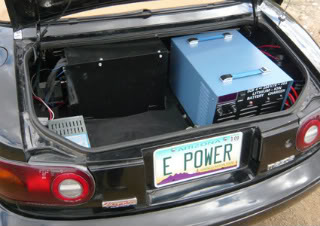
Are there any venting concerns? (my battery now sits in a closed plastic box)
How much longer would you guess the positive lead to the battery would have to be, than the stock length?
How much weight would one be adding to the car using 2 AWG wire, plus brackets to hold the battery in place?
Find an electrical ground at the trunk to tie into.?
I'm guessing a car battery weighs about 35 lbs. This is probably about the weight of the spare tire, which I do not carry in my car. I like this idea, but to move 35 lbs from the front to the rear may cost an extra several lbs in cabling and bracket hardware.
On the other hand, you are removing your battery from the heat of the engine compartment. This should increase battery life.
Performance upgrade or a waste of time?
Last edited by Patterson; Sep 23, 2011 at 02:07 AM.
Veteran member
Joined: May 2008
Posts: 14,803
Likes: 4,102
From: Great Mills, MD
Patterson, as for weight increases to the car overall, you are only looking at but maybe 2-3 pounds due to the wiring. The rest of the weight from this modification is simply moving it from one point to another.
As for the additional length of cable, you are looking at about 15-20 feet of extra lead length (dependent on how you run the cable). The big thing to keep in mind is to make sure that you keep the cable away from sharp edges. If you must go past a sharp edge, steps should be taken to minimize the likelihood of the edge cutting into the cable.
As for the ground point, any metal structure back there in the truck that goes to a bare metal spot will work. Remember, the whole body of the car is a ground point. So, something as easy as drilling say a 1/4" hole into a support structure for say the seat, threading the hole and then using a bolt to hold the eyelet of the battery cable in place will work. I would suggest using something that is welded to the body of the car because if you use something that is bolted in place, in theory you can arc weld this type of joint due to passing current through it. Granted, I have never seen that happen.
As for mounting the battery to the truck, my solution would be to use some fender washers, some 2" long bolts and put the battery in the trunk where you want, make sure there is nothing on the other side of the sheet metal, drill 4 holes (near the corners of the battery box) and then use the fender washers next to the head of the bolt and at the nut to distribute the forces and bolt the box down. Like I mentioned, make sure you are not going to accidentally drill into a fuel line, electrical cable, etc.
As for the gases emitted by a battery. This is my thought process. If you go with a sealed battery, they are meant to not emit any gases, so the need to run a vent line is not required. If you are truely still worried about it, you will need to spend a little bit extra on a new battery (since your options will be pretty open at this point due to the customization) and what you will want to look for is what is referred to as a "spiral wound" battery. These are a special type of battery that don't emit gases. The major battery that you will find like this is called "Optima Red Top". You will also find Yellow Top and Blue Top batteries by them. You don't need these unless you are doing something a lot more than simply driving your car. The yellow and blue tops have special purposes that they are designed to work in.
As for any performance gains, that I can't really speak about. I would think that it would push the car more towards a true 50/50 weight distribution which in theory will help with cornering. But, really, you would only see this if you are racing on a track. Normal daily driving is not going to result in any gains. As for battery life, it should result in a longer life as the battery will not be subjected to as much heat, therefore not stressing the chemical reactions that go on. But, again, is it enough gain to offset the cost? I think this is more in the eye of the beholder. Tough call as I see it.
As for the additional length of cable, you are looking at about 15-20 feet of extra lead length (dependent on how you run the cable). The big thing to keep in mind is to make sure that you keep the cable away from sharp edges. If you must go past a sharp edge, steps should be taken to minimize the likelihood of the edge cutting into the cable.
As for the ground point, any metal structure back there in the truck that goes to a bare metal spot will work. Remember, the whole body of the car is a ground point. So, something as easy as drilling say a 1/4" hole into a support structure for say the seat, threading the hole and then using a bolt to hold the eyelet of the battery cable in place will work. I would suggest using something that is welded to the body of the car because if you use something that is bolted in place, in theory you can arc weld this type of joint due to passing current through it. Granted, I have never seen that happen.
As for mounting the battery to the truck, my solution would be to use some fender washers, some 2" long bolts and put the battery in the trunk where you want, make sure there is nothing on the other side of the sheet metal, drill 4 holes (near the corners of the battery box) and then use the fender washers next to the head of the bolt and at the nut to distribute the forces and bolt the box down. Like I mentioned, make sure you are not going to accidentally drill into a fuel line, electrical cable, etc.
As for the gases emitted by a battery. This is my thought process. If you go with a sealed battery, they are meant to not emit any gases, so the need to run a vent line is not required. If you are truely still worried about it, you will need to spend a little bit extra on a new battery (since your options will be pretty open at this point due to the customization) and what you will want to look for is what is referred to as a "spiral wound" battery. These are a special type of battery that don't emit gases. The major battery that you will find like this is called "Optima Red Top". You will also find Yellow Top and Blue Top batteries by them. You don't need these unless you are doing something a lot more than simply driving your car. The yellow and blue tops have special purposes that they are designed to work in.
As for any performance gains, that I can't really speak about. I would think that it would push the car more towards a true 50/50 weight distribution which in theory will help with cornering. But, really, you would only see this if you are racing on a track. Normal daily driving is not going to result in any gains. As for battery life, it should result in a longer life as the battery will not be subjected to as much heat, therefore not stressing the chemical reactions that go on. But, again, is it enough gain to offset the cost? I think this is more in the eye of the beholder. Tough call as I see it.
Thread Starter
|
Senior Member
Joined: Mar 2010
Posts: 210
Likes: 10
From: Tucson AZ
I started this thread and appreciate all the theories coming out on here. I have not actually done this yet or even priced the needed components. My whole point in bringing it up was to help the weight distribution. If we could do the math, it might not reveal any major change in the %. But psychologically, I would feel better getting that big dumb deadweight out of the front where it over-hangs so far forward. The battery I now have from Interstate has a little tube on it which I would just run out a little hole. Again, I say thank you to all who are participating in this exchange of ideas. --Tom
Veteran member
Joined: May 2008
Posts: 14,803
Likes: 4,102
From: Great Mills, MD
Thomas, looking online, it appears that the X-Type has a 60/40 (F/R) weight distribution. With a curb weight of 3516 lbs, that means roughly 2110 pounds are on the front wheels, with 1406 pounds on the rear wheels. Since the battery in stock form is effectively over the front axle (if anything, slightly beyond the front axle), all the weight there is on the front axle and none rests on the rear axle. Moving the battery to the rear of the car, mounting it in the trunk (most likely on the shelf there just behind the seat), this will put the full weight of the battery on the rear axle. Assuming the battery/box/ect weighs in at 50 pounds, that would mean that the front is now carrying 2060 pounds and the rear is carrying 1456 pounds. So, this would result in a weight distribution of 58.6/41.4. So, you are looking at changing it about 1.5% roughly.
Is this enough to feel a difference in your cornering and traction? I am not sure. Also keep in mind that atleast on the 02-03 vehicles, the power ratio is 40/60 (F/R). With the weight transfer from the car moving forward, you may find the front wheel traction slightly less than what it was before, potentially leading to some slip. Do I see this being extreme, by no means. But if you mash your foot down on wet roads, you may feel it.
Hopefully this gives you some numbers to play around with and helps you decide if this is a worthwhile modification or not.
Is this enough to feel a difference in your cornering and traction? I am not sure. Also keep in mind that atleast on the 02-03 vehicles, the power ratio is 40/60 (F/R). With the weight transfer from the car moving forward, you may find the front wheel traction slightly less than what it was before, potentially leading to some slip. Do I see this being extreme, by no means. But if you mash your foot down on wet roads, you may feel it.
Hopefully this gives you some numbers to play around with and helps you decide if this is a worthwhile modification or not.
Thread Starter
|
Senior Member
Joined: Mar 2010
Posts: 210
Likes: 10
From: Tucson AZ
Doing the math is always instructive so thank you for this analysis. Is there not a multiplying factor when the weight in question is beyond the front axle axis? The old fulcrum-lever equations come to mind suggesting the force is even greater than just the dumb weight of the battery itself. Plus you have the polar moment of inertia effect too. Here in AZ, I don't have a lot of worry about traction on wet as we hardly ever have any wet to deal with. But that is a valid point of course.
Being as I have a manual trans, the fluid access is moot. But there are plenty of other maintenance and repair access issues that a relocated battery would alleviate. That is another guiding principle here for me.
Being as I have a manual trans, the fluid access is moot. But there are plenty of other maintenance and repair access issues that a relocated battery would alleviate. That is another guiding principle here for me.
Veteran member
Joined: May 2008
Posts: 14,803
Likes: 4,102
From: Great Mills, MD
Thomas, yes, you are correct in the fact that because the battery is sitting in front of the front tires, that the perceived weight would be more than simply the weight of the battery. But, relatively speaking, this distance is insignificant when you look at the overall length of the car. The battery sits roughly 1 foot in front of the tire, but the wheel base of the car is 106.7". So, it is going to weight in roughly at about 56 pounds on the front tires and a negative 6 pounds on the rear tires (the pivot point is the front tires, so, you have a 1 foot lever trying to lift a 9 foot lever). So, that does help in making the weight distribution closer to the ideal 50/50, but we are now talking tenths of a percent. Granted, every tenth helps.
You bring up inertia. This is a more significant effect, but really, this only comes into play when you are braking or accelerating (you are changing the balance front to rear, on cornering, it is a proportional gain that is equal on both the front and rear). Assuming you can brake at say 1G (which is better than the car can do), the effective weight transfer is roughly 1.414, or under extreme braking, the front of the car will effectively go from the 2110 pounds (pre-battery movement weight) to 2984 pounds. But, since the car is still only weighing in at 3516, this means that the rear of the car will only effectively weigh 532 pounds.
For acceleration, the 3.0L motor is only rated to accelerate the car from 0-60 mph in 7.0 seconds. So, this averages out to around and average of 0.41G's. Now, this is not a constant, so, giving the initial launch of the car a 1.5 times advantage (compared to the acceleration at 60 mph), your launch G's is say 0.6Gs. So, the weight distribution has a value of 1.17. In this case, the rear will become more heavy, so, the front would then weigh 1803 pounds, and the rear would go to 1759 pounds. that would almost make for a true 50/50 weight distribution.
Just some numbers to toss around. I find them rather interesting.
You bring up inertia. This is a more significant effect, but really, this only comes into play when you are braking or accelerating (you are changing the balance front to rear, on cornering, it is a proportional gain that is equal on both the front and rear). Assuming you can brake at say 1G (which is better than the car can do), the effective weight transfer is roughly 1.414, or under extreme braking, the front of the car will effectively go from the 2110 pounds (pre-battery movement weight) to 2984 pounds. But, since the car is still only weighing in at 3516, this means that the rear of the car will only effectively weigh 532 pounds.
For acceleration, the 3.0L motor is only rated to accelerate the car from 0-60 mph in 7.0 seconds. So, this averages out to around and average of 0.41G's. Now, this is not a constant, so, giving the initial launch of the car a 1.5 times advantage (compared to the acceleration at 60 mph), your launch G's is say 0.6Gs. So, the weight distribution has a value of 1.17. In this case, the rear will become more heavy, so, the front would then weigh 1803 pounds, and the rear would go to 1759 pounds. that would almost make for a true 50/50 weight distribution.
Just some numbers to toss around. I find them rather interesting.

Thread
Thread Starter
Forum
Replies
Last Post
rominempire
XJ XJ6 / XJ8 / XJR ( X350 & X358 )
28
Oct 8, 2020 10:39 AM
FS[SouthEast]: Books - Various Jaguar Titles
SCMike
PRIVATE For Sale / Trade or Buy Classifieds
6
Nov 25, 2015 07:55 AM

Currently Active Users Viewing This Thread: 1 (0 members and 1 guests)