When you click on links to various merchants on this site and make a purchase, this can result in this site earning a commission. Affiliate programs and affiliations include, but are not limited to, the eBay Partner Network.
This one has me scratching my head.. I have recently bought a 1993 3.2 XJ40 which runs beautifully however tonight I noticed that at idle after an open road run the oil pressure gauge had risen to 8, once some revs are on it drops to about 6.5.
It wasn't like this a couple of days ago, however it was a "Sunday car" which hadn't been out in the rain or at night (not sure why as the lights are amazing) so I'm expecting some gremlins.
I have never seen oil pressure rise as revs drop, can anyone provide some wisdom please.
Today I found the reason for the gauge rise, low oil volume. Presumably someone has replaced the gauge sender with one for a light and the 8 was the oil pressure light coming on at idle
After putting in a couple of litres of oil the light went away.
When I bought the car the add said uses no oil between oil changes, unfortunately this is clearly not true as I had to fill it 4 days after purchase. The sump plug is covered in silicone and the underside of the transmission is oily.
IT appears that the sump is damaged as one area of the silicone is very soft.
There are a couple of gaskets on the oil filter housing and some O-rings on the fittings to the oil cooler adapter and either the cooler pipes or bypass pipe, depending on whether you have the oil cooler or not. On some cars, I believe the gaskets #13 and #14 were replaced with silicone sealant.
You can look up parts diagrams and part numbers at parts.jaguarlandroverclassic.com
The easiest way to access the oil filter housing is to disconnect the intake manifold and tie it back to the left fender. While you're there, also replace the oil dipstick tube seal, the oil pressure switch, and the water rail gaskets and the coolant hose that can only be replaced with the intake manifold away from the head.
Regarding the oil pan, my recollection is that to replace it, the engine must be supported from above, and the front subframe must be dropped. Not as bad a job as you might think, and a great opportunity to replace the subframe Vee mounts and rear pivot bushings.
Thank you DonThat's really helpful.
Now I have got over the initial disappointment I'm looking forward to getting it sorted.
I have always done more than required when repairing things, this car I'm doing my best to just fixing the problem at hand.
We will see how long that theory lasts!
The primary reason that the oil pressure rises at idle and drops at cruising speed is that the replacement oil pressure transducer fitted (Item 11 in above) is a "European" (vdo gauge) style unit.
These transducers work in the opposite way to the OEM/Jaguar or "American" parts.
In OEM transducer / gauge pairings, as pressure increases the resistance drops, but in the VDO style the opposite happens - as pressure increases, so does the resistance. So instead of the gauge reading lower when revs drop, it does the opposite - moves up.
To add to the confusion, both transducers can have similar outward appearance with single connector and same thread.
I once fitted the wrong type and experienced the same symptoms.
The primary reason that the oil pressure rises at idle and drops at cruising speed is that the replacement oil pressure transducer fitted (Item 11 in above) is a "European" (vdo gauge) style unit.
These transducers work in the opposite way to the OEM/Jaguar or "American" parts.
In OEM transducer / gauge pairings, as pressure increases the resistance drops, but in the VDO style the opposite happens - as pressure increases, so does the resistance. So instead of the gauge reading lower when revs drop, it does the opposite - moves up.
To add to the confusion, both transducers can have similar outward appearance with single connector and same thread.
I once fitted the wrong type and experienced the same symptoms.
Larry
Thank you Larry, that's very helpful.
I will test the oil pressure with a mechanical gauge to make sure it is fine then add a transducer change to the list of jobs.
I was worried that someone had fitted an oil light switch and the gauge rising was actually the low oil pressure light coming.
Martin you can see if you have a transducer or a switch by the relative size. The illustration above gives a pretty good description of the physical proportions, the transducer is quite a bit larger. Of course it's difficult to see "in there" where it lives
If you can get the car onto a hoist you can change the oil pressure transducer by removing the oil filter (not the housing) to get access to the area. I had a leak actually coming through the transducer.
Another common leakage point on the oil filter housing is the bypass assembly (part no 4 in Don B's illustration. New O rings should fix it.
Reference the sump repairs I saw a case about 3 years ago where a damaged alloy sump in a Jag sports car was welded while the engine was still in the car in a country town in Queensland.
I don't know if it was TIG or MIG or whatever but the owner was happy and the car is still running.
Cheers
If you can get the car onto a hoist you can change the oil pressure transducer by removing the oil filter (not the housing) to get access to the area. I had a leak actually coming through the transducer.
Another common leakage point on the oil filter housing is the bypass assembly (part no 4 in Don B's illustration. New O rings should fix it.
Reference the sump repairs I saw a case about 3 years ago where a damaged alloy sump in a Jag sports car was welded while the engine was still in the car in a country town in Queensland.
I don't know if it was TIG or MIG or whatever but the owner was happy and the car is still running.
Cheers
I fitted new 19*3mm Viton o rings tonight which fixed the leak from the oil cooler bypass. Saturdays job will be to degrease the sump, transmission, exhaust shrouds as it appears this leak has been going a long time. It will be easier to find any other leaks on a relatively clean sump etc.
May I suggest you get rid of that silicon blob on the sump and try some LOCTITE® EPOXY WELD™ BONDING COMPOUND.As an interim repair.
This stuff really clings, and I have used it on repairs where welding was impractical.
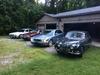
That is an interesting looking car beside the XJ40. Care to tell us what it is?
I'm a bit nervous to remove the silicone at the moment, it's a job when I do an oil change.
Now I have changed the o-rings it doesn't leak a drop.
The car beside the XJ40 is a 1949 Rolls Royce Silver Wraith that has been in the family since 1965.
Its a really special old car.
I agree you should not remove the "blob" before an oil change.
I understand Rolls Royce cars and their appeal. I have helped a friend restore a 1925 tourer and a 1956 sedan.
Cheers



 Oil pressure gauge rising at low engine revs