When you click on links to various merchants on this site and make a purchase, this can result in this site earning a commission. Affiliate programs and affiliations include, but are not limited to, the eBay Partner Network.
I have always wondered what the purpose of these
little stand-off brackets with the screw in the middle were for. Either side of the driveshaft tunnel, more on the right. There are similar brackets where the tunnel and fire wall come together, I think those are for attaching the heat shield. Can anyone shed some light on these little beggars?
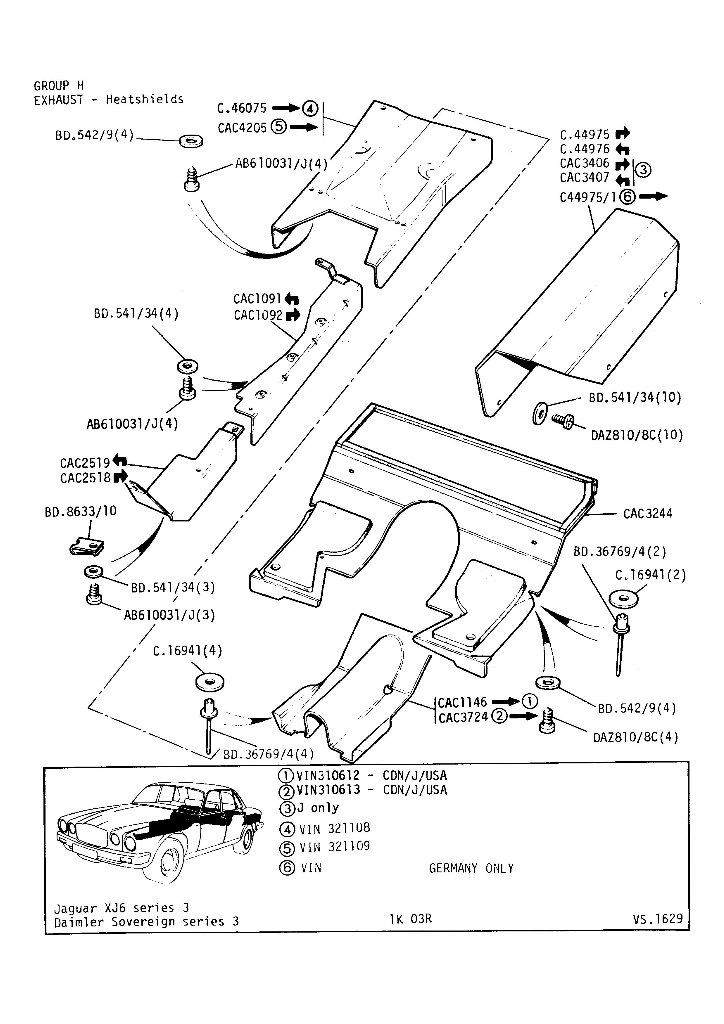
There is or was a series of heat shields that you are missing. these shields would provide a gap between the exhaust and the floor of your car. The other thing I would like to say is you are missing is a knife and fork to eat off the bottom of your car.
Well, I guess that's something else that didn't come with the car package. Do you have a picture of them in-place, are they made of fiber board like those in the engine compartment or are they a sheet metal item? If I could find a picture of their layout, I might try building something.
Thank you for your kind observation Larry, but in fairness, it has never left my heated garage under its own power. No chance to get dirty yet, but the day will come.
Well, I guess that's something else that didn't come with the car package. Do you have a picture of them in-place, are they made of fiber board like those in the engine compartment or are they a sheet metal item? If I could find a picture of their layout, I might try building something.
Aluminum.
At least the ones that run along the underbody parallel to the prop shaft. Others, towards the rear, are that composite fiber stuff.
Cheers
DD
Thanks Carl, I'll revisit the pile of stuff that I got with the car, seems to me there might be a strange piece of tin in there. Maybe I'll get lucky.
I have ordered a few things from David, very happy with the products. Wrecking yards???? There are 2, maybe 3, withing 200 miles of my house. They happily state that they don't carry anything older that 2000 and the couple of times I've said "Jaguar", they almost ask me to spell it before saying "nah, we don't have any of those". I have to buy from the internet or substitute from local parts stores or make it myself.
My car was converted when I got it as I have mentioned numerous times, and I also wondered what those extra thingys and empty holes were under there where something had obviously been originally.
One day as we were extracting a complete IRS (which I have named Rhonda) from a Series 3 in the local Wrecking Yard, THERE WAS THE ANSWER!
So I removed both plates with their screws. The larger one aluminum and wrinkle/crinkled for strength which covered the center bearing. It wouldn't fit under my car as some of the Conversion components were in the way, but I did put the small steel one up just to fill the holes.
I still have the larger one out there if you want it, but unless you have a 2-piece drive shaft I don't see why you would.
(';')
At least the ones that run along the underbody parallel to the prop shaft. Others, towards the rear, are that composite fiber stuff.
Thanks Doug. I've seen one of the CAC1091. Seems like it was hanging be a screw somewhere up in the engine compartment. I'll find it and do a fit-test under the car.
One day as we were extracting a complete IRS (which I have named Rhonda) from a Series 3 in the local Wrecking Yard, THERE WAS THE ANSWER!
Elinor, I am keeping the 2-piece driveshaft and I appreciate the offer, but I'll go through my pile again. Rhonda is a nice name.
Doug, Elinor
I still haven't figured out how to make the nice high-lighted references towards other posts in my replies. Hope you can sort out my last.
Jaguar heaven. Stockton, CA. My car's demise was on the freeway at that off ramp. I coasted off the freeway to a gas station. It was just east of jaguar Heaven. We went by aboard a flat bed. Had I known that, I might have left it with them and figured out another way to get home!!! .
PS my conversion as a one piece drive shaft. Teh tin went back on with no conflict.
The muffler guy had no issues with fitting the pipes from the down pipes back to the Jaguar front mufflers. It has worked out just fine.
Dave,
I had to go back and look closely at your photos to see what I missed.
My car had plastic "T" brackets intended to hold the brake and fuel lines from aft to forward, originally mounted in similar positions of your stand-off brackets.
Over the intervening decades most of them broke, allowing both brake and fuel lines to rattle against the floor pan in a most Irritating manner.
Notice where the original brackets have broken, leaving clean areas on the lines.
I was especially enchanted when I found these two Zip-tied together with nothing much holding either end.
I screwed them securely to the floor pan in several places.
These won't be moving any time soon. Problem solved.
(';')
Here's another picture showing the original fuel return line and the brake line under the left side. Mine were/are attached with nicely made little saddle clamps sized to the lines. These same clamps were used on the right side to attach the pressure fuel line. I was able to re-purpose those when I moved the pressure line to the left side. I don't think plastic was a good call by Jaguar, in this case. Your solution is bomb proof.
Just a gentle reminder for anyone working on/around those rear silencer/muffler/exhaust heat shields (shown in the diagram above and described as "pressed material"). That "pressed material" is asbestos and given the age of our cars, by now it is often cracked and broken and brittle and potentially shedding particles. If we have to disturb them to work on a customer's vehicle, we hose them down well with water to discourage any dust and put them outside in the sun to dry. Once they are dry, they get multiple coats of "heat resistant" paint and then a cosmetic coat of silver to return them to their original appearance - everything is then sealed with multiple layers of 2pak epoxy clear coat. The aim is to stabilize them for the safety of owners and technicians working on the vehicles into the future. thought the safety awareness and remedial approach applied might be of interest to some.
Cheers everyone!
Just a gentle reminder for anyone working on/around those rear silencer/muffler/exhaust heat shields (shown in the diagram above and described as "pressed material"). That "pressed material" is asbestos and given the age of our cars, by now it is often cracked and broken and brittle and potentially shedding particles. If we have to disturb them to work on a customer's vehicle, we hose them down well with water to discourage any dust and put them outside in the sun to dry. Once they are dry, they get multiple coats of "heat resistant" paint and then a cosmetic coat of silver to return them to their original appearance - everything is then sealed with multiple layers of 2pak epoxy clear coat. The aim is to stabilize them for the safety of owners and technicians working on the vehicles into the future. thought the safety awareness and remedial approach applied might be of interest to some.
Cheers everyone!
Yes. My engine bay bulkhead (firewall to some here) is lined with a thick sheet of this. I recognized it immediately for what it is, and although it's well coated with "Automatic Rust Protection," (oily dust) I have left it strictly alone anyway.
(';')
my '84 has those asbestos shields above the two rear mufflers (exactly under the rear seat floor), and around the two rear resonators protecting the tank walls.The large shield on the firewall looks like formed fiberglass, and there is a small asbestos or fiberglass shield held with a bracket at the lowest corner of the steel shield over the manifolds, which seems to be protecting the fuel cooler.
I am not sure anymore if they are asbestos or formed fiberglass,since both materials look the same when they tear. Also the material in the XJ shields is identical to the fan shroud material in my '65 S type, a greyish-silvery fiberglass type of material similar to the firewall in the XJ. The S type's exhaust system is identical to the XJ's exhaust system, and it has identical heat or sound shields in the same places, so to me it is obvious that Jaguar has been using these shields since the 1960's, whatever the material is.





 Odd little brackets